
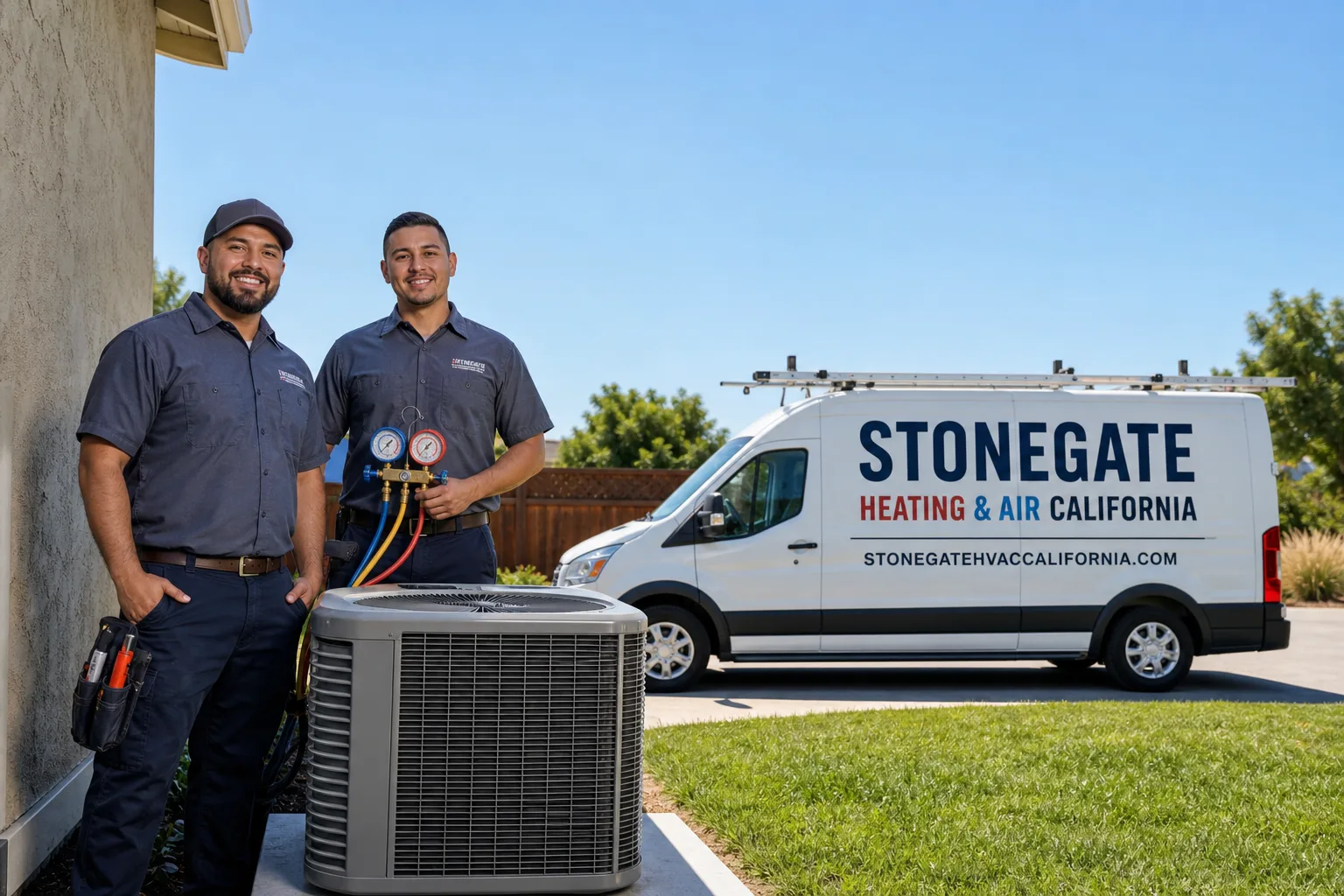
Fast, Reliable Heat Pump & Mini Split Across Stanford
Heat pump and mini-split installation in Stanford, CA typically runs $3,500–$7,500 for a full system, with most repair calls in the $150–$650 range. We’re Stonegate Heating & Air California, and our Heat Pump & Mini Split team makes the drive from Sacramento to Stanford regularly, including same-day response for faculty homes near Campus Drive and emergency calls to campus research buildings off Serra Mall. Call (855) 467-1888 for a free estimate.
Stanford’s not a standard suburban market. The university owns the land, controls the aesthetics, and enforces carbon-neutrality targets that shape what equipment can go where. We’ve spent 16 years learning how to navigate that reality so our Stanford customers don’t get stuck in permitting limbo.
Why Stonegate Heating & Air California Is Stanford’s Preferred Heat Pump & Mini Split Company
We’ve got 499 verified reviews averaging 4.7 stars, and a solid share of them come from Stanford faculty and campus facilities managers who found us after other contractors couldn’t clear the university’s vendor requirements. Owner Jason Trent serves as Field Supervisor on jobs, meaning the person signing off on your heat pump sizing or mini-split placement is the same person who’ll answer if something needs adjustment.
Our technicians know the route to Stanford. We factor in 101 traffic patterns and the campus access protocols so we’re not burning your morning figuring out parking permits. For faculty homes in the neighborhoods off Mayfield Avenue, Alvarado Row, or the stretch near Frenchman’s Road, that means showing up when we said we would with the right equipment already loaded.
Jason supervises every project. Not from a truck, not from a back office. On the job site. That’s the difference between a company that knows Stanford’s dual-permitting maze and one that’ll leave you chasing Santa Clara County and Stanford’s Land Use Office for weeks.
Our Heat Pump & Mini Split Services in Stanford
Heat Pump Installation
Heat pump installation in Stanford demands more than standard Manual J load calculations. The sharp diurnal swing here, 25–35°F between morning lows and afternoon highs, means oversized equipment short-cycles on cooling and undersized units can’t keep up during those low-to-mid-90s summer afternoons. We size for the swing, not just the peak. For faculty homes in the 1950s–1970s ranch stock, we also factor in whether the original build had any mechanical cooling at all, many didn’t, so wall and attic insulation becomes part of our assessment. Stanford’s Land Use Office requires separate sign-off for any exterior heat pump or mini-split condenser placement, even for faculty housing in the ‘Faculty Ghetto’, adding weeks to permitting timelines. We build that into our project schedule from day one so you’re not caught off guard.

Multi-Zone System
Multi-zone mini-splits are our most common request for Stanford’s larger faculty homes and the newer campus-adjacent properties near Sand Hill Road. One outdoor condenser, three to five indoor heads, each with independent temperature control. We replaced an undersized 1960s wall furnace and window AC with a Daikin multi-zone mini-split in a ranch home on Alvarado Row, navigating Stanford’s Land Use approval for two outdoor condensers placed on side-yard pads approved by the university’s architectural review. The key on that job, and on most Stanford multi-zone installs, was getting the condenser placement approved before Santa Clara County ever saw the mechanical permit application.

Ductless System
Ductless mini-splits solve the problem Stanford’s older housing stock creates: no existing ductwork, no attic space for routing, and strict rules about where you can punch through exterior walls. For the sandstone quad buildings and 1890s Richardsonian Romanesque structures on core campus, ductless is often the only viable path to adding cooling without triggering historic preservation review. We work with Daikin and Bryant equipment that meets Stanford’s electrification mandates and doesn’t require the district plant tie-ins that newer campus buildings use.

Heat Pump Repair
Heat pump repair calls in Stanford spike in late spring and early fall when systems switch between heating and cooling modes and the reversing valves get a workout. The campus microclimate’s dryness accelerates capacitor degradation on outdoor units, and we’ve seen more than a few compressor failures traced to condensers installed in direct afternoon sun without adequate clearance. We stock common parts for Carrier, Daikin, Bryant, and American Standard to minimize return trips.

Mini Split Repair
Mini-split repair in Stanford often involves refrigerant leaks at flare connections or failed condensate pumps in attic-mounted air handlers. The faculty homes off Campus Drive and the rental properties near downtown Palo Alto border tend to see more clogged drain lines from oak pollen and dust. We pressure-test, evacuate, and recharge to manufacturer spec, not guesswork.

What happens when you call
- 1
A real person answersNo phone trees — you reach a local pro.
- 2
You get an upfront price rangeHonest numbers before anyone is dispatched.
- 3
A background-checked tech heads outLicensed & insured, dispatched right away.
- 4
You approve before work beginsNothing starts until you say go.
Trusted Brands We Service in Stanford
We’re certified to work on nine leading HVAC brands: Carrier, Trane, Lennox, Goodman, Rheem, York, Daikin, Bryant, and American Standard. For Stanford customers, that means whatever brand is already in your home or specified by Facilities Management, we can service it without the “we don’t work on that” dead end. We stock common Daikin and Bryant mini-split components locally for faster turnaround on repair calls to 94305, and our familiarity with Carrier heat pump control boards has saved several campus jobs from extended downtime. Nine brands, one team. From a single-room mini split to a full commercial system.
Common Heat Pump & Mini Split Problems We See in Stanford Homes
- Short-cycling from improper sizing. Improper sizing for Stanford’s sharp diurnal swing (25-35°F) causes short-cycling on cooling in faculty homes built without mechanical cooling. A unit that’s right for a 75°F Palo Alto afternoon will cycle on and off repeatedly when Stanford hits 92°F, wearing out compressors prematurely.
- Dual-permitting delays leaving equipment exposed. Delays from dual permitting (Santa Clara County + Stanford Land Use) leave partial installs exposed to weather for weeks. We’ve seen condensers sitting on pallets behind homes on Mayfield Avenue while paperwork crawls through two offices.
- Condenser placement violations on historic structures. Mini-split condensers placed too close to historic sandstone structures on campus violate Stanford’s preservation rules, leading to retroactive relocation orders. The university’s architectural review has specific setback and screening requirements that don’t appear in county code.
- Reversing valve failures at mode-change season. Stanford’s mild winters mean heat pumps don’t run hard in heating mode, but when that first warm October afternoon hits and the system switches to cooling, stuck reversing valves reveal themselves. We catch these during pre-season tune-ups.
Pricing for Heat Pump & Mini Split in Stanford, CA
Here’s what we typically see for Stanford-area jobs. These ranges reflect the extra permitting steps and the university’s equipment requirements, not markup for markup’s sake.
| Service | Typical Range in Stanford |
|---|---|
| AC Repair (includes heat pump repair) | $150–$650 |
| AC Installation (includes heat pump & mini-split systems) | $3,500–$7,500 |
| Tune-Up / Preventive Maintenance | $80–$200 |
Heat pump installation in Stanford tends toward the higher end of that range when we’re navigating dual permits or installing multi-zone Daikin systems with multiple indoor heads. Mini-split installs for single-zone ductless systems in smaller faculty homes can land closer to mid-range. What drives cost: equipment capacity, number of zones, electrical panel capacity (many 1960s ranches need service upgrades), and whether Stanford Land Use requires revised placement drawings. We quote upfront after a site visit. Call (855) 467-1888 for an exact quote, estimates are free.
We Also Serve Cities Near Stanford
Our service radius from Sacramento covers the full Peninsula corridor. We regularly run to Palo Alto for downtown bungalow mini-split installs, Atherton for estate heat pump retrofits, East Palo Alto for multi-family ductless upgrades, and Los Altos Hills for hillside homes with zoning challenges. If you’re in 94305 or any of these neighboring communities, the same owner-supervised crew handles your job.
Serving Stanford, CA — Our Local Coverage Area
We’re based in the Stanford area and know this community well. Use the map below to see our service coverage — if you’re nearby, we can almost certainly help.
FAQs — Heat Pump & Mini Split in Stanford
Yes. Stanford’s Land Use Office must approve exterior equipment placement and any duct penetrations before Santa Clara County will issue the mechanical permit. Start with Land Use, get their sign-off on condenser location and pad type, then file with the county. We’ve seen contractors skip this step and get red-tagged mid-project. Call (855) 467-1888 and we’ll walk you through the sequence, estimates are free.
Generally no, unless Facilities Management is decoupling your building from the district chilled water and hot water loops. Core campus buildings on the Central Energy Facility system aren’t candidates for standalone heat pumps, peripheral buildings and new construction sometimes are. We coordinate directly with Stanford Facilities on scope, but the district plant decision is theirs. Call (855) 467-1888 to review your building’s status.
Improper sizing for Stanford’s 25–35°F diurnal swing. A mini-split sized for average Bay Area conditions will reach setpoint too quickly on a 92°F Stanford afternoon, then cycle off, then restart minutes later as the poorly insulated ranch home reheats. We size for the swing and the building envelope, not just peak load. Call (855) 467-1888 for a load calculation and right-sizing assessment.
Stanford doesn’t publish a single approved-brand list for all properties, but their electrification mandates favor high-efficiency heat pumps that meet current SEER2 and HSPF standards. Daikin, Carrier, Bryant, and American Standard equipment we install typically clears Facilities review without issue. Individual faculty home installs may face additional architectural review based on exterior visibility. Call (855) 467-1888 to confirm your specific property’s requirements.
Sometimes, with significant restrictions. The sandstone quad buildings fall under historic preservation review, and any exterior penetrations or visible condensers face high scrutiny. Interior ductless cassettes with remote condensers hidden in mechanical penthouses or underground vaults have been approved in specific cases. Standard wall-mounted units with exterior condensers on the ground generally are not. We assess each building individually and coordinate with Stanford’s preservation office when needed. Call (855) 467-1888 to discuss your specific space.
Ready to get your Stanford heat pump or mini-split project moving without the permitting surprises? Call Stonegate Heating & Air California at (855) 467-1888 for a free estimate. Jason Trent, our Field Supervisor, will make sure your job is sized right, permitted right, and done right the first time.
Written by Jason Trent, Owner at Stonegate Heating & Air California, serving Stanford since 2008.