
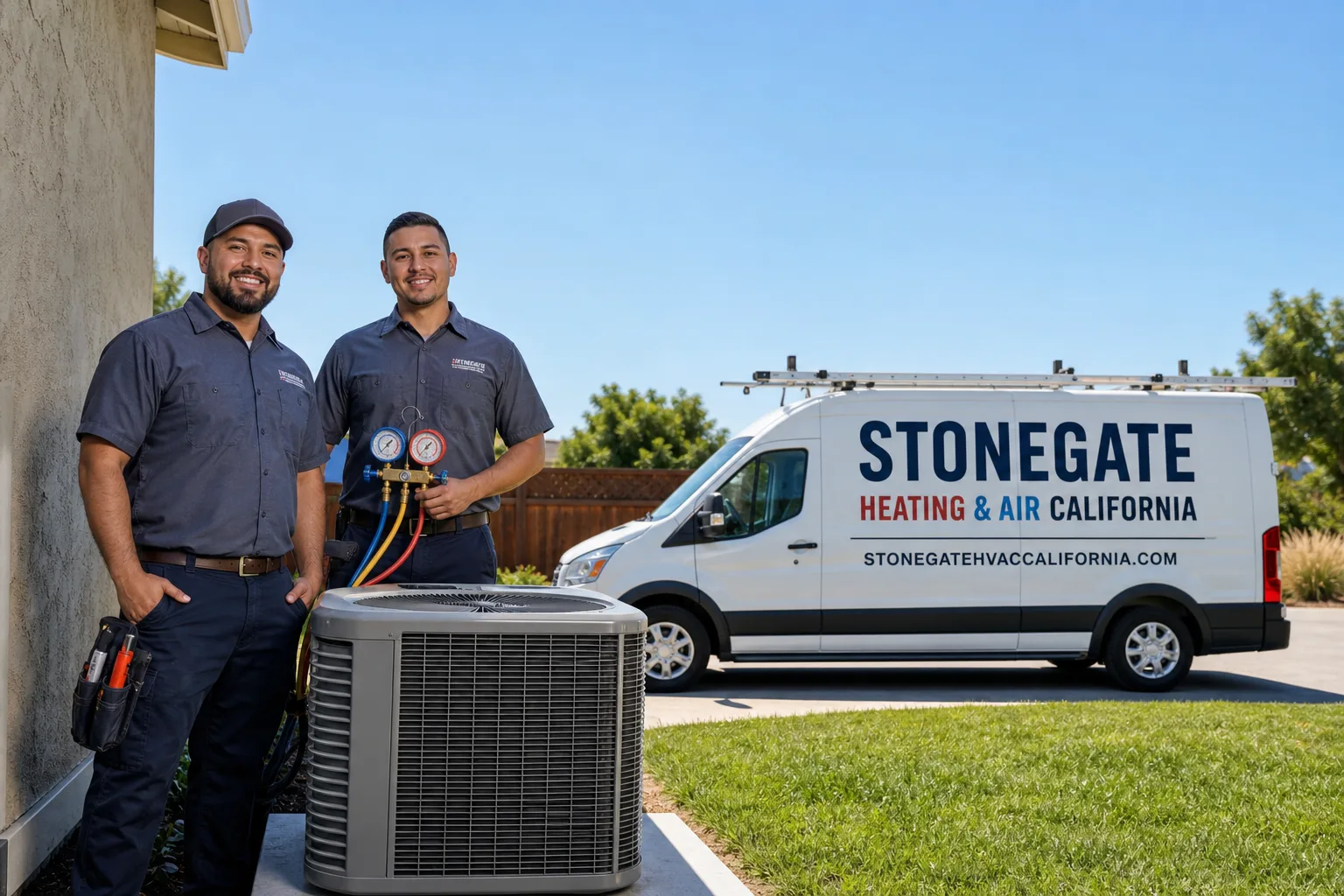
Fast, Reliable Heating & Furnace Across Stanford
Furnace repair in Stanford, CA typically costs $150–$700, with most calls completed same-day or next-day for homes and campus buildings throughout the 94305 zip code. If your furnace won’t start, cycles too quickly, or you’re smelling burning dust or gas, call us at (855) 467-1888 — our Heating & Furnace team dispatches from Sacramento with regular routes down I-280 and El Camino Real, and we know the dual-permitting dance that Stanford properties require.
We’ve been serving the Peninsula corridor for 16 years, and Stanford is unlike any other city we work. Nearly all residential properties here sit on university-leased land. That 1970s ranch on Frenchman’s Road or the mid-century home on Alvarado Row? Stanford’s Land Use Office holds veto power over exterior equipment placement, venting changes, even the color of a condenser pad. Outside contractors who don’t know this get blindsided. We don’t. Owner Jason Trent has walked enough faculty homeowners through this process that we build the university review timeline into every Stanford project from day one.
Why Stonegate Heating & Air California Is Stanford’s Preferred Heating & Furnace Company
Our reputation in Stanford is built on not wasting people’s time. We’ve got 499 verified reviews averaging 4.7 stars, and the feedback we hear most from Stanford clients is simple: “You actually knew about the university approval step.” That’s because Jason Trent serves as active Field Supervisor on jobs, not a back-office owner. When we’re working in the Faculty Ghetto or near campus, he’s the one confirming venting clearances with Stanford’s architectural review board before we pull Santa Clara County permits.
Response time to Stanford runs same-day for most furnace repair calls placed before noon, next-morning for afternoon requests. We’re not based in Menlo Park or Mountain View pretending to know the area — we’ve driven the loop around Lake Lagunita, navigated the narrow streets of the College Terrace neighborhood, and worked in enough 1950s faculty ranches to recognize the original gravity furnace models on sight. That local fluency means faster diagnosis and no surprises when we open the utility closet.
Our Heating & Furnace Services in Stanford
Furnace Repair
Most furnace repair calls we get in Stanford come from two situations: a dead ignitor on a 1990s-era gas furnace in a College Terrace duplex, or a failed control board on a unit that’s been baking in a cramped utility closet off a kitchen with no ventilation. Our technicians carry ignitors, flame sensors, gas valves, and control boards for Carrier, Trane, Lennox, and Goodman systems — the brands we see most in Stanford’s housing stock. A typical furnace repair in Stanford runs $150–$700, with simpler fixes like ignitor replacement landing at the lower end and gas valve or control board work trending higher. We diagnose before we quote, and estimates are free.

Furnace Replacement
This is where Stanford gets complicated. Nearly all homes in Stanford are located on university-leased land, so even a simple furnace replacement requires architectural review and approval from Stanford’s Land Use Office — a step that can stall projects by weeks if not anticipated. We’ve seen outside contractors show up with a new unit, ready to swap, only to discover they can’t touch the exterior wall until Stanford signs off on venting placement. We front-load this step. Before we spec equipment, we confirm whether your property needs dual permitting: Santa Clara County for the mechanical work, Stanford for exterior modifications. A full furnace replacement in Stanford typically runs $3,500–$7,500 depending on efficiency tier, ductwork condition, and whether we’re routing new PVC venting through a sandstone foundation or a stucco-over-frame wall.

Furnace Tune-Up
Stanford’s Bay Area Mediterranean microclimate — warmer and drier than coastal Palo Alto, with summer afternoons hitting the low-to-mid 90s and sharp diurnal swings of 25–35°F — punishes furnaces that sit idle for eight months then get asked to cycle hard on January mornings. Our tune-up in Stanford includes heat exchanger inspection, burner cleaning, gas pressure verification, and airflow measurement through ducts that were often sized for 1960s heating loads, not modern equipment. A furnace tune-up runs $80–$200, and for homes in the Faculty Ghetto or along Santa Teresa Street, we specifically check for heat exchanger stress cracks from decades of daily thermal expansion.

Heat Exchanger Inspection and Repair
This is the safety-critical one. A cracked heat exchanger can leak carbon monoxide into living spaces, and in Stanford’s older faculty housing, we find them more often than you’d hope. The original 1950s–1970s gravity furnaces with their heavy steel exchangers were built for a different era of gas composition and cycling frequency. Decades of Stanford’s sharp temperature swings — cold nights, warm days, repeat — fatigue the metal until it fails. Heat exchanger inspection and repair runs $150–$700. If the exchanger is cracked and the furnace is past 20 years, we typically recommend replacement: new exchangers for obsolete models are often unavailable, and the labor to install one approaches the cost of a new high-efficiency unit.
We were called to a 1970s ranch home on Salvatierra Walk in the Faculty Ghetto where the original gas-fired gravity furnace had finally failed — the heat exchanger had a hairline crack, and no replacement parts were available. We guided the homeowners through the dual-permitting process: first getting Stanford’s sign-off on the exterior venting location, then pulling Santa Clara County mechanical permits. We ended up installing a high-efficiency Carrier gas furnace with a PVC vent system, sized to handle the sharp diurnal swings of Stanford’s microclimate.

What happens when you call
- 1
A real person answersNo phone trees — you reach a local pro.
- 2
You get an upfront price rangeHonest numbers before anyone is dispatched.
- 3
A background-checked tech heads outLicensed & insured, dispatched right away.
- 4
You approve before work beginsNothing starts until you say go.
Trusted Brands We Service in Stanford
We don’t do the “sorry, we don’t work on that brand” thing. Our technicians are experienced with nine major HVAC brands — Carrier, Trane, Lennox, Goodman, Rheem, York, Daikin, Bryant, and American Standard — and we stock common parts for the four we see most in Stanford: Carrier, Trane, Lennox, and Goodman. For faculty homes with original equipment, we also maintain supplier relationships for legacy parts that most shops won’t hunt down. If you’ve got a 1980s Lennox G8 or an early Carrier WeatherMaker, we’ve probably worked on its cousin before. That parts fluency means faster turnaround and fewer return trips, which matters when you’re waiting on Stanford’s Land Use Office already.
Common Heating & Furnace Problems We See in Stanford Homes
- Heat exchanger cracks from decades of daily 35°F temperature swings. Stanford’s microclimate stresses metal fatigued by 40+ years of expansion and contraction. We catch these with combustion analysis and visual inspection during tune-ups, because a cracked exchanger is a CO hazard, not just a heating problem.
- Original 1950s–1970s gravity furnaces with obsolete controls. No manufacturer supplies parts for many of these systems anymore. When the gas valve or thermostat relay fails, replacement is the only path — and that means navigating Stanford’s dual-permitting process.
- Undersized ductwork in older faculty homes designed for minimal heating. These ranch-style houses were built when “heating” meant taking the chill off a January morning, not maintaining 68°F through a Bay Area cold snap. Drop a modern high-efficiency furnace into those ducts without modification and you’ll get short-cycling, uneven rooms, and premature equipment failure.
- Failed ignitors on 1990s-era furnaces in College Terrace and south campus rentals. These units often live in exterior closets or crawl spaces with poor moisture control. Silicon nitride ignitors degrade faster in damp conditions, and we’ve learned to check the vent termination while we’re at it — blocked intake pipes kill ignitors fast.
Pricing for Heating & Furnace in Stanford, CA
Here’s what furnace work actually costs in Stanford’s market. These ranges reflect our 16 years of pricing jobs from the Faculty Ghetto to campus-adjacent rentals:
| Service | Price Range |
|---|---|
| Furnace Repair | $150–$700 |
| Furnace Replacement | $3,500–$7,500 |
| Furnace Tune-Up | $80–$200 |
| Heat Exchanger Inspection and Repair | $150–$700 |
What moves a job within these ranges? For repair, it’s parts — ignitors are cheap, gas valves and control boards aren’t. For replacement, efficiency tier (80% vs. 96% AFUE), ductwork modifications, and the complexity of Stanford’s dual-permitting process all factor in. We’ve had straightforward swaps in College Terrace that ran toward the lower end, and Salvatierra Walk jobs with sandstone foundation venting that needed creative routing. We quote upfront after diagnosis, and estimates are free. Call (855) 467-1888 to schedule.
We Also Serve Cities Near Stanford
Our routes down the Peninsula regularly cover Palo Alto to the north, Atherton and Los Altos Hills to the west, and East Palo Alto to the east. Each city has its own permitting quirks and housing stock patterns — Atherton’s estate homes with multiple zones, East Palo Alto’s mix of mid-century and newer construction — but our Heating & Furnace team brings the same owner-supervised approach to every job. If you’re on the border between Stanford and a neighboring city, we’ll sort the jurisdiction questions before we arrive.
Serving Stanford, CA — Our Local Coverage Area
We’re based in the Stanford area and know this community well. Use the map below to see our service coverage — if you’re nearby, we can almost certainly help.
FAQs — Heating & Furnace in Stanford
Yes. Nearly all faculty homes in Stanford sit on university-leased land, and Stanford’s Land Use Office must approve any exterior equipment placement, venting modifications, or duct penetrations before Santa Clara County will issue the mechanical permit. We handle this step as part of our project planning, not as a surprise add-on. Call (855) 467-1888 and we’ll walk you through the timeline.
Sometimes, but parts availability is the limiting factor. We can often replace thermocouples, gas valves, and blower belts on standing-pilot gravity furnaces, but if the heat exchanger is cracked or the manufacturer no longer supports the control system, replacement becomes the practical option. We’ve sourced legacy parts for Stanford faculty homes before, but we won’t chase a part for three weeks when a new high-efficiency unit will be running in days. We’ll give you both paths and our honest recommendation.
Short-cycling in Stanford’s older faculty homes usually means one of three things: a dirty flame sensor or failing thermostat causing premature shutdown, or — most commonly here — undersized ductwork choking a modern furnace that needs more airflow than the 1960s system delivered. The first two we fix same-day. The third requires duct modification, which we scope during diagnosis and quote before proceeding. Call (855) 467-1888 for a free inspection.
You can, and Stanford’s aggressive carbon-neutrality and electrification mandates make heat pumps an increasingly common choice for campus-adjacent properties. The catch is sizing: Stanford’s sharp diurnal swings demand careful load calculation to prevent short-cycling on cooling, and many older faculty homes lack the electrical panel capacity for a heat pump without an upgrade. We assess electrical service, duct compatibility, and university approval requirements before recommending a heat pump over gas. It’s not always the right fit for every Stanford property.
No. Campus buildings tied into Stanford’s Central Energy Facility district plant — the chilled water and hot water loops serving core campus structures — are maintained by Stanford Facilities Energy Management, not outside contractors. We service standalone heating equipment in faculty housing, administrative buildings with independent systems, and research facilities with their own boilers or furnaces. If you’re unsure which system your building uses, check for a rooftop unit or basement mechanical room versus a connection to the campus tunnel system. Call (855) 467-1888 and we’ll help you sort it out.
Ready to get your Stanford home’s heat fixed right? Call Stonegate Heating & Air California at (855) 467-1888 for a free estimate. Owner Jason Trent supervises every project, and we’ve got 16 years and nearly 500 reviews backing up the work.
Written by Jason Trent, Owner at Stonegate Heating & Air California, serving Stanford since 2009.