
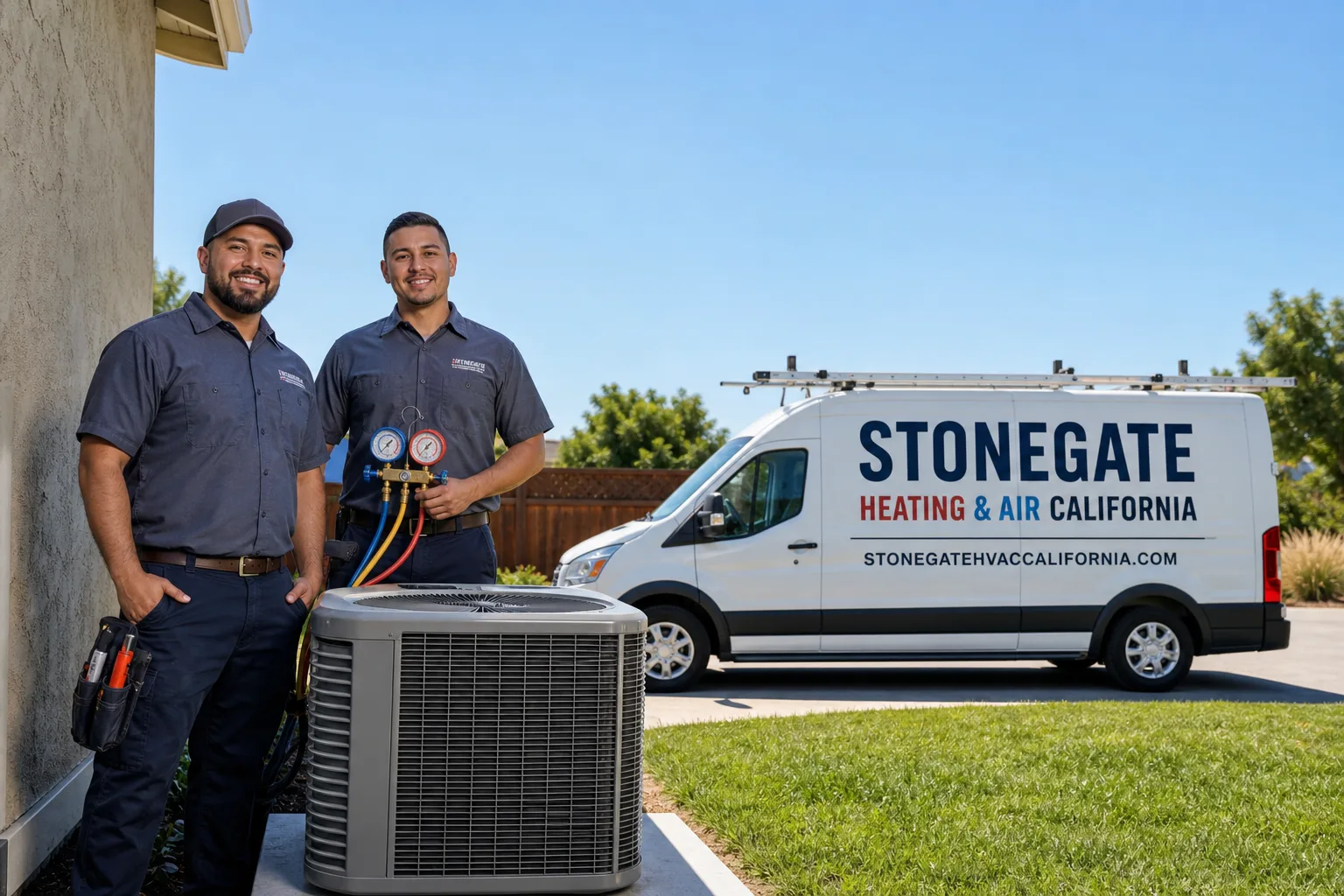
Fast, Reliable Emergency & Commercial HVAC Across Stanford
Our Emergency & Commercial HVAC team reaches Stanford within 30–45 minutes from our Sacramento base, and we’ve learned the hard way that HVAC work here isn’t like anywhere else in the Bay Area. Whether you’re dealing with a failed compressor in a faculty home off Salvatierra Walk or a chiller alarm in a campus research building near the Main Quad, Stanford’s unique dual-permitting system can turn a simple repair into a weeks-long headache if your contractor doesn’t know the local process. We’ve spent 16 years navigating California’s most complex HVAC environments, and that includes Stanford’s Land Use Office requirements, university vendor qualifications, and the architectural review standards that govern every exterior equipment decision in this 94305 zip code. Call (855) 467-1888 for emergency response or to schedule a free estimate.
Why Stonegate Heating & Air California Is Stanford’s Preferred Emergency & Commercial HVAC Company
We’ve built our reputation on owner-supervised work, and that matters especially in Stanford where a missed permitting step can cost thousands. Jason Trent, our Field Supervisor, personally reviews every commercial and emergency job that heads toward campus or faculty housing. He’s not managing from a back office — he’s checking that our techs have the right paperwork, the right equipment colors, and the right quiet-operation specs before we arrive.
Our 499 verified reviews averaging 4.7 stars reflect what happens when the same accountable team shows up repeatedly. Stanford facility managers and homeowners have told us directly: they chose us because they could cross-reference our name across multiple review platforms and find consistent patterns of follow-through, not just a handful of cherry-picked testimonials.
Response time to Stanford runs 30–45 minutes for emergency calls, and we maintain parts inventory for the nine brands we service — Carrier, Trane, Lennox, and others — so we’re not ordering components from San Jose and making you wait. That inventory matters when you’re trying to restore cooling to a heat-sensitive lab or a faculty home during one of Stanford’s occasional 90°F summer afternoons.
Our local knowledge runs deeper than map directions. We know which campus buildings tie into the Central Energy Facility’s chilled water loops versus standalone systems. We know the Faculty Ghetto’s 1950s–1970s ranch homes often lack ductwork for modern cooling loads. And we know that outside contractors who skip Stanford Land Use Office approval end up with stop-work orders that leave their customers in worse shape than when they started.
Our Emergency & Commercial HVAC Services in Stanford
24/7 Emergency HVAC
Stanford’s Mediterranean microclimate delivers sharp diurnal swings — 25–35°F between day and night — and that thermal stress cracks compressors, blows capacitors, and trips high-pressure switches at the worst moments. Our emergency line at (855) 467-1888 routes directly to dispatch, not a call center, and we arrive with the parts to fix nine major brands on the first trip. For campus-adjacent commercial buildings and faculty housing alike, we carry the documentation templates that Stanford’s Land Use Office expects, so emergency repairs don’t become emergency violations.

Commercial HVAC
Stanford’s commercial HVAC market is dominated by university-owned properties, and contractors who aren’t pre-qualified on Stanford’s approved vendor list are effectively locked out. We work with property managers and facilities teams on the procurement pathway, and for privately owned commercial buildings near campus — along El Camino Real or in the Stanford Research Park periphery — we deliver the same owner-supervised standard. From single-story retail to multi-zone office systems, we size equipment for Stanford’s mild winters and occasionally hot summers, never oversizing just to sell bigger units.

Rooftop Unit Service
Commercial buildings near Stanford’s campus often use rooftop units for space efficiency, but the university’s sightline and noise restrictions can complicate placement and replacement. We evaluate structural loading, curb compatibility, and Stanford’s quiet-operation decibel requirements before we spec any RTU work. Our Field Supervisor, Jason Trent, climbs every roof we quote, because satellite photos don’t show the duct corrosion or the exhaust proximity issues that determine whether a unit will pass inspection.

Chiller Service
Buildings connected to Stanford’s Central Energy Facility rely on district chilled water, but standalone chillers still serve peripheral campus properties and private commercial buildings in 94305. We service scroll, screw, and centrifugal chillers, and we understand the redundancy requirements that research facilities demand — no single point of failure can jeopardize temperature-sensitive work. Our chiller diagnostics include oil analysis, refrigerant profiling, and tube integrity testing, with results documented for facilities managers who report upstream to university procurement.

Annual Maintenance
Stanford’s faculty housing leases often require documented annual HVAC maintenance as a condition of occupancy. We structure our maintenance agreements to satisfy both Santa Clara County mechanical inspection requirements and Stanford Land Use Office records requests. Our tune-ups run $80–$200 and include filter analysis, refrigerant charge verification, and combustion safety checks — the baseline that prevents emergency calls in July when the campus is deserted and parts suppliers are closed.

What happens when you call
- 1
A real person answersNo phone trees — you reach a local pro.
- 2
You get an upfront price rangeHonest numbers before anyone is dispatched.
- 3
A background-checked tech heads outLicensed & insured, dispatched right away.
- 4
You approve before work beginsNothing starts until you say go.
Trusted Brands We Service in Stanford
We maintain factory-trained experience across nine leading HVAC brands: Carrier, Trane, Lennox, Goodman, Rheem, York, Daikin, Bryant, and American Standard. For Stanford customers, this means no dead ends. We’ve encountered original Trane chillers in 1960s campus buildings, newer Carrier rooftop units on research park properties, and Lennox split systems in faculty homes that need color-matched replacement cabinets. Our parts inventory covers the most common failure components for each brand, and our relationships with regional distributors mean we can source specialty items without the multi-week delays that plague contractors who only stock one or two brands.
Common Emergency & Commercial HVAC Problems We See in Stanford Homes
- Short-cycling from oversized cooling: Many Faculty Ghetto homes were built without mechanical cooling, and retrofitted systems are often too large for the mild climate and small thermal mass. The 25–35°F diurnal swing means an oversized unit reaches setpoint too fast, cycles off, then immediately calls again — wearing out compressors and delivering humidity control. We size replacements using Manual J load calculations, not rules of thumb.
- Failed capacitors after hot afternoons: Stanford’s inland position puts it 5–10°F warmer than coastal Palo Alto on summer afternoons, and capacitor failure rates spike when condensers run at sustained high head pressure. We stock dual-run and start capacitors for all nine brands, and we check contactor condition while we’re there — the companion failure that follows a weak capacitor.
- Dual-permitting delays on emergency swaps: Outside contractors who replace a failed condenser without Stanford Land Use Office approval trigger stop-work orders and HOA fines. We build the approval timeline into every quote for faculty housing, and we submit color-matching and noise-spec documentation simultaneously with the Santa Clara County mechanical permit.
- Chiller loop contamination in standalone buildings: Peripheral campus buildings with independent chillers sometimes develop glycol degradation or biological fouling that district-connected buildings never see. We test loop chemistry, flush contaminated circuits, and document recovery for facilities managers who need maintenance records for university compliance.
Pricing for Emergency & Commercial HVAC in Stanford, CA
HVAC work in Stanford carries permitting complexity that adds administrative cost compared to neighboring Palo Alto or East Palo Alto, but our labor rates remain consistent across the region. Here’s what typical services run:
| Service | Price Range in Stanford |
|---|---|
| AC Repair | $150–$650 |
| Furnace Repair | $150–$700 |
| AC Installation | $3,500–$7,500 |
| Tune-Up / Maintenance | $80–$200 |
What moves a job toward the higher end: Stanford’s dual-permitting requirements add coordination hours that straightforward Santa Clara County jobs don’t need; color-matched or quiet-spec equipment carries manufacturer premiums; and access restrictions on campus or in historic sandstone buildings can extend labor time. We quote every line item before work begins, and estimates are free. Call (855) 467-1888 for exact pricing on your specific system.
We Also Serve Cities Near Stanford
Our emergency and commercial coverage extends throughout the southern Peninsula, including Palo Alto to the north, Atherton and Los Altos Hills to the west, and East Palo Alto to the northeast. Each city has its own permitting landscape — Palo Alto’s historic district reviews, Atherton’s strict noise ordinances, East Palo Alto’s different jurisdiction requirements — and we maintain current knowledge for all of them. The same owner-supervised team that handles Stanford’s university compliance manages jobs across these neighboring communities.
Serving Stanford, CA — Our Local Coverage Area
We’re based in the Stanford area and know this community well. Use the map below to see our service coverage — if you’re nearby, we can almost certainly help.
FAQs — Emergency & Commercial HVAC in Stanford
Yes. Stanford’s Land Use Office must separately approve any exterior equipment placement or duct penetrations, even for routine condenser swaps in university-leased faculty housing. We handle both the Santa Clara County mechanical permit and the Stanford Land Use Office submission simultaneously, including color-matching documentation and noise-spec verification. Call (855) 467-1888 and we’ll walk you through the exact timeline for your property.
Stanford enforces decibel limits that vary by zoning district, with stricter standards near residential faculty housing than near research or administrative buildings. We spec equipment that meets or exceeds the relevant standard for your specific address, and we document sound ratings in our Land Use Office submissions. Most modern Carrier and Trane units in our inventory carry quiet-operation certifications that satisfy Stanford’s requirements without custom orders.
No. Stanford’s architectural review specifies approved color palettes for exterior equipment, and condensers must match the assigned house palette. We source color-matched cabinets from our nine supported brands — Lennox and American Standard both offer extensive finish options — and we photograph the existing unit before removal to ensure the replacement passes visual inspection. Installing a non-approved color triggers a violation notice and potential removal order.
Stanford’s Facilities Management maintains a pre-qualification process that includes insurance verification, safety record review, and past performance documentation on university projects. We completed this qualification years ago and maintain active status. If you’re a facilities manager evaluating contractors for a new project, we can share our vendor reference contacts within Stanford’s procurement department. For property owners outside direct university ownership, this status isn’t required — our standard commercial licensing and bonding apply.
Buildings on the district heating and cooling loop receive chilled water and hot water from the Central Energy Facility, meaning your local HVAC consists of air handlers, terminal units, and controls rather than standalone chillers or boilers. We service the terminal equipment — valves, coils, VAV boxes, and control systems — but we coordinate with Stanford Facilities for any loop-side work. Our technicians carry the lockout/tagout training that campus buildings require, and we document every service interaction for your facilities records.
Written by Jason Trent, Owner and Field Supervisor at Stonegate Heating & Air California, serving Stanford and the greater Sacramento region since 2008.