
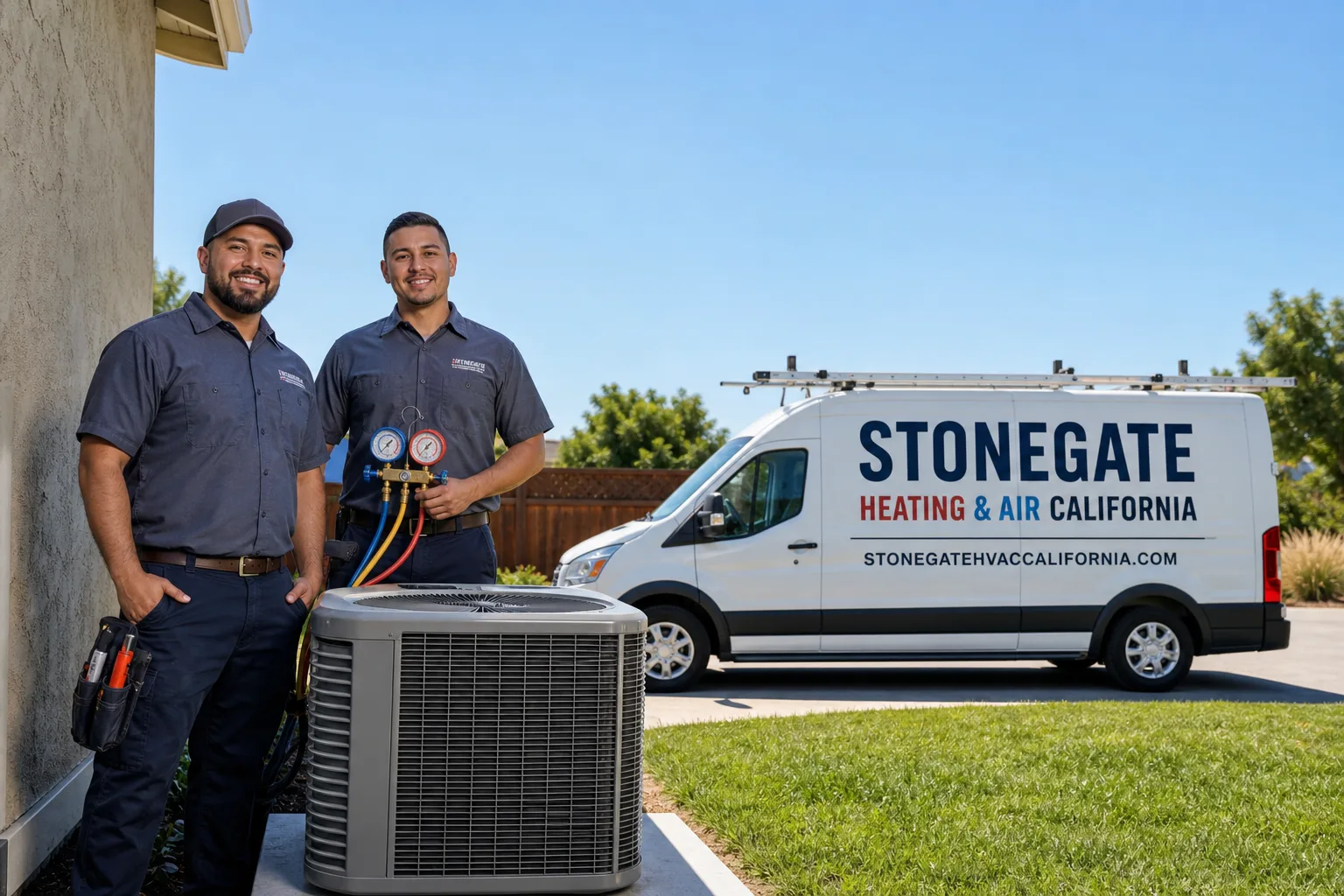
Fast, Reliable Air Quality & Ventilation Across Stanford
Air quality and ventilation work in Stanford, CA isn’t like the rest of the Bay Area. Most of this 94305 zip code sits on Stanford University-owned land, and that changes everything about how we approach filtration, humidification, and fresh-air systems here. Whether you’re in a 1960s faculty ranch off Salvatierra Walk, a sandstone quad building, or a modern research facility tied to the Central Energy Facility, the job starts with understanding Stanford’s dual-permit reality. We’re Stonegate Heating & Air California, and we’ve spent 16 years navigating California’s toughest HVAC environments. Owner Jason Trent still serves as Field Supervisor on jobs, and our team is factory-trained on nine major brands including Carrier, Bryant, and American Standard. If your home or building needs cleaner air, balanced humidity, or proper ventilation, call us at (855) 467-1888. We’ll walk you through what Stanford specifically requires.
Why Stonegate Heating & Air California Is Stanford’s Preferred Air Quality & Ventilation Company
Stanford customers find us the same way most people find contractors now: they read reviews. We’ve earned nearly 500 verified customer reviews at a 4.7-star average across platforms, built over 16 years of owner-supervised work. That volume matters more than any marketing claim. It means we’ve handled enough jobs that the patterns here are familiar.
Jason Trent doesn’t delegate supervision to a project manager. He’s on job sites. In Stanford, that matters because university-leased faculty housing and campus buildings present complications that only reveal themselves once you’re crawling a crawlspace or tracing original 1950s ductwork. An absentee owner misses those details.
Our response time to Stanford is straightforward: we’re Sacramento-based with crews that know the 101 corridor and Page Mill Road routes, and we schedule air quality consultations with enough buffer to account for the dual-approval processes that catch outside contractors off-guard. We’ve learned not to promise speed we can’t control, but we do promise competence we can prove.
We also don’t turn away equipment. Nine brands — Carrier, Trane, Lennox, Goodman, Rheem, York, Daikin, Bryant, and American Standard — means whatever system you’re working with, we’ve seen it. From a single-room mini split to a full commercial system connected to Stanford’s district plant, one call handles it.
Our Air Quality & Ventilation Services in Stanford
Air Filtration
Whole-home air filtration in Stanford faculty housing runs into a specific problem: the original 1950s–1970s sheet-metal ductwork was never designed for it. These uninsulated ducts, often buried in crawlspaces under ranch homes near Campus Drive East or the Faculty Ghetto, leak pressure and pull in crawlspace air. A high-MERV filter on a leaky system is like putting a surgical mask on someone with a broken nose. We test duct integrity first. When the ducts can be sealed, we recommend media filters or electronic air cleaners sized to your airflow. Typical filtration upgrades in Stanford run $400–$1,200 installed, depending on whether we need to modify the return plenum for modern filter dimensions.

Humidifier Install
Stanford’s Bay Area Mediterranean microclimate skews warmer and drier than coastal Palo Alto, with those sharp 25–35°F diurnal swings. Winter mornings can drop into the 30s with relative humidity crashing alongside temperature. Older faculty homes with gravity furnaces never had humidification. We install bypass and fan-powered humidifiers on forced-air systems, or standalone units where ductwork doesn’t allow integration. In university-leased properties, we coordinate with Stanford’s Land Use Office on any exterior penetrations or drain line routing. Humidifier installations in Stanford typically cost $350–$900.

Dehumidifier Install
Here’s the counterintuitive part: Stanford’s dry summers mean whole-home dehumidification is rarely the priority it is in Sacramento or the Central Valley. But the 94305 microclimate still sees marine layer penetration, and older homes with slab-on-grade construction near Escondido Road can develop localized moisture issues in basements or utility rooms. We size dehumidifiers to actual load, not guesswork. Portable units for targeted areas start around $250–$500; whole-home integrated systems run $1,000–$2,500 depending on duct modifications.

UV Air Purifier
UV-C systems target coil-mounted microbial growth and airborne pathogens. In Stanford’s context, they’re particularly relevant for homes running window units or portable cooling during university approval delays — conditions that create condensation management problems and biofilm buildup. We install UV lamps in existing ductwork where access allows, typically $300–$800 per unit. For campus buildings on the Central Energy Facility loop, UV is sometimes specified as part of the university’s IAQ maintenance protocol; we coordinate with Facilities on those installations.

ERV/HRV System
This is where Stanford’s carbon-neutrality mandate becomes concrete. Energy Recovery Ventilators (ERVs) and Heat Recovery Ventilators (HRVs) bring in fresh outside air without dumping the energy you’ve already spent conditioning the inside air. For 1960s faculty homes being retrofitted with heat pumps, an ERV is often the only way to meet ventilation code without violating Stanford’s electrification goals. We recently serviced a 1960s ranch home on Salvatierra Walk in the Faculty Ghetto where the original gravity furnace was still pushing air through uninsulated ducts. After university Land Use approved exterior equipment placement, we installed a Carrier Infinity system with a heat pump and a fresh-air intake, adding an ERV to balance indoor air quality without losing Stanford’s carbon-neutrality compliance. ERV/HRV installations in Stanford typically run $2,500–$5,500, with university approval timelines adding 2–6 weeks to the schedule.

Ventilation Install
Proper ventilation in Stanford means understanding whether your building stands alone or ties into the Central Energy Facility. Core campus buildings on district heating and cooling loops need ventilation strategies that integrate with that infrastructure — exhaust-only, balanced, or demand-controlled — without fighting the plant’s operating parameters. Faculty housing off-campus (but still on university land) faces the dual-permit hurdle: Santa Clara County for the mechanical work, Stanford Land Use for exterior equipment and penetrations. Our Air Quality & Ventilation team handles both permit tracks. Standalone ventilation installs range from $1,500–$4,000 for residential; commercial tied to campus systems requires site-specific assessment.

What happens when you call
- 1
A real person answersNo phone trees — you reach a local pro.
- 2
You get an upfront price rangeHonest numbers before anyone is dispatched.
- 3
A background-checked tech heads outLicensed & insured, dispatched right away.
- 4
You approve before work beginsNothing starts until you say go.
Trusted Brands We Service in Stanford
We stock parts and complete systems from Carrier, Bryant, and American Standard — three brands we see frequently in Stanford’s newer construction and retrofit projects. Carrier’s Infinity line with Greenspeed intelligence pairs well with ERV retrofits in older homes because the variable-speed blower compensates for the additional static pressure of fresh-air ducting. Bryant’s Evolution series offers similar capability at a slightly different price point. American Standard’s AccuClean filtration integrates cleanly with their communicating systems. Because we’re factory-trained on all nine major brands, we don’t waste your time with “we don’t service that” dead ends. For Stanford customers, that means faster turnaround and fewer return trips.
Common Air Quality & Ventilation Problems We See in Stanford Homes
- Duct leakage in original 1950s sheet-metal ducts. Uninsulated and often buried in crawlspaces, these leak supply air and pull in unfiltered crawlspace air. Whole-home filtration can’t work when the duct system itself is the contamination source. We test with duct blasters and seal what can be saved.
- Single-zone gravity systems never designed for cooling. These short-cycle in Stanford’s warm, dry summers, which reduces any dehumidifier to ineffective status and recirculates dust through the home. Retrofitting requires careful load calculation and often zoning.
- University approval delays forcing temporary solutions. Homeowners run window units or portable air cleaners for months while waiting for Land Use sign-off. These strain local circuits, create condensation problems, and degrade IAQ. We design permanent solutions that survive the approval timeline.
- Carbon-neutrality compliance conflicts with conventional equipment. Stanford’s electrification mandate rules out gas-fired ventilation strategies. We specify heat-pump-based and electrically driven ERV/HRV systems that satisfy both code and university policy.
Pricing for Air Quality & Ventilation in Stanford, CA
Here’s what air quality and ventilation work actually costs in the 94305 market. These are installed ranges for typical residential jobs in faculty housing and nearby neighborhoods:
| Service | Typical Range in Stanford |
|---|---|
| Air Filtration Upgrade (media/electronic) | $400 – $1,200 |
| Humidifier Install | $350 – $900 |
| Dehumidifier Install (whole-home) | $1,000 – $2,500 |
| UV Air Purifier | $300 – $800 |
| ERV/HRV System | $2,500 – $5,500 |
| Ventilation Install (standalone) | $1,500 – $4,000 |
| AC Repair | $150 – $650 |
| Furnace Repair | $150 – $700 |
| AC Installation | $3,500 – $7,500 |
| Tune-Up | $80 – $200 |
What moves you within these ranges? Duct condition, university approval complexity, equipment accessibility, and whether we’re integrating with existing forced air or starting from a gravity-furnace base. We don’t quote over the phone for ventilation retrofits — we need to see the crawlspace, the electrical panel, and the exterior wall where fresh air will enter. Estimates are free. Call (855) 467-1888 to schedule.
We Also Serve Cities Near Stanford
Our crews regularly work Palo Alto to the north, Atherton and Los Altos Hills to the west, and East Palo Alto to the northeast. Each has different housing stock, different permit offices, and different microclimates. What unifies them is our same approach: owner-supervised work, nine-brand fluency, and estimates that come from looking at the actual job, not guessing from a desk in Sacramento.
Serving Stanford, CA — Our Local Coverage Area
We’re based in the Stanford area and know this community well. Use the map below to see our service coverage — if you’re nearby, we can almost certainly help.
FAQs — Air Quality & Ventilation in Stanford
No. Internal maintenance and in-duct accessories that don’t require exterior penetration or structural modification typically don’t trigger Land Use review. We still verify your lease or ownership structure before starting, since university-leased faculty housing may have maintenance clauses that affect who can perform the work. For a quick check on whether your specific situation needs dual approval, call (855) 467-1888 — estimates are free.
Usually no — the gravity furnace and its oversized ductwork aren’t compatible with the airflow requirements of a heat pump or ERV. We typically remove the gravity system, resize the ducts for modern velocities, and install a variable-speed air handler. The ERV then ties into the new duct system with its own dedicated fresh-air drop. University Land Use must approve exterior condenser placement and any new penetrations. Call (855) 467-1888 and we’ll assess your specific layout.
Buildings on the district plant typically have centralized filtration at the air handling unit, but individual zone reheat boxes and terminal units often lack secondary filtration. We assess whether your space needs local HEPA or MERV-13 upgrades at the terminal level, or if the central plant maintenance schedule is sufficient. For faculty housing off the district loop, standalone media filters or electronic air cleaners on the main return are the standard approach. We can evaluate either — call (855) 467-1888.
It rules out gas-fired or combustion-based ventilation strategies and strongly favors electrically driven heat recovery. ERVs with ECM motors, heat-pump-based dehumidification, and DC-powered ventilation fans all align with Stanford’s electrification pathway. We specify equipment that satisfies both Santa Clara County energy code and Stanford’s internal sustainability requirements. For equipment recommendations specific to your building type, call (855) 467-1888.
Not necessarily. We start with duct leakage testing and internal inspection. If the metal is intact but unsealed, aerosol sealant or manual mastic repair can drop leakage to acceptable levels without replacement. If the ducts are corroded, collapsed, or improperly sized for modern equipment, replacement becomes the better investment. Campus Drive East homes often have accessible crawlspaces that make either approach workable. We’ll test and give you real numbers — call (855) 467-1888 for a free estimate.
Ready to improve the air in your Stanford home or building? Stonegate Heating & Air California brings 16 years of owner-supervised HVAC work, nearly 500 verified reviews, and factory training on nine major brands to every job we touch. Jason Trent is on site, not in a back office. We understand Stanford’s dual-permit process, its legacy housing stock, and its carbon-neutrality requirements because we’ve worked here. Call (855) 467-1888 today for your free air quality and ventilation estimate.
Written by Jason Trent, Owner and Field Supervisor at Stonegate Heating & Air California, serving Stanford and the greater Sacramento region since 2008.