
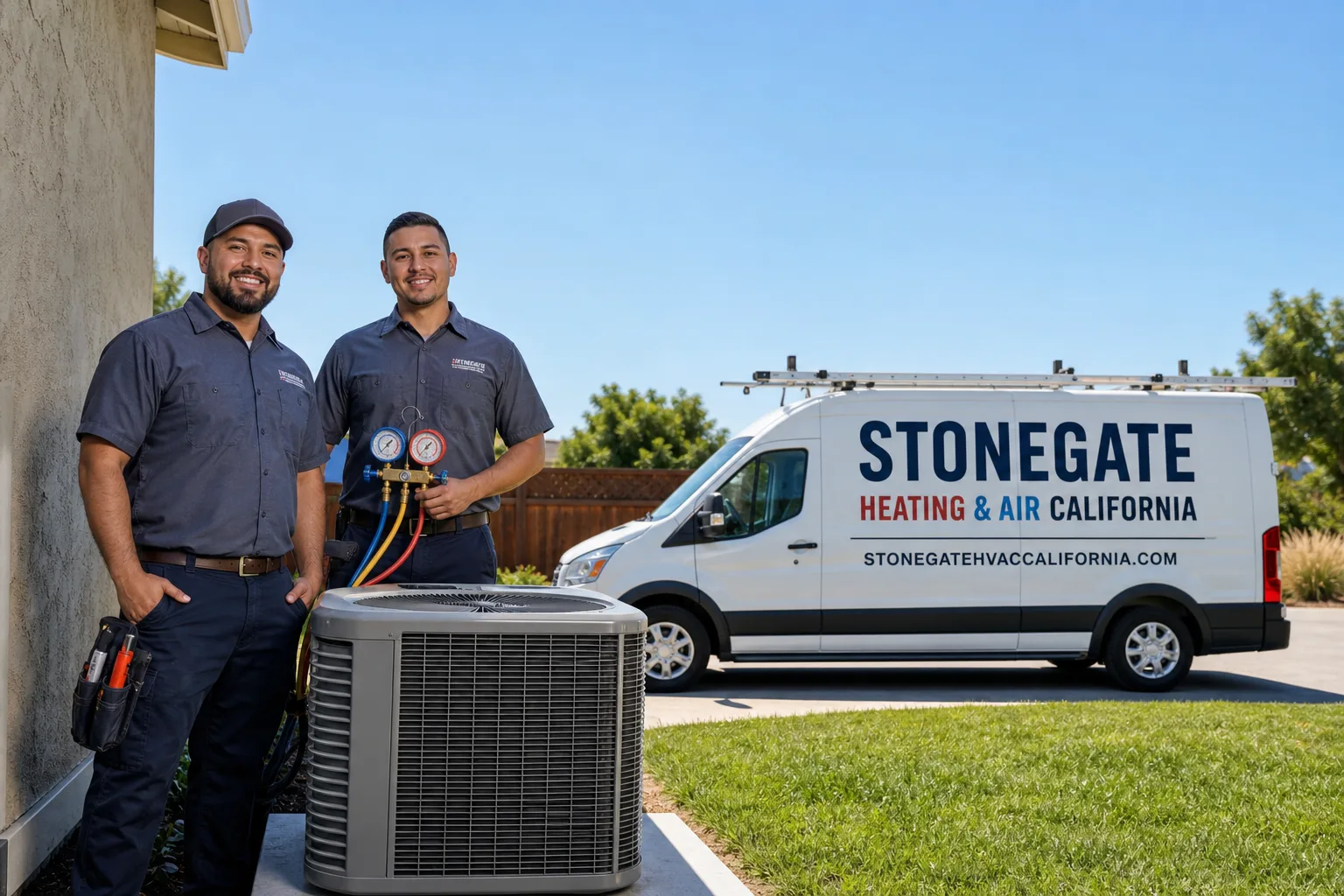
Fast, Reliable Heating & Furnace Across Rodeo
Heating and furnace repair in Rodeo, CA typically costs $150–$700 for repairs and $80–$200 for tune-ups, with most service calls completed same day. Stonegate Heating & Air California has been driving to Rodeo from our Sacramento base for 16 years, and our Heating & Furnace team knows the exact failure patterns this town throws at equipment. We’re familiar with the refinery corridor along San Pablo Avenue, the mid-century homes packed into the 94572 ZIP, and how the marine layer off San Pablo Bay changes what breaks and when. If your furnace is cycling odd, smelling off, or not keeping up on damp January mornings, call us at (855) 467-1888 for a free estimate.
Why Stonegate Heating & Air California Is Rodeo’s Preferred Heating & Furnace Company
We’ve earned 499 verified reviews averaging 4.7 stars across platforms, and a solid share of those come from repeat calls in West Contra Costa County. Rodeo customers specifically mention that we show up when we say we will, that Jason Trent personally supervises fieldwork rather than dispatching random subcontractors, and that we don’t try to sell equipment the house doesn’t need.
Our response time to Rodeo runs same-day to next-morning depending on call volume and whether it’s a declared emergency. We know the local streets, from the older tract homes near Rodeo Avenue up to the hillside pockets above Interstate 80. That geographic familiarity matters when a heat exchanger crack or gas valve failure has left a family without heat on a 45-degree fog night.
Jason Trent holds the title of Field Supervisor, not just Owner. That means company leadership is physically present on job sites, not managing from a back office. For Rodeo homeowners who’ve dealt with franchise chains that send whichever tech is available, this accountability structure is the difference between a quick, correct fix and a return visit.
Our Heating & Furnace Services in Rodeo
Furnace Repair
Furnace repair in Rodeo runs $150–$700 depending on what’s failed and how accessible the component is. The most common calls we get from Rodeo homes involve ignition problems, blower motor strain, and control board faults, all of which can be traced partly to the corrosive environment near the Phillips 66 refinery. Our technicians carry parts for Carrier, Bryant, and American Standard units on the truck, which cuts wait time for most repairs.

Furnace Replacement
When a furnace in Rodeo has reached the end of its useful life, replacement typically falls in the $3,500–$7,500 range for standard residential equipment. We pay special attention to duct compatibility because so many Rodeo homes were built in the 1940s through 1960s with duct systems sized for smaller heating loads or window units. Oversizing or undersizing the new furnace to fit bad ductwork is a shortcut we don’t take.

Furnace Tune-Up
A furnace tune-up in Rodeo costs $80–$200 and should happen annually, though we advise some Rodeo customers to consider fall and mid-winter checks given the local environmental stress. During a tune-up, we inspect the heat exchanger for corrosion patterns specific to this area, clean the flame sensor more aggressively than we would inland, and check gas valve integrity. The particulate loading here is real, and skipping these steps leads to mid-season failures.

Heat Exchanger Inspection & Replacement
This is where Rodeo’s environment hits hardest. Furnace heat exchangers in Rodeo fail 2–3 years sooner than inland equivalents because the Phillips 66 refinery’s sulfur compounds mix with salt fog from San Pablo Bay, forming sulfuric acid on metal surfaces during cool, damp winters. We replaced a cracked Carrier heat exchanger on a 12-year-old furnace on San Pablo Avenue; the homeowner had complained of a rotten-egg smell. Our tech found accelerated corrosion along the leading edge of the exchanger, a pattern we see consistently in homes within a half-mile of the refinery. We swapped in a coated exchanger and advised quarterly filter changes due to the heavy particulate loading. Heat exchanger work is not a DIY job, cracked exchangers can leak carbon monoxide, and we flag this danger explicitly on every call.

Ignitor Replacement
Hot surface ignitors in Rodeo furnaces tend to cycle more frequently due to flame sensor fouling, which stresses the ignitor material. Replacement is straightforward when done by a trained tech who can also diagnose why the ignitor failed prematurely. We check gas pressure, airflow restriction, and control sequence to make sure we’re not just swapping parts.

Gas Valve Repair
Gas valve corrosion from prolonged moisture exposure is a recurring issue in Rodeo’s marine corridor. Rust-through of burner tubes and gas valves happens when Carquinez Strait fog keeps outdoor components damp for days at a stretch. We test valve operation, check for leakage at all fittings, and replace with components rated for the local environment when standard parts show early degradation.

What happens when you call
- 1
A real person answersNo phone trees — you reach a local pro.
- 2
You get an upfront price rangeHonest numbers before anyone is dispatched.
- 3
A background-checked tech heads outLicensed & insured, dispatched right away.
- 4
You approve before work beginsNothing starts until you say go.
Trusted Brands We Service in Rodeo
We’re factory-trained or experienced on nine leading HVAC brands: Carrier, Trane, Lennox, Goodman, Rheem, York, Daikin, Bryant, and American Standard. For Rodeo customers, this means no “we don’t service that brand” dead end. We stock common parts for Bryant and American Standard locally, and our Carrier supply chain gets us most components within 24 hours. Whatever brand you have, one team handles it, from a single-room mini split to a full commercial system.
Common Heating & Furnace Problems We See in Rodeo Homes
- Heat exchanger cracking from acid corrosion. The refinery-sulfur and salt-fog combination forms sulfuric acid on metal heat exchanger surfaces during damp winter cycles. This isn’t theoretical; we document it on inspection reports regularly. Cracked exchangers can leak carbon monoxide and require immediate professional attention.
- Rust-through of burner tubes and gas valves. Prolonged moisture from Carquinez Strait fog keeps furnace interiors damp longer than in drier inland climates. Metal components that would last 15 years in Sacramento sometimes show significant rust in 8–10 years here.
- Flame sensor failure from particulate coating. Refinery emissions deposit fine particulates on the flame sensor surface, interrupting the signal that tells the gas valve to stay open. The furnace lights, then shuts down seconds later. More frequent cleaning solves it, but the root cause is environmental, not equipment defect.
- Ductwork undersized for retrofitted central heating. Many Rodeo homes were built with window units or wall furnaces in mind. When central forced-air was added decades later, duct runs were often squeezed into tight spaces with insufficient return capacity. The furnace works harder, cycles shorter, and fails sooner.
Pricing for Heating & Furnace in Rodeo, CA
Here’s what furnace work costs in the Rodeo market:
| Service | Price Range in Rodeo |
|---|---|
| Furnace Repair | $150–$700 |
| Furnace Tune-Up | $80–$200 |
| Furnace Replacement (installed) | $3,500–$7,500 |
What moves the needle within these ranges: accessibility of the furnace (crawl space vs. garage), whether the heat exchanger is involved, and whether duct modifications are needed. Rodeo’s older housing stock often adds time to jobs because we’re working in tight mechanical closets or retrofitting around existing infrastructure. We provide upfront pricing before any work begins, and estimates are free. Call (855) 467-1888 to schedule.
We Also Serve Cities Near Rodeo
Our service radius covers the full Carquinez Strait corridor. We regularly run calls to Hercules, Pinole, Tara Hills, and El Sobrante, and we understand the subtle differences in equipment stress across these towns. Hercules sees similar marine exposure but less direct refinery impact. Pinole’s slightly inland position moderates corrosion rates. Tara Hills and El Sobrante share Rodeo’s hillside exposure and aging housing stock. The same owner-supervised team handles every call.
Serving Rodeo, CA — Our Local Coverage Area
We’re based in the Rodeo area and know this community well. Use the map below to see our service coverage — if you’re nearby, we can almost certainly help.
FAQs — Heating & Furnace in Rodeo
The rotten-egg smell usually indicates a cracked heat exchanger leaking combustion gases, and in Rodeo this happens earlier than expected due to sulfuric acid corrosion from refinery emissions mixing with salt fog. Even if the furnace seems to heat adequately, a cracked exchanger is a carbon monoxide hazard and the unit should be shut off and inspected immediately. Call (855) 467-1888 for emergency service, estimates are free.
A coated or corrosion-resistant heat exchanger is advisable for Rodeo homes within a half-mile of the refinery, though stainless steel is not always the only or best option depending on furnace model. We evaluate the existing unit’s compatibility and the home’s exposure level before recommending specific materials. Call (855) 467-1888 and we’ll inspect your setup and give you a straight answer.
Every 30–45 days for homes directly downwind of the Phillips 66 refinery, rather than the standard 90-day interval. Because of routine flaring and particulate output, filters reach maximum loading in roughly one-third the normal time, and restricted airflow from a clogged filter is the root cause of many apparent equipment failures we diagnose. Set a phone reminder and buy filters in bulk, it’s cheaper than a service call.
Exterior rust within 3–5 years is unfortunately common in Rodeo due to the marine moisture corridor, but it’s not something to ignore. Surface rust on the cabinet can progress to interior component damage, and we recommend annual inspections to catch corrosion before it reaches burner tubes, gas valves, or the heat exchanger. Call (855) 467-1888 to schedule a corrosion assessment.
The Diablo wind itself doesn’t directly harm furnaces, but the brief temperature spikes into the high 90s can stress systems that are otherwise lightly used for cooling, and the wind-driven dust loads filters faster. Most furnace issues during Diablo events are actually secondary: overloaded filters restricting airflow, or thermostats calling for cooling from systems that haven’t run in months. A pre-season tune-up catches these problems before the wind arrives.
Written by Jason Trent, Owner and Field Supervisor at Stonegate Heating & Air California, serving Rodeo and the greater Sacramento region since 2008.