
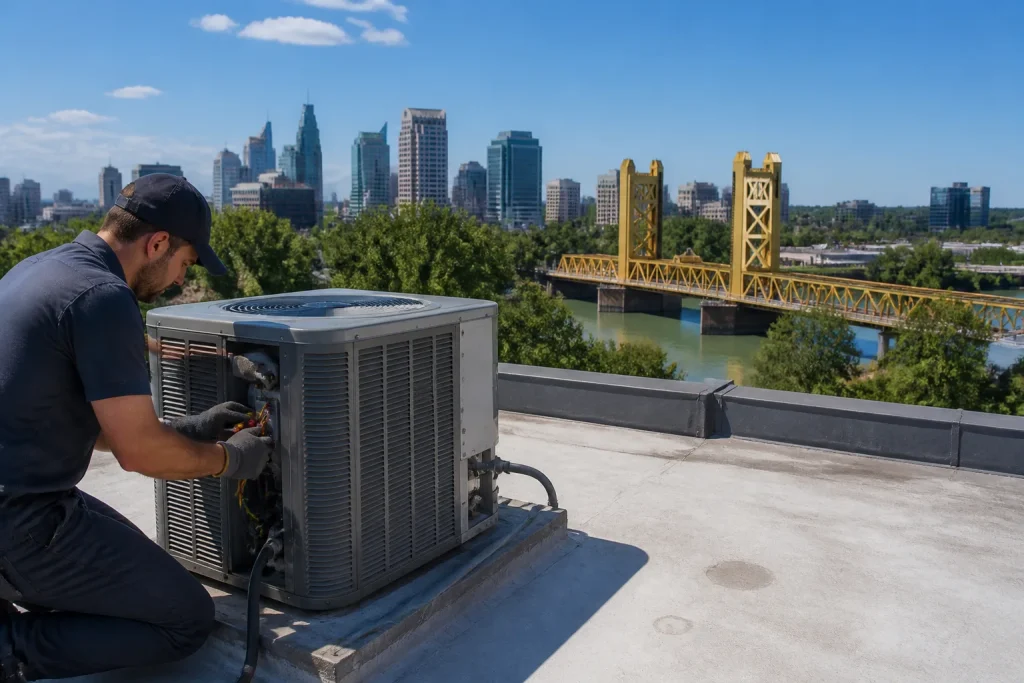
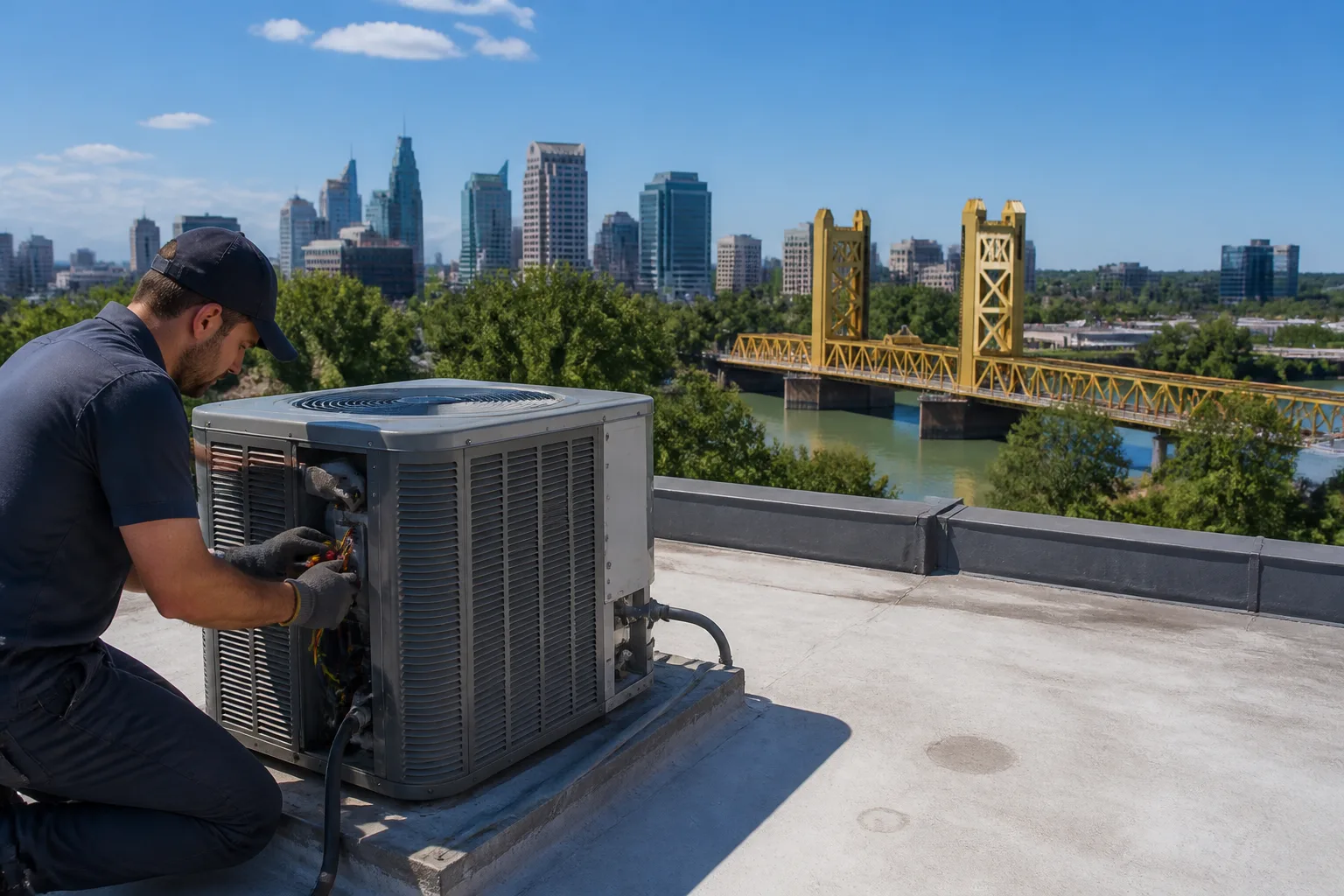
How to Choose the Right HVAC Company in Sacramento
Choosing the right HVAC company in Sacramento means looking past star ratings and verifying who’s actually accountable when the technician shows up at your door. A licensed company with thousands of reviews can still dispatch an unsupervised new hire to your home on a 104°F July afternoon. The filter that actually matters is operational structure: whether company leadership is physically present on jobs, or managing from a back office while crossing fingers.
If you’d rather skip the vetting process and talk with a team where the owner serves as Field Supervisor, call Stonegate Heating & Air California at (855) 467-1888. We’ve been serving Sacramento since 2010.
Why Reviews Alone Won’t Protect You
Here’s what most Sacramento homeowners learn the hard way: a 4.7-star franchise with 2,000 reviews measures sales performance and first impressions, not installation quality. Those reviews get collected after the phone call, after the quote, sometimes before the work is even finished. They rarely capture what happens six months later when the condensate drain backs up because the tech forgot to level the pan.
We’ve fixed plenty of those callbacks. Over in Natomas last summer, we got called to a system that had been “professionally installed” eight months prior. The previous crew had used flex duct where rigid was specified, creating a sag that collected condensation and grew mold. The homeowner had chosen that company based on a 4.9 average across 800 reviews. The reviews were real. The supervision was not.
The point isn’t to distrust reviews. It’s to understand what they measure. Volume plus recency tells you a company is good at generating reviews. It doesn’t tell you who’s standing behind the work on your specific job.
What to check instead:
- Whether the owner or a named supervisor is listed as physically present on job sites
- How the company describes its quality control process — specific steps, not vague promises
- Whether recent reviews mention follow-up visits or callback resolution
- If the company has sustained review volume over years, not a sudden spike
Our 499 verified reviews at a 4.7-star average accumulated across 16 years, not six months of aggressive solicitation. That pace reflects repeat customers and word-of-mouth in Sacramento communities, not a marketing push.
The Licensed Contractor vs. Licensed Company Trap
This distinction trips up even careful homeowners. A company can hold a valid CSLB license while the person actually working on your system has no individual coverage. Here’s how it happens: the company maintains a license and bond, then sends out technicians as “employees” who aren’t individually listed or insured for the work they’re performing.
If something goes wrong — property damage, injury, a code violation — you may find the company’s liability coverage disputes the claim because the specific worker wasn’t properly classified.
How to verify in Sacramento:
- Check the CSLB license number on cslb.ca.gov. Confirm the classification is C-20 (Warm-Air Heating, Ventilating and Air-Conditioning), not a general B or handyman classification.
- Look at the “Personnel” section. Is the owner or qualifying individual someone you can actually speak with?
- Review complaint history. One or two complaints over a decade is normal for active contractors. A pattern of similar complaints — installation defects, permit issues, warranty disputes — is a signal.
- Check bond status. A suspended bond means the company can’t legally contract for work, even if the license shows active.
At Stonegate, Jason Trent holds the license and serves as Field Supervisor. When we say owner-supervised, we mean Jason is on job sites, not reviewing paperwork on weekends.
Five Questions That Reveal Real Accountability
Every HVAC company in Sacramento will tell you they stand behind their work. The difference shows up when you ask how they handle the callback. These five questions separate accountable operators from transactional ones:
1. “If my system fails two weeks after installation, who comes out, and how fast?”
Vague answers — “we’ll take care of it” — suggest no defined process. Specific answers — “the same lead technician, within 24 hours” — indicate operational discipline. Ask if the owner gets involved in callbacks. At Stonegate, Jason Trent personally reviews every callback before dispatch.
2. “Can I speak with the technician who’ll be on my job before I sign?”
Companies that rotate through a hiring pool will resist this. Owner-supervised operations can typically arrange it. The technician’s name should appear on your estimate or contract.
3. “What documentation do I receive showing the work was done to manufacturer specification?”
Proper HVAC installation requires specific refrigerant charge, airflow measurement, and electrical verification. A company that hands you nothing but an invoice is leaving you without proof of proper installation — which voids manufacturer warranties when disputes arise.
4. “Walk me through your permit process for this job.”
Sacramento County and city jurisdictions have specific requirements. A contractor who says “permits aren’t needed for this” without checking jurisdiction is either cutting corners or uninformed. Either way, you’re exposed.
5. “Show me how you calculate load for equipment sizing.”
Manual J load calculation is required by code for replacement installations in California. Contractors who size by “what’s there now” or “square footage rule of thumb” are guessing. In Sacramento’s climate, oversizing causes short-cycling, humidity control failures, and premature equipment death.
Why Lowest-Bid Selection Fails Harder for HVAC
Homeowners understandably apply the same bidding logic across trades: get three quotes, pick the middle. This works reasonably well for roofing or painting, where materials are visible and installation variance is limited. HVAC is different.
Equipment installation quality varies enormously because the critical work is hidden. Duct sealing happens in attics and crawl spaces. Refrigerant charge requires precise measurement, not visual inspection. Airflow balancing depends on manual calculation, not guesswork. A low bidder can install the same Goodman or Rheem unit as a quality contractor and produce half the lifespan through sloppy execution.
The data supports this. Industry studies consistently show that improper installation — not equipment defects — accounts for the majority of premature system failures. A $2,000 “savings” on installation that reduces system life from 15 years to 8 is the most expensive money you never spent.
In Sacramento specifically, our climate stresses equipment uniquely: extended cooling seasons, dry heat that increases static pressure in ductwork, occasional winter freezes that crack improperly drained condensate lines. Local experience matters. A technician who’s worked 16 years in California’s HVAC market has seen these failure patterns before. One who’s been in Sacramento two summers hasn’t.
What to evaluate instead of price:
- Scope specificity — does the quote break out labor, materials, permits, and equipment model numbers?
- Installation details — duct modifications, electrical upgrades, pad replacement, refrigerant line sets
- Warranty terms — equipment warranty plus labor warranty, and who’s responsible for each
- Post-installation documentation — commissioning report, airflow readings, refrigerant pressures
How to Read a CSLB Record Like an Inspector
Most Sacramento homeowners check that a license exists, then stop. The CSLB record contains more useful information if you know where to look.
Start with the “Complaint Disclosure” section. California requires disclosure of complaints filed in the past five years, even if resolved. Read the complaint category, not just the count. A complaint about “contract abandonment” suggests financial distress. “Structural defect” in HVAC work usually means improper installation affecting the building envelope. “Fraud” or “misrepresentation” complaints warrant direct conversation with the contractor about what happened.
Check “Bond History.” A surety bond pays consumers if the contractor abandons work or fails to pay subcontractors. If the bond has been forfeited or replaced multiple times, that’s financial instability. If it’s currently suspended, the contractor cannot legally perform work.
Review “Workers’ Compensation Insurance.” HVAC work involves electrical components, refrigerant handling, and often attic or rooftop work. Uninsured workers on your property create liability exposure. Verify the policy is current and covers the classification.
Finally, check “Business Name History.” Frequent name changes can indicate reputation problems or attempts to shed complaint history. Stability matters in a trade where warranty work may be needed years later.
Stonegate Heating & Air California has operated under one name for 16 years. Jason Trent’s license and bond records are available for review, and we carry current workers’ compensation coverage for all field personnel.
When to Call a Pro
If you’re evaluating HVAC companies because your system is failing now — not planning ahead — the vetting process above still applies, but compressed. Focus on the two fastest trust signals: whether the owner is reachable for your job, and whether the company can explain their callback process in specific terms. Everything else is secondary when it’s 103°F in Sacramento and your compressor just locked out.
Related services in Sacramento: AC Repair & Installation in West Covina, Heating & Furnace in West Covina, Heat Pump & Mini Split in West Covina.
The Bottom Line
The right HVAC company in Sacramento isn’t the one with the most reviews or the lowest quote. It’s the one where accountability lives on your job site, not in a marketing department. Verify individual licensing, ask the five callback questions, read the full CSLB record, and weight installation quality over equipment price. The 15-year system life you want depends on the hands that install it.
If you’re in Sacramento and want to talk with a team where the owner serves as Field Supervisor, Stonegate Heating & Air California offers free estimates. We’ve worked on Carrier, Trane, Lennox, Goodman, Rheem, York, Daikin, Bryant, and American Standard equipment across residential and commercial jobs for 16 years. Call (855) 467-1888.
Frequently Asked Questions
Go to cslb.ca.gov and enter the license number. Confirm the classification is C-20 for HVAC work, check that the bond is active, and review any complaints in the past five years. Don’t accept “we’re licensed” at face value. Call (855) 467-1888 if you’d like help understanding what you’re seeing.
Yes, because installation quality — not equipment brand — determines system lifespan. Owner-supervised operations catch errors before they become callbacks, and you have a named individual accountable when issues arise. The cost difference typically pays for itself in avoided repeat visits and longer equipment life. For a free estimate from an owner-supervised team in Sacramento, call (855) 467-1888.
A qualified contractor should work on all major brands without restriction. In our experience, Sacramento homes run everything from budget-friendly Goodman and Rheem systems to high-efficiency Daikin and York units. If a company says “we don’t service that brand,” you’re dealing with limited training, not a brand problem. Stonegate handles all nine major brands — whatever’s in your home or building, we’ve worked on it.
Get three, but evaluate them on scope specificity and installation detail, not just bottom-line price. The lowest bid often omits necessary duct modifications, proper permitting, or commissioning documentation. Ask each contractor to explain their Manual J load calculation and show you their commissioning process. Call (855) 467-1888 for a detailed, itemized estimate from Stonegate Heating & Air California.
Written by Jason Trent, Owner / Field Supervisor at Stonegate Heating & Air California, serving Sacramento since 2010.
Need HVAC Help?
Call Stonegate Heating & Air California — licensed & insured, available 24/7 in California.
(855) 467-1888