
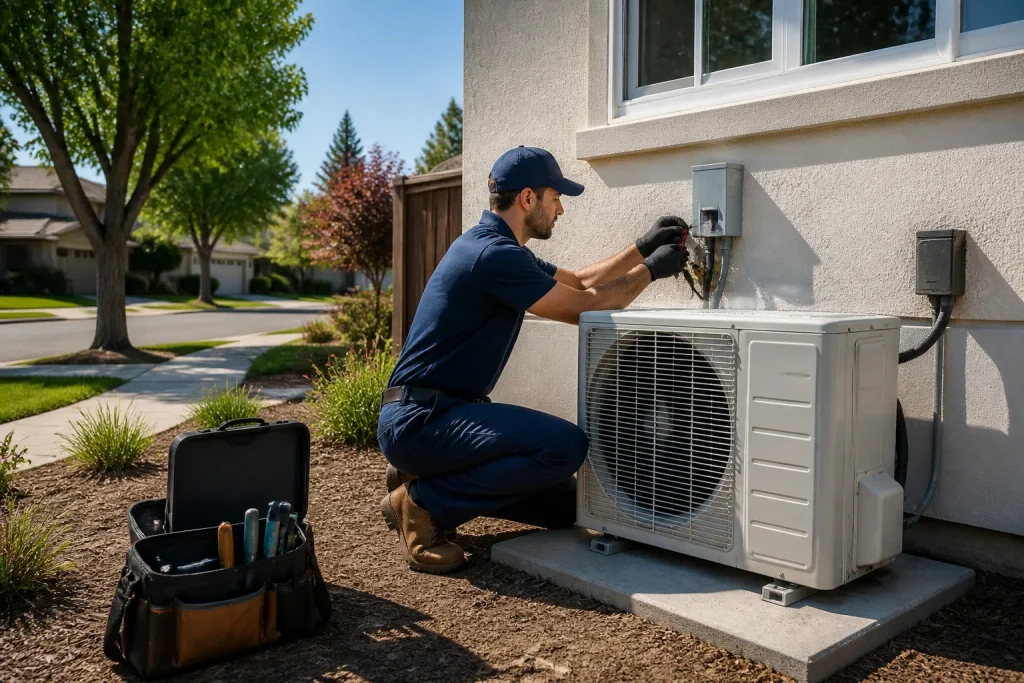
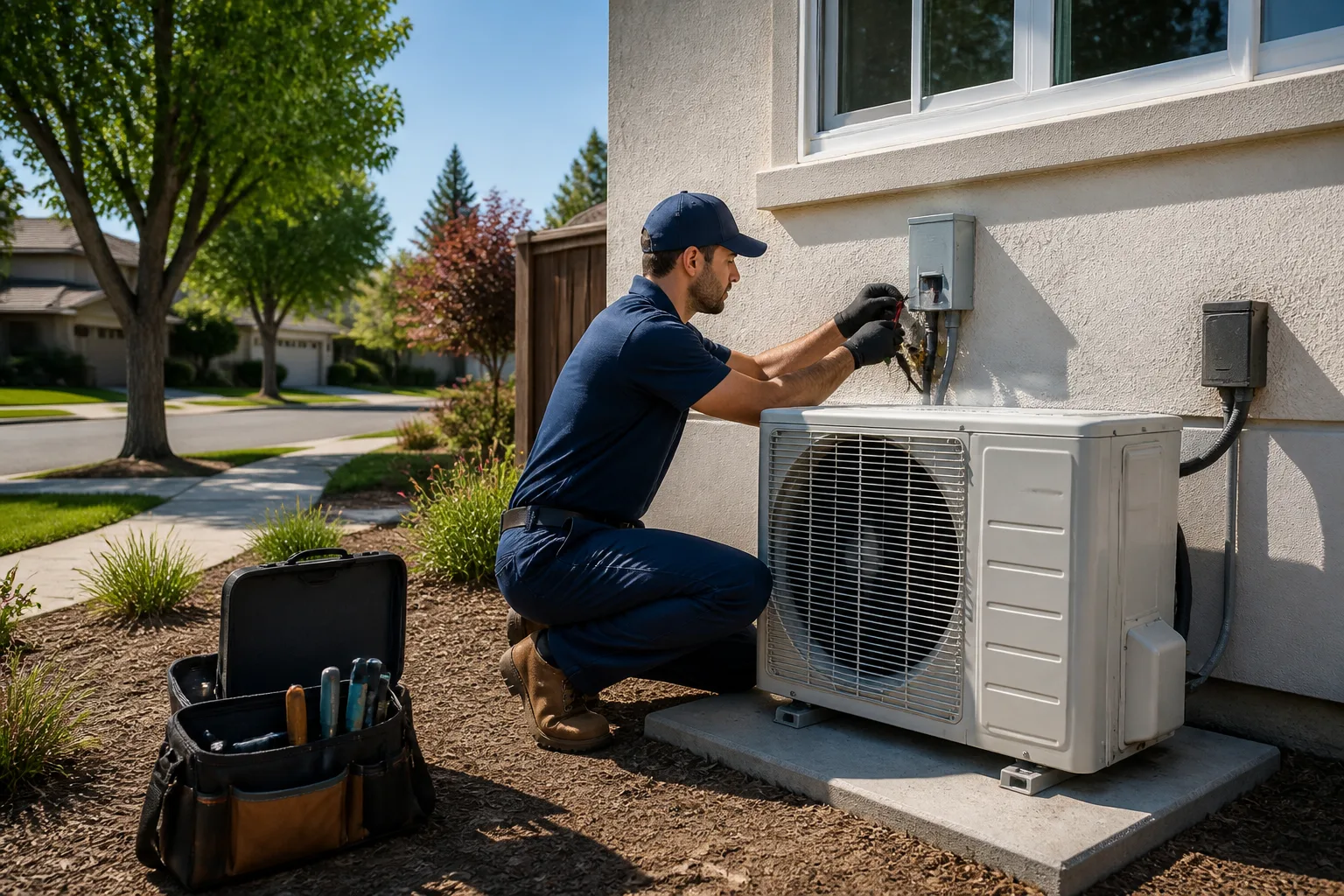
Daikin AC Repair & Installation in Sacramento: A Homeowner’s Guide
Daikin AC repair and installation in Sacramento requires technicians who understand inverter-driven technology, not just conventional cooling systems. Daikin’s variable-speed compressors and proprietary communication protocols fail in ways that generic HVAC techs routinely misdiagnose, turning a 20-minute wiring fix into a $600 parts replacement. If you’re troubleshooting a Daikin system yourself and hit an error code you can’t clear, call us at (855) 467-1888 — we’ll diagnose it properly.
We’ve been working on Daikin equipment in Sacramento for 16 years, and here’s what we’ve learned: these systems are excellent when installed and serviced correctly, and expensive when they’re not. The gap between those two outcomes usually comes down to whether the technician recognizes which Daikin product line they’re looking at and knows how its controls behave differently from a standard single-stage AC.
Three Daikin Systems You’ll Find in Sacramento Homes
Most Daikin installations in Sacramento fall into one of three product families, and each has distinct failure patterns:
- FTX Series Wall-Mounts: These are the compact indoor units paired with RXS or RXS-Q outdoor condensers, common in Sacramento’s older bungalow conversions and garage ADUs. The FTX uses a DC fan motor with a dedicated control board that communicates with the outdoor unit via shielded twin-core wiring. When that communication fails, you get an E7 error — and we’ve watched techs who don’t know Daikin replace the fan motor when the real problem is a $12 terminal block corroded from Sacramento’s dry, dusty summer air.
- DX Series Ducted Systems: The DX17VSS and DX20VC are Daikin’s inverter-driven central air units, increasingly popular in Natomas and Elk Grove new construction. These modulate compressor speed from 25% to 100% based on cooling load. The failure mode most techs miss: refrigerant leaks cause the inverter to hunt continuously, overheating the compressor module. A single-stage system just runs low and freezes up; an inverter keeps trying to optimize until it burns itself out.
- Aurora Heat Pumps (DZ20VC/DZ17VSA): Daikin’s cold-climate heat pump line, which matters more in Sacramento than people think — our winter nights drop into the 30s regularly, and heat pumps that can’t maintain capacity at 35°F leave homeowners running emergency heat. The Aurora uses a vapor injection circuit that adds complexity and a specific set of pressure sensors generic techs often don’t test.
We pulled a DX20VC out of a garage over in Land Park last month where a previous company had added refrigerant three times in two years without finding the actual leak at the indoor coil header. By the third overcharge, the inverter module had failed completely. That’s a $2,400 mistake that started as a $280 repair.
Why Daikin Inverter Compressors Fail Differently
The core difference between Daikin’s inverter systems and conventional AC: the compressor doesn’t just turn on and off. It varies speed continuously, which means refrigerant charge tolerance is much tighter.
On a single-stage system, being 10% overcharged usually just reduces efficiency slightly. On a Daikin inverter, overcharge causes the compressor to overspeed at low load conditions, generating excessive discharge temperature. The onboard protection logic will shut it down with an E3 error (high discharge temperature), but repeated cycling degrades the compressor insulation. We’ve replaced inverter compressors in Sacramento that failed after two years because the original installer charged by sight glass instead of weighing in the exact charge per Daikin’s subcooling tables.
Here’s what proper Daikin service requires:
- Refrigerant charge weighed precisely, not estimated
- Subcooling and superheat verified against Daikin’s variable-speed performance charts, not generic rules of thumb
- Inverter current draw checked at multiple speed stages — a failing IPM (intelligent power module) shows up as asymmetric current before it fails completely
- Communication voltage between indoor and outdoor units verified under load, not just at rest
We carry the Daikin-specific charging calculator and have the inverter diagnostic software on our laptops. Most Sacramento HVAC companies don’t, which is why you’ll see “replace compressor” recommended when the real issue is charge accuracy or a failed discharge thermistor.
What the Daikin Dealer Network Actually Means for Your Warranty
Daikin’s warranty structure is stricter than brands like Rheem or York. The 12-year parts warranty on premium units is only valid if:
- The installing contractor is a Daikin Comfort Pro or Daikin Dealer at time of installation
- The system is registered within 60 days of startup
- The installation follows Daikin’s clearance and lineset specifications exactly
We’ve seen homeowners in Sacramento lose full warranty coverage because a generic installer didn’t register the equipment, or because the lineset exceeded Daikin’s maximum length without the required oil trap and additional charge calculation. Daikin will deny claims for improper installation — it’s not a maybe, it’s standard practice.
Stonegate Heating & Air California works with Daikin as one of our nine certified brands. We handle warranty registration as part of every install, and we document clearance measurements and lineset routing with photos. If you ever need warranty service, that documentation is what gets your parts covered.
Sacramento Error Codes: E1, E3, U4 and What They Actually Mean
Daikin’s error codes are specific, but only if you know the platform. Here’s what we see most often in Sacramento’s climate:
- E1 — High Pressure Protection: In Sacramento’s 105°F+ summer stretches, this usually means the outdoor coil can’t reject heat. Could be dirty condenser (common with our cottonwood season in May-June), failed outdoor fan, or — on inverter systems — the compressor running at maximum speed because the charge is low. Generic diagnosis: “bad compressor.” Actual diagnosis: check charge first, then check outdoor fan RPM feedback.
- E3 — High Discharge Temperature: Almost always refrigerant-related on inverters. Undercharge, overcharge, or restriction. We’ve found TXV restrictions in Daikin systems caused by brazing without nitrogen purge — a shortcut that leaves oxidation flakes in the system. Sacramento’s hard water doesn’t help if the condenser has scale buildup reducing heat transfer.
- U4 — Communication Failure: Indoor and outdoor units can’t talk. On FTX wall-mounts, this is often the shielded communication wire grounded against metal framing. On DX ducted systems, it’s frequently a failed interface board after a summer power surge — Sacramento’s grid gets unstable during heat waves when everyone’s AC cycles simultaneously.
The U4 is the one that gets expensive when misdiagnosed. We’ve been called to jobs where the previous company replaced both the indoor and outdoor control boards ($1,800+) when the actual problem was a single wire pinched during a recent rodent-proofing job in the crawl space. Twenty minutes with a multimeter found it.
Installation Details Generic Contractors Routinely Miss
Daikin specifies clearances and lineset requirements that differ from American-standard equipment. These aren’t suggestions — they’re warranty conditions.
Clearance: Daikin outdoor units need 24 inches minimum service access on the control box side and 12 inches on other sides. In Sacramento’s tight side-yard installations, we’ve seen units crammed against fences with 6 inches clearance, causing chronic high-pressure trips and premature compressor failure. The unit might “fit” in the space and still violate Daikin’s requirements.
Lineset: Daikin mini-splits and some DX systems use flare connections, not brazed joints. The flare must be made with Daikin’s specified torque — undertorqued leaks, overtorqued cracks the flare nut. We use calibrated torque wrenches on every flare. We’ve found leaks in other companies’ installs where the flare was hand-tightened and checked with bubble solution that didn’t show the micro-leak until operating pressure built up.
Electrical: Daikin inverters require dedicated circuits with proper grounding impedance. Sacramento’s older homes in Midtown and East Sac often have panels with questionable grounding. We’ve had to run new grounding electrodes to get Daikin inverters to start reliably — the onboard diagnostics are sensitive to ground noise in a way that old furnaces never were.
When to call a pro: If your Daikin is showing any error code, making unusual clicking sounds from the outdoor unit, or cycling on high-pressure protection more than once, don’t keep resetting it. Inverter damage is cumulative — the system might restart, but you’re degrading the compressor insulation each time.
Related services in Sacramento: AC Repair & Installation in West Covina, Heat Pump & Mini Split in West Covina
The Bottom Line
Daikin builds some of the most efficient HVAC equipment available in Sacramento, but that efficiency comes with complexity that demands brand-specific knowledge. The three product lines — FTX, DX, and Aurora — each have distinct control architectures and failure modes. Inverter compressors require precise refrigerant management that generic charging practices destroy. Warranty coverage depends on documented, specification-compliant installation. And the error codes that show up during Sacramento’s extreme summer heat have specific meanings that save money when interpreted correctly.
We’ve spent 16 years and nearly 500 jobs learning these systems. If you’re in Sacramento and need Daikin AC repair or installation, or you’re trying to figure out whether a quoted “compressor replacement” is actually necessary, call (855) 467-1888. We’ll diagnose it properly and give you a free estimate. No charge to tell you what’s actually wrong.
Frequently Asked Questions
Most Daikin repairs in Sacramento range from $180 for communication wiring fixes to $1,400 for inverter control board replacement. Compressor failures on inverter systems run higher, typically $2,000–$3,200 including refrigerant recovery and recharge. The key variable is accurate diagnosis — we’ve saved homeowners hundreds by finding that their “failed compressor” was actually a $45 discharge thermistor. Call (855) 467-1888 for a free estimate.
If your Daikin is under 8 years old and the repair is under $1,000, repair usually makes sense. Between 8–12 years, compare repair cost against replacement — inverter technology has improved significantly, and new Daikin systems hit 20+ SEER2. Over 12 years, replacement is typically the better investment, especially if you’ve had multiple refrigerant leaks or inverter faults. We don’t push replacement; we’ve repaired 14-year-old Daikins that had another 4 years left because the issue was minor.
Any licensed contractor can legally service Daikin, but brand familiarity matters enormously. Daikin’s inverter controls, communication protocols, and warranty requirements are proprietary. We’ve been called to fix other companies’ Daikin “repairs” more than 50 times in the last five years — usually because the tech treated it like a generic system and replaced the wrong part. Ask specifically whether the technician has Daikin inverter diagnostic tools and training.
Daikin warranty registration must be completed within 60 days of installation. You can verify registration by calling Daikin customer service with your serial numbers, or ask your installer for the registration confirmation email. If you’re unsure and your system was installed recently, we can check registration status during a service call and help complete it if needed — unregistered systems drop to 5-year parts coverage instead of 12. Call (855) 467-1888 and we’ll sort it out.
Written by Jason Trent, Owner / Field Supervisor at Stonegate Heating & Air California, serving Sacramento since 2010.
Need HVAC Help?
Call Stonegate Heating & Air California — licensed & insured, available 24/7 in California.
(855) 467-1888