
AC Repair & Installation: Repair or Replace? How Sacramento Homeowners Decide
Most Sacramento homeowners facing a broken AC are given a binary choice: fix it or buy new. The better question is whether the repair is a smart investment or a loan on a depreciating asset. In our 16 years across Sacramento, we’ve found the decision hinges on three factors: compressor age, refrigerant type, and what the next failure will cost. If you’d rather not run the math yourself, call us at (855) 467-1888 for a free, no-pressure estimate.
The $400 Capacitor Trap: When Cheap Repairs Fool Smart People
A homeowner in East Sacramento called us last July. Their 14-year-old system needed a $400 capacitor replacement. The previous company sold it as a quick fix. Six months later, the compressor failed. That $400 “repair” became part of a $3,200 replacement they could have done in the first place.
Here’s the field formula we use: if the repair costs more than 30-40% of a new system’s price, and the unit is over 10 years old, replacement is almost always the better financial decision. Not because we’re selling equipment, but because we’ve tracked the failure curves. A 12-year-old compressor in Sacramento’s 100-degree summers is living on borrowed time. The capacitor, the contactor, the condenser fan motor — these are symptoms of a system that’s been cycling hard for over a decade.
We pulled a Goodman unit out of a garage over in Land Park last season where the homeowner had spent $1,800 over three years on “minor” repairs. The system still ran. It also still used R-22 and cost him $340 a summer in extra electricity compared to a modern Rheem. He’d been sold three loans on an asset worth zero.
R-22 Refrigerant: The Hidden Tax on Old Systems
If your AC was installed before 2010, it likely runs R-22 refrigerant. Production was banned in 2020, and remaining supplies are reclaimed, scarce, and expensive. In Sacramento, we’ve seen R-22 recharge costs hit $150-$250 per pound. A typical system holds 5-10 pounds. A “simple” leak repair can suddenly cost $800-$1,500 before any actual mechanical work.
This artificially inflates repair economics. A $900 leak repair on paper becomes $2,100 with refrigerant. That’s past the 30-40% threshold for most residential systems. Yet homeowners don’t see it coming because the initial quote rarely includes the full refrigerant cost.
We always check refrigerant type first on any pre-2010 system in Sacramento. If it’s R-22, we flag it immediately. The math changes. A new York or Daikin system running R-410A or R-32 isn’t just more efficient — it’s repairable at reasonable cost for its full lifespan.
Title 24 and Utility Rebates: How California Changes the Math
California’s Title 24 energy standards don’t just regulate new construction. They create real financial incentives that shift the repair-vs-replace calculation. A new system meeting current SEER2 standards can qualify for SMUD rebates ranging from $300 to $1,500 depending on efficiency tier and equipment type.
We’ve had Sacramento homeowners call us for a $1,200 repair quote and end up replacing because the net cost after rebates was $1,800 more — with a 10-year warranty, 25% lower utility bills, and no R-22 exposure. The repair would have bought them two years of declining performance.
The rebate landscape changes annually. We keep current on SMUD, PG&E, and federal heat pump incentives because they genuinely affect whether replacement is the smarter play. A system that “works” but bleeds efficiency is a monthly tax most homeowners don’t know they’re paying.
Commercial vs. Residential: Different Rules Entirely
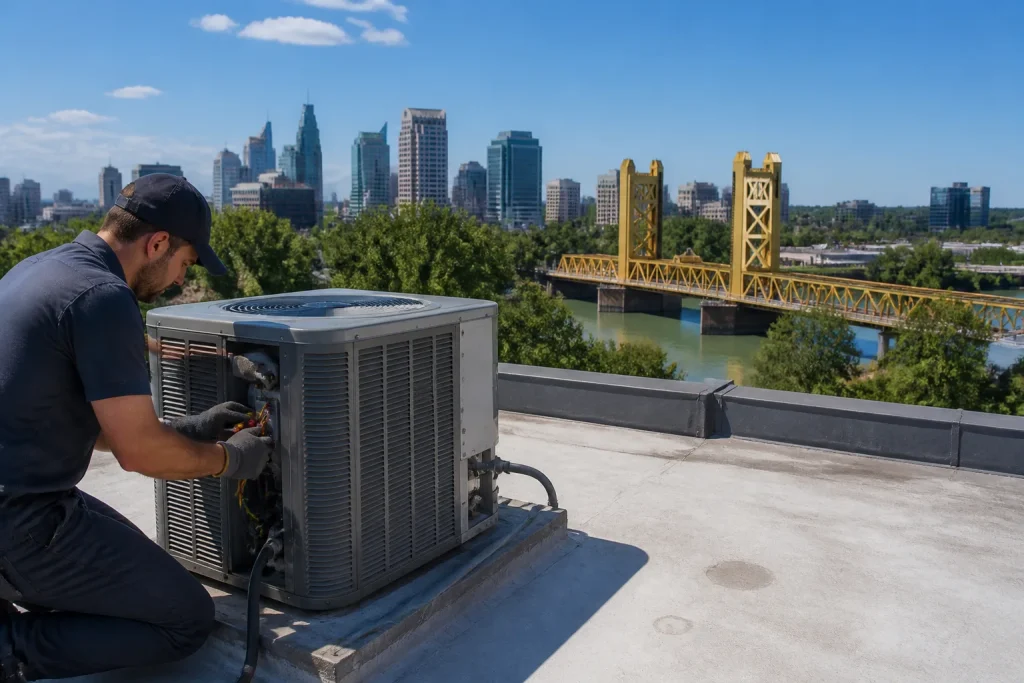
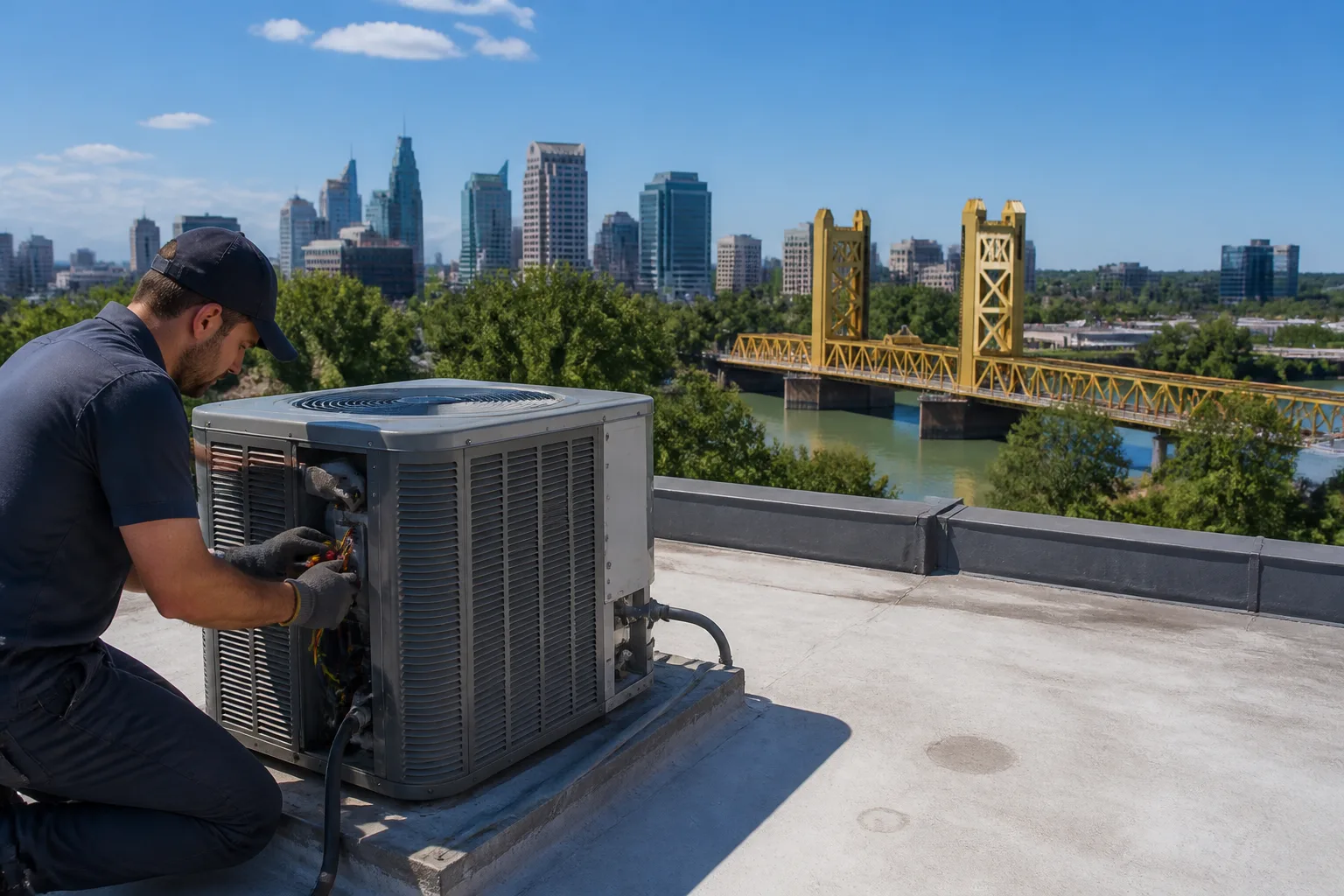
Commercial rooftop units in Sacramento face different replacement thresholds than residential split systems. A 5-ton packaged unit on a small office in Natomas might cost $6,000-$8,000 to replace but $2,500 to repair a compressor. The 30-40% rule still applies, but commercial equipment has longer expected lifespans — 15-20 years versus 12-15 for residential — and downtime costs matter more.
We’ve serviced commercial systems in Sacramento where a $3,000 repair bought three more years of reliable operation. We’ve also seen $1,800 repairs on 18-year-old units fail within eight months. The difference is usually maintenance history and whether the unit was properly sized for the building’s load. Oversized commercial equipment cycles more, wears faster, and skews replacement math toward earlier action.
For residential, the decision is more straightforward. A family’s comfort system doesn’t generate revenue. The cost of being wrong is a hot August night and an emergency call. We weigh that differently.
“It Still Blows Cold” — The Efficiency Deception
This is the myth we encounter most. A system running cool is not a healthy system. Compressor efficiency degrades 20-30% over its lifespan even when output feels the same. The unit just runs longer, cycles harder, and draws more amps to achieve the same result.
We see this constantly in older Sacramento neighborhoods like Curtis Park and Oak Park, where 1990s and early-2000s systems still operate. Homeowners report “no problems” while paying $280-$340 monthly electric bills in July. A modern Rheem or Daikin system in the same home often cuts that to $180-$220. The old system “works” the way a 15-mpg truck “works” — functionally, but not economically.
The only way to catch this is comparing year-over-year usage against cooling degree days, or having a tech measure actual amp draw and subcooling/superheat values. We do this on every diagnostic call in Sacramento. Most homeowners are surprised by what we find.
Key Takeaways
- Use the 30-40% rule: repair cost versus replacement cost, weighted by system age
- R-22 refrigerant adds $150-$250 per pound to any repair — factor it in
- California utility rebates can make replacement cost-competitive with major repairs
- Commercial equipment follows different timelines; residential decisions favor earlier replacement
- Systems can feel fine while losing 20-30% efficiency — check amp draw and run times, not just comfort
The Bottom Line
The repair-vs-replace decision is a cost-over-time analysis, not a single invoice comparison. In 16 years and nearly 500 jobs across Sacramento, we’ve learned that homeowners who get the full picture upfront avoid the serial-repair trap. The ones who don’t often call us twice: once for the “cheap” fix, again for the replacement they needed all along.
If you’re in Sacramento and weighing a repair against replacement, we’ll give you straight numbers — current refrigerant costs, efficiency comparisons, rebate eligibility, and what the next likely failure looks like. No upsell. Just the math we’ve seen play out hundreds of times.
Call Stonegate Heating & Air California at (855) 467-1888 for a free estimate. Owner Jason Trent supervises every project personally.
Related Services in Sacramento
For heating system decisions, see our Heating & Furnace in West Covina page. If you’re considering a heat pump or ductless solution, our Heat Pump & Mini Split in West Covina team covers system design and installation. For full-service AC work, visit AC Repair & Installation in West Covina or our Stonegate Heating & Air California home page.
What happens when you call
- 1
A real person answersNo phone trees — you reach a local pro.
- 2
You get an upfront price rangeHonest numbers before anyone is dispatched.
- 3
A background-checked tech heads outLicensed & insured, dispatched right away.
- 4
You approve before work beginsNothing starts until you say go.
Frequently Asked Questions
Most residential AC repairs in Sacramento range from $200 for electrical fixes like capacitors or contactors, to $1,500-$2,500 for compressor or refrigerant work. R-22 systems add $150-$250 per pound for refrigerant. Call (855) 467-1888 for an exact quote — estimates are free.
It depends on system age and repair cost. If the repair exceeds 30-40% of replacement cost and your system is over 10 years old, replacement is usually cheaper over time. Factor in R-22 costs, efficiency losses, and utility rebates. We run these numbers on every call.
Residential systems typically last 12-15 years in Sacramento’s climate, though we’ve seen well-maintained units hit 18 and neglected ones fail at 8. Commercial rooftop units often reach 15-20 years. The difference is usually maintenance quality and proper initial sizing.
Emergency HVAC is available. In Sacramento’s summer heat, we prioritize calls from vulnerable households and businesses with critical needs. Same-day service depends on call volume and parts availability for your specific brand. Call (855) 467-1888 and we’ll give you a real timeline.
Written by Jason Trent, Owner / Field Supervisor at Stonegate Heating & Air California, serving Sacramento since 2010.
Need HVAC Help?
Call Stonegate Heating & Air California — licensed & insured, available 24/7 in California.
(855) 467-1888