
5 Mistakes to Avoid With Heat Pump & Mini Split
The five costliest heat pump and mini split mistakes are all preventable: oversizing the unit, choking outdoor airflow, neglecting condensate drains, running AUTO fan mode year-round, and DIY lineset work with bad flares. In 16 years across Sacramento, we’ve found these five errors account for more than half the “premature failure” calls we get on systems less than five years old. If you’d rather have us assess your setup instead, call (855) 467-1888 for a free estimate.
Here’s the thing most homeowners don’t hear at the sales table: the number-one cause of mini split inefficiency in Sacramento homes isn’t the unit. It’s that nobody showed the homeowner where the air handler filters were, so they were never cleaned. That single oversight — plus the four below — is why we see so many 3-year-old systems performing like they’re 10.
Mistake 1: Buying Too Big a Unit for the Room
Oversizing feels like buying insurance. More BTUs must mean better comfort, right? Wrong. A mini split that’s too large for its zone short-cycles constantly: blasts cold air, hits the setpoint in four minutes, shuts off, and repeats. The compressor never runs long enough to reach steady-state efficiency, and the startup current draw wears it down fast.
We’ve replaced Goodman compressors in Sacramento tract homes that were sized for 450 square feet but installed in 280-square-foot bonus rooms. The homeowner thought they were being smart. What they got was a unit that ran 47 cycles per day instead of 12, and a dead compressor at year four instead of year fifteen.
The right sizing protocol is Manual J load calculation, not rule-of-thumb. It factors Sacramento’s 100°F summer design temperature, ceiling height, window orientation, and insulation grade. A south-facing room in Elk Grove with single-pane windows needs a different number than an identical room in Folsom with upgraded glass.
- Short cycling = compressor death from electrical and mechanical stress
- Oversized units don’t dehumidify well; Sacramento’s dry summers mask this, but spring and fall shoulder seasons get clammy
- Correct sizing often costs less upfront and far less over the equipment life
When we spec a Lennox or Rheem mini split for a Sacramento home, we measure every time. No exceptions.
Mistake 2: Cramming the Outdoor Unit Against a Wall or Fence
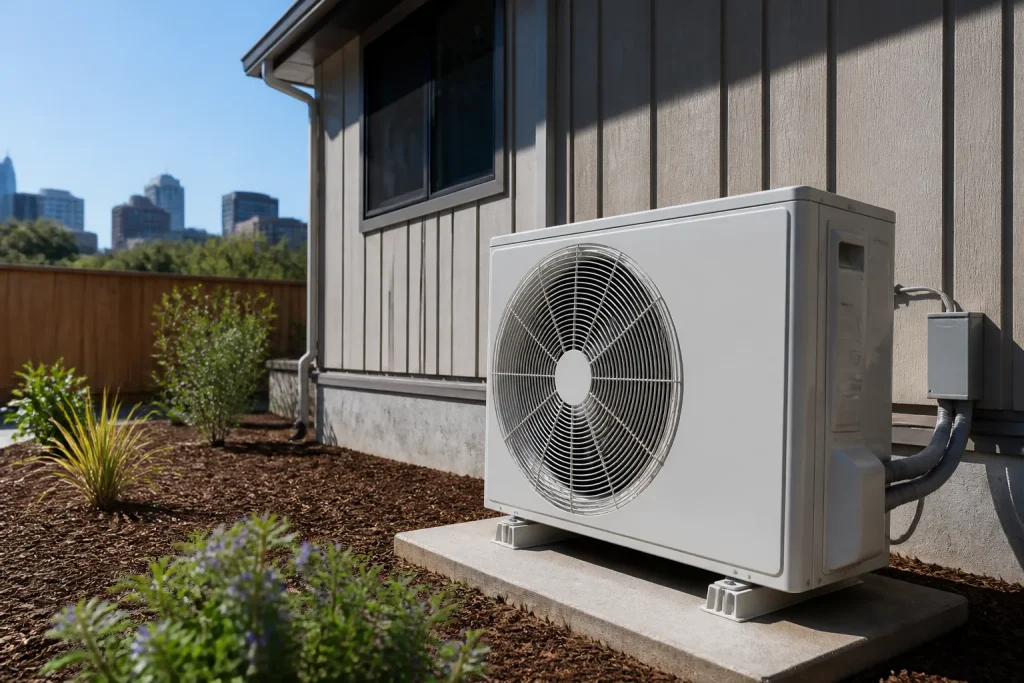
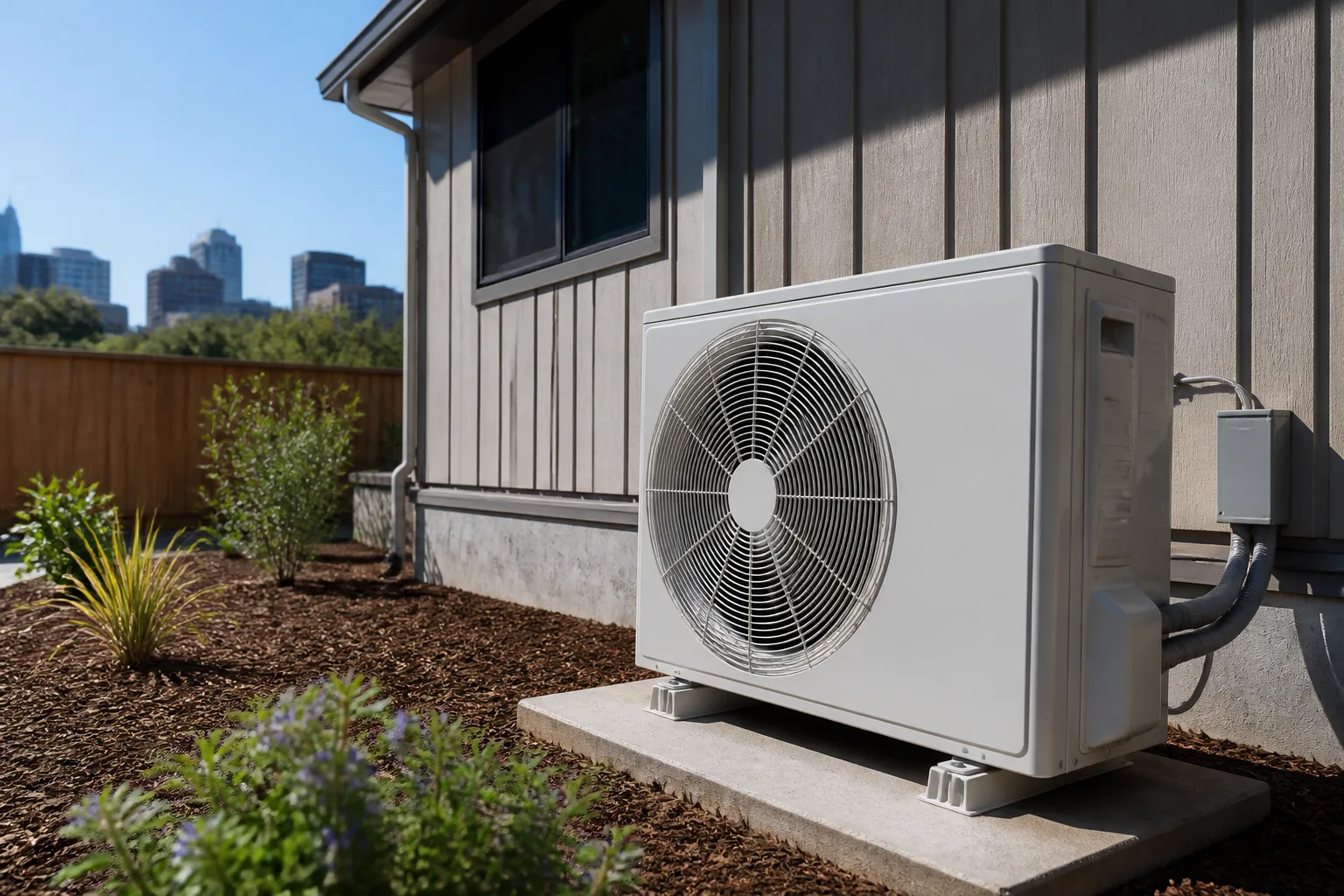
Manufacturer clearance specs exist for a reason. The outdoor condenser needs breathing room to reject heat. When it’s shoehorned against a stucco wall or wooden fence — extremely common in West Covina and Sacramento’s older tract developments — hot air recirculates back through the coil. Head pressure climbs. Efficiency drops. Compressor lifespan shortens.
The minimum is usually 12 inches to a solid surface and 24 inches to any overhead obstruction, but we’ve seen “installations” with 3-inch gaps because the patio slab was already poured and nobody wanted to pour another one.
In Sacramento’s 105°F August afternoons, that recirculated air can be 20 degrees hotter than ambient. Your system is now designed for 95°F but eating 115°F. We’ve pulled units out of Rocklin backyards where the coil was so heat-stressed the fins had actually work-hardened and started cracking.
Related services in Sacramento: Heat Pump & Mini Split in West Covina
Mistake 3: Treating the Condensate Drain as “Set It and Forget It”
Mini splits produce water. Not as much as a central AC in Houston, but Sacramento’s fall and spring shoulder seasons — when it’s 65°F and humid outside, and you’re still cooling inside — generate surprising condensate. That drain line, usually a 3/4-inch PVC or vinyl tube running from the wall-mounted air handler, can clog with dust, biofilm, or the occasional insect.
When it backs up, water hits the float switch (if you have one) and kills the system. No float switch? It overflows into the wall cavity. We’ve opened air handlers in Natomas where the drain pan had been slowly leaking for two seasons, and the drywall behind the unit was black with mold that the homeowner never saw because the unit sits 7 feet up.
Check it seasonally. Pour a cup of water or dilute vinegar through the line and verify it exits where it should. In Sacramento’s older neighborhoods with mature trees, check the outdoor termination point for leaf debris too.
When to call a pro: If your mini split throws a water error code, or you see staining on the wall below the air handler, don’t just reset it. The problem is mechanical, not electronic. We handle condensate issues on all nine brands we service — Stonegate Heating & Air California home
Mistake 4: Leaving the Fan on AUTO Year-Round
AUTO mode seems logical. The fan runs only when the compressor runs, saving electricity. Except it doesn’t work that way for comfort or equipment health.
In AUTO, the fan cycles with the compressor. Every stop lets moisture re-evaporate off the wet coil back into your room. In Sacramento’s spring, when outdoor humidity spikes before the real heat arrives, that means your system cools but never truly dries the air. You feel clammy at 72°F.
Worse, the constant start-stop wears the fan motor and stresses the control board. We’ve replaced more blower motors on AUTO-habit systems than on any other configuration.
Our recommendation for Sacramento’s climate:
- Summer (May–October): LOW or MEDIUM continuous fan. Keeps air moving, finishes dehumidification between compressor cycles, evens out temperature stratification in vaulted-ceiling rooms common in Roseville and Granite Bay
- Winter (November–March): LOW continuous fan. Heat pumps deliver air at lower temperature than gas furnaces; continuous circulation prevents the “cool draft” complaint we hear constantly
- Shoulder seasons: Match to comfort, but avoid AUTO if humidity feels off
The electricity cost of continuous LOW is roughly that of a 40-watt bulb. The comfort and equipment protection return is substantial.
Mistake 5: DIY Lineset with Improper Flares
This is the silent killer. Refrigerant leaks from bad flares don’t show up immediately. The system works fine for months, even a year. Performance degrades so gradually the homeowner adjusts the thermostat to compensate. By month 18, the unit’s working twice as hard for the same output, and nobody knows why.
Then the compressor fails. No warranty coverage, because the manufacturer requires a certified installer and proper nitrogen-purged brazing. That DIY flare you made with a hardware-store tool and YouTube confidence? It voided your 10-year parts warranty on day one.
We’ve found leaking flares in garage installations over in Arden-Arcade where the homeowner ran the lineset through the wall himself to “save money.” The leak rate was so slow our electronic detector barely registered it at the service valve. But over 18 months, he’d lost 22% of his charge. His “savings” cost him a $1,800 compressor replacement and full warranty denial.
Flaring copper for R-410A or R-32 requires precision: clean cuts, proper deburring, exact flare angle, torque to spec. Then pressure-test with nitrogen, evacuate to 500 microns, and weigh in the charge. No shortcuts. If you’re not set up for that, you’re not set up for this work.
Related services in Sacramento: AC Repair & Installation in West Covina | Heating & Furnace in West Covina
The Bottom Line
Most mini split and heat pump problems we see in Sacramento aren’t equipment failures. They’re installation and operation errors that compound until something expensive breaks. The five above — oversizing, clearance violations, neglected drains, AUTO fan habit, and DIY refrigerant work — are predictable enough that we can often guess the problem from the model number and install date.
The good news: all five are avoidable with proper sizing, installation discipline, and a few operating habits that cost nothing. If you’re unsure whether your system was set up right, or you’re planning new equipment and want it done once, done right, call Stonegate Heating & Air California at (855) 467-1888. We offer free estimates, and Jason Trent supervises every project in the field — not from a back office.
Key Takeaways
- Right-size with Manual J; oversizing destroys compressors through short cycling
- Maintain manufacturer clearance around outdoor units, especially against stucco walls and fences
- Check condensate drains seasonally; Sacramento shoulder seasons produce more moisture than expected
- Use continuous LOW/MEDIUM fan instead of AUTO for better dehumidification and motor life
- Never DIY refrigerant lines; improper flares void warranties and cause slow, expensive failures
Frequently Asked Questions
If it cools the room in under 5 minutes then shuts off repeatedly, or if you notice temperature swings of more than 2 degrees, it’s likely oversized. A properly sized unit runs longer, steadier cycles. Call (855) 467-1888 and we can assess your load calculation — estimates are free.
No reputable technician will charge a system with a DIY lineset. The liability and warranty exposure are too high, and most can’t verify your flares and brazing meet code. In our experience, the “charge-only” call almost always turns into a full reinstall. Save the double labor and have it done right once.
You’re probably running AUTO fan mode, which lets moisture re-evaporate off the coil between cycles. Switch to LOW continuous fan and give it 48 hours. If that doesn’t resolve it, you may have a refrigerant charge issue or an oversized unit — both need professional diagnosis. Call (855) 467-1888.
Every 2–4 weeks during heavy-use months. Sacramento’s valley dust and pollen load is significant, and a clogged filter drops airflow, freezes coils, and eventually burns the blower. Lift the front panel — if you don’t know where the filters are, that’s your first problem. We show every homeowner during installation; if yours didn’t, call us.
Written by Jason Trent, Owner / Field Supervisor at Stonegate Heating & Air California, serving Sacramento since 2010.
Need HVAC Help?
Call Stonegate Heating & Air California — licensed & insured, available 24/7 in California.
(855) 467-1888