
5 Mistakes to Avoid With Emergency & Commercial HVAC
The five costliest mistakes in commercial HVAC emergencies are: skipping a signed service agreement before peak season, deferring refrigerant leak repairs, approving work without written scope, failing to document rooftop unit details, and applying uniform maintenance schedules to units with different load demands. These aren’t theoretical risks — in 16 years of field work across Sacramento, we’ve watched each one turn a manageable repair into a five-figure emergency. If you’re reading this during a crisis, call Stonegate Heating & Air California at (855) 467-1888 — we answer, and Jason Trent supervises every emergency call personally.
1. No Signed Commercial Service Agreement Before Summer
Here’s what Sacramento building owners learn the hard way: emergency HVAC rates without a service contract typically run 40–60% higher than contracted priority response. Worse, availability isn’t guaranteed.
We’ve taken emergency calls in July where the facility manager had no existing relationship with any HVAC contractor. They’d call three or four companies. Maybe one answers. Maybe that company can send someone today, maybe tomorrow. Meanwhile, the server room’s hitting 85 degrees and the landlord’s getting calls from every tenant.
A commercial service agreement locks in response priority, documents your equipment baseline, and — this part matters — establishes who is authorized to approve work and up to what dollar amount. Without that pre-negotiated framework, you’re making financial decisions under heat stress, often without your normal approval chain available.
What a proper agreement should include:
- Defined response time windows for emergency vs. priority vs. standard calls
- Pre-authorized spending limits for after-hours repairs
- Equipment inventory with make, model, serial number, and install date
- Seasonal inspection schedule tied to Sacramento’s cooling load patterns
- Single point of contact at the HVAC company who knows your building
We write these agreements for properties from single-tenant retail up to 50,000-square-foot office complexes. The ones who sign before May almost never call us in panic mode. The ones who wait until the first 105-degree day in Sacramento are already behind.
2. Deferring Refrigerant Leak Repairs on Commercial Systems
Sacramento’s high ambient temperatures accelerate compressor wear on undercharged systems. We’ve tracked this pattern for 16 years: a $400 refrigerant leak repair deferred in spring becomes a $4,000 compressor replacement by fall. Every single time.
The mechanism is straightforward. Low refrigerant charge reduces suction pressure, which raises compressor operating temperature. In Sacramento’s Central Valley heat, that compressor is already working harder than identical equipment in milder climates. Add undercharge, and you’re running sustained overload conditions.
Commercial systems compound this problem because they’re often oversized for the load and cycle less efficiently. A 20-ton rooftop unit with a slow leak might keep the space cool for weeks while the compressor slowly cooks itself. The building feels fine. The electric bill creeps up. Nobody notices until the compressor seizes on a Saturday afternoon in August.
We serviced a commercial kitchen in Natomas last summer where exactly this happened. They’d added refrigerant twice in 18 months, never fixed the leak. Third time, the compressor locked rotor — $3,800 replacement, plus two days of lost kitchen operation. The original leak repair would have been $340.
Early warning signs we tell Sacramento clients to watch for:
- Gradual loss of cooling capacity over 2–3 weeks, not sudden failure
- Ice formation on suction lines during overnight operation
- Electric bills rising 15–20% without usage changes
- Previous “top-off” of refrigerant within the last two years
Any of these, and you need leak detection, not another recharge. We use electronic leak detectors and nitrogen pressure testing — the actual fix, not the band-aid.
3. Approving Emergency Repairs Without Written Scope
Verbal authorizations during a crisis routinely lead to scope creep. Commercial repair invoices without itemized parts and labor have no warranty recourse. We’ve cleaned up after this mistake more times than I can count.
The scenario plays out predictably. It’s 7 PM on a Friday. The building’s 87 degrees. The after-hours technician describes a “bad compressor and maybe a bad contactor too.” The facilities manager, not physically present, approves “$2,500 or whatever it takes, just get it running.” Monday morning, the invoice is $4,200, the contactor was fine, and there’s no written record of what was actually replaced or why.
Jason Trent won’t let our technicians work without signed authorization on anything over the pre-agreed limit. But not every company operates that way. Some after-hours services specifically target stressed decision-makers with open-ended “just fix it” approvals.
Protect yourself with these steps:
- Require photo documentation of failed parts before replacement
- Insist on itemized parts list with manufacturer part numbers
- Get labor hours estimated in writing, not just a flat “emergency rate”
- Specify warranty terms on both parts and labor, in writing
- Designate a backup approver with clear dollar authority if primary contact is unreachable
Stonegate’s emergency calls include digital authorization with photo documentation as standard. But if you’re working with another contractor, demand this structure. A legitimate HVAC company won’t hesitate. A sketchy one will push back.
4. Failing to Document Rooftop Unit Details Before an Emergency
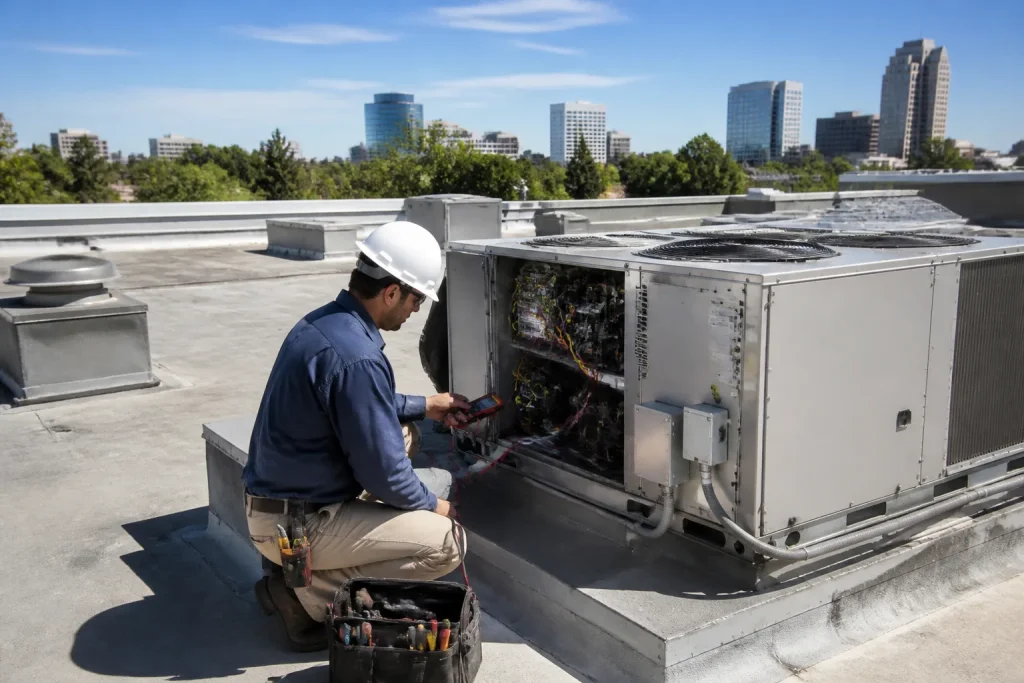
This information is required to get accurate parts quotes fast, and rooftop access during an emergency wastes time technicians should spend diagnosing. We keep equipment documentation for every contracted client. The ones who don’t have it cost themselves 30–60 minutes on every emergency call.
Here’s what happens. Technician arrives. Needs to verify compressor model to confirm replacement compatibility. Climbs to roof. Finds the data plate sun-faded or grease-coated. Spends 20 minutes cleaning and photographing. Calls supplier. Supplier needs serial number to confirm revision level. Back up the ladder. Another 15 minutes.
Meanwhile, the building’s still hot, the tenant complaints are escalating, and you’re paying emergency labor rates for ladder time.
Minimum documentation every Sacramento commercial building should maintain:
- Make, model, and serial number for each rooftop unit
- Installation date and original installing contractor
- Refrigerant type and charge specification
- Last service date and findings
- Known issues or deferred repairs from previous visits
We provide this documentation to our service agreement clients after the first inspection. If you’re not contracted with us, walk your roof this month and photograph every data plate. Store it where you can access it at 10 PM on a Saturday. Future you will thank present you.
5. Treating All Rooftop Units as Identical for Maintenance Scheduling
Older units in high-load zones need twice-annual service, not the once-a-year standard applied to office space units. This mistake is invisible until it isn’t — the unit that needed attention every six months fails in year three of annual-only maintenance.
Sacramento’s commercial buildings have uneven thermal loads. A west-facing retail space with full afternoon sun exposure, a server room with constant equipment heat, and a commercial kitchen with exhaust makeup air all stress rooftop units differently. The 15-year-old Daikin on the kitchen wing is not the same maintenance case as the 5-year-old Rheem on the office wing.
We assess load zones during our initial building survey and tag units by service priority:
- High-load / aged units: Filter change every 2 months, full inspection every 6 months
- Standard commercial: Filter change every 3 months, full inspection annually
- Light-load / newer units: Filter change every 3–4 months, inspection annually
A Goodman unit serving a south-facing server room in Elk Grove failed on us last August — 14 years old, annual maintenance, never flagged for accelerated wear. The replacement compressor was obsolete. Full unit replacement, $7,200, three-week lead time. If we’d been servicing it on a six-month cycle, we’d have caught declining amp draw and rising head pressure a year earlier. Planned replacement, better pricing, no emergency.
When to call a pro: If you can’t state the last service date, refrigerant type, and current operational status of every rooftop unit on your building, you need an inspection before Sacramento’s next heat wave. We offer these assessments with full documentation — no obligation, no pressure.
Related services in Sacramento: AC Repair & Installation in West Covina | Heating & Furnace in West Covina | Heat Pump & Mini Split in West Covina
The Bottom Line
Commercial HVAC emergencies in Sacramento are almost never sudden. They’re the endpoint of predictable decisions: no service agreement, deferred repairs, verbal authorizations, missing documentation, and uniform maintenance schedules that ignore actual load conditions. Each mistake is preventable with a straightforward facility management checklist.
Key takeaways:
- Sign a commercial service agreement before May — not during the first heat wave
- Fix refrigerant leaks properly; never accept repeated “top-offs”
- Require written, itemized scope for every repair over $500
- Document every rooftop unit’s details now, while you can read the data plate
- Schedule maintenance by load zone and unit age, not by calendar convenience
If you’re in Sacramento and need help implementing any of this, Stonegate Heating & Air California offers free estimates for commercial system assessments and service agreements. Jason Trent supervises every project personally. Call (855) 467-1888.
Frequently Asked Questions
Emergency rates without a service agreement typically run 40–60% higher than contracted priority response, and guaranteed availability is not included. A signed agreement locks in both pricing and response priority before the crisis hits. Call (855) 467-1888 to discuss commercial service agreement options — estimates are free.
Yes. In Sacramento’s high-heat climate, an undercharged system runs sustained overload conditions that overheat and seize the compressor within a single cooling season. We’ve replaced compressors that would have been saved by a $400 leak repair six months earlier. If your system needed refrigerant added in the last two years, you have a leak that needs detection and repair.
It should specify the exact scope of work, itemized parts with manufacturer part numbers, estimated labor hours, total not-to-exceed dollar amount, and warranty terms for both parts and labor. Photo documentation of failed components before replacement protects both parties. Never approve “whatever it takes” verbally — get it in writing, even if it adds 10 minutes to the process.
Units serving server rooms, commercial kitchens, or west-facing spaces in Sacramento should receive full inspection and service every six months, with filter changes every two months. Standard office units typically need annual inspection with quarterly filter changes. Age matters too — equipment over 10 years in any load zone benefits from accelerated inspection frequency.
Written by Jason Trent, Owner / Field Supervisor at Stonegate Heating & Air California, serving Sacramento since 2010.
Need HVAC Help?
Call Stonegate Heating & Air California — licensed & insured, available 24/7 in California.
(855) 467-1888