
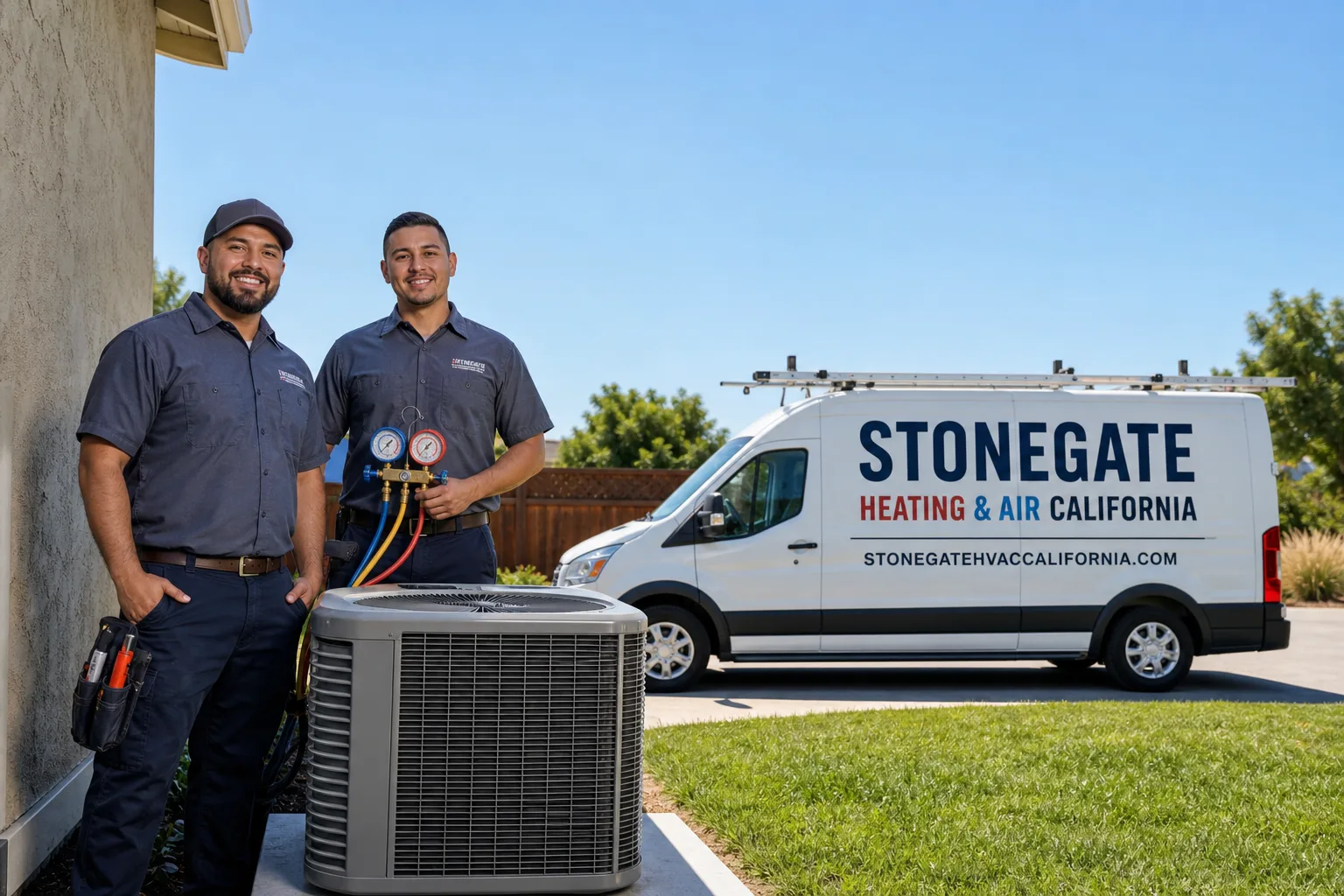
Fast, Reliable Air Quality & Ventilation Across Mountain House
Whole-home air quality upgrades in Mountain House typically run $150–$4,500 depending on whether you need a media filter replacement, garage door weatherstripping seal, or a full ERV system with ductwork. Most Mountain House homes we service are in that 2003–2015 build window, so we’re familiar with the builder-grade shortcuts that let Delta Breeze dust and Valley heat slip past standard filtration. We’re at homes in Wicklund Village, Altamont Village, and Hansen Village regularly — call (855) 467-1888 and we’ll get you scheduled.
Why Stonegate Heating & Air California Is Mountain House’s Preferred Air Quality & Ventilation Company
We’ve been driving out to Mountain House since the first villages were finishing construction in the mid-2000s. Sixteen years and nearly 500 reviews later, we know the equipment patterns here — the same Goodman and Carrier systems, the same undersized returns, the same garage-to-house infiltration issues that keep showing up across neighborhood after neighborhood.
Our 4.7-star average across 499 verified reviews includes plenty of Mountain House homeowners who found us after other contractors treated their symptoms instead of the source. Jason Trent, our owner, still works as Field Supervisor on jobs. He’s not in a back office. He’s on-site, checking duct static pressure and verifying that an ERV install actually balances the pressure differential instead of just running air through a box.
Because Mountain House sits at the western edge of the San Joaquin Valley near the Altamont Pass corridor, the Delta Breeze hits harder here than in Stockton or Modesto. That sounds like free cooling until you realize it’s pushing pollen, dust, and agricultural particulate through every unsealed gap in a home built during the tract-home boom. We account for that in our load calculations and filtration specs. Response time to Mountain House is typically same-day or next-morning during peak season.
Our Air Quality & Ventilation Services in Mountain House
Air Filtration & Media Filter Upgrades
The 1-inch fiberglass filters installed in most Mountain House homes were never meant to handle the particulate load this area generates. Builder-grade systems came with a slot for a cheap throwaway filter, and that’s what most homeowners have been swapping for fifteen years. We upgrade to 4-inch or 5-inch media cabinets — AprilAire, Honeywell, or Carrier-compatible — with MERV 11 to MERV 13 ratings that actually capture the fine dust the Delta Breeze carries. A media filter upgrade in Mountain House runs $150–$400 installed, including the cabinet modification at the return drop.

ERV & HRV System Installation
Mountain House’s tight tract homes were built for efficiency but not for breathing. No fresh air ventilation, minimal envelope leakage, and occupants who keep windows closed against summer heat and winter tule fog. An Energy Recovery Ventilator (ERV) or Heat Recovery Ventilator (HRV) brings in filtered outside air and pre-conditions it using energy from the exhaust stream. In Mountain House’s climate — those 30°F+ daily swings — an ERV is usually the better choice because it handles both temperature and humidity transfer. Full ERV or HRV installation with ductwork in Mountain House runs $2,000–$4,500. We size them properly, which means measuring actual airflow, not guessing based on square footage.

Ventilation Install & Duct Modifications
Many Mountain House homes have return ducts that are simply too small for the air volume of a two-story plan. The system runs negative pressure, which pulls from the path of least resistance — often the garage, the attic access, or gaps around the return air platform. Our Air Quality & Ventilation team measures static pressure and identifies these bypass paths. We’ll enlarge returns, seal platforms with mastic, and add dedicated ventilation where code and health require it. Every modification gets verified with a manometer, not a visual guess.

Garage Door Weatherstripping & Pressure Sealing
This is the Mountain House-specific fix that most HVAC contractors miss. The door between your garage and living space was installed with a basic sweep and maybe a foam strip. The garage itself probably has an uninsulated steel door with no weatherstripping at the jambs or header. Delta Breeze pressurizes the garage, dust blows under and around the pass-through door, and your HVAC system distributes it through the house. We install continuous compression weatherstripping and a proper threshold seal — $100–$250 — which stops the infiltration at its source instead of trying to filter it after the fact.

What happens when you call
- 1
A real person answersNo phone trees — you reach a local pro.
- 2
You get an upfront price rangeHonest numbers before anyone is dispatched.
- 3
A background-checked tech heads outLicensed & insured, dispatched right away.
- 4
You approve before work beginsNothing starts until you say go.
Trusted Brands We Service in Mountain House
Whatever system is in your Mountain House home, we’ve worked on it. Our technicians are factory-trained or field-experienced on Carrier, Trane, Lennox, Goodman, Rheem, York, Daikin, Bryant, and American Standard — nine brands, not two or three. That matters in a community where production builders rotated through suppliers based on bulk pricing, leaving neighborhoods with a mix of equipment that smaller shops often decline to touch. We stock common media filters, ERV cores, and control boards for faster turnaround, and Jason Trent verifies parts compatibility himself before dispatch. No “we’ll have to order that and come back next week.”
Common Air Quality & Ventilation Problems We See in Mountain House Homes
- Builder-grade garage doors act as unfiltered intake louvers. The thin single-layer steel doors installed across Mountain House’s villages have no insulation, no thermal break, and often no perimeter weatherstripping. Combined with the afternoon western sun exposure that accelerates material fatigue, these doors leak continuously. We find garage temperatures 15–20°F above ambient in summer, and that heat plus dust migrates straight into the return air path.
- Undersized return ducts create negative pressure that bypasses the filter entirely. The 2003–2015 build wave standardized on duct designs that barely met code minimums. In two-story homes with 1,800–2,400 square feet, a single 14-inch return often isn’t enough. The system doesn’t “choose” to pull from the garage — physics demands makeup air, and the garage pass-through is the easiest path.
- Tight envelopes trap humidity and VOCs with no fresh air exchange. Mountain House homes score well on energy efficiency tests but poorly on air changes per hour. Without mechanical ventilation, cooking fumes, off-gassing from 2000s-era materials, and respiration moisture accumulate. The 30°F+ daily temperature swing means overnight cooling can condense moisture inside the HVAC cabinet, especially on aging evaporator coils with compromised drain pans.
- Original equipment hitting end-of-life simultaneously across entire neighborhoods. Because virtually every home in Mountain House was built in the same 12-year window, the first-generation furnaces and air handlers are failing in clusters. A 2005-installed system with a cracked heat exchanger isn’t just a heating problem — it’s a carbon monoxide and combustion spillage risk that affects indoor air quality directly.
Pricing for Air Quality & Ventilation in Mountain House, CA
| Service | Typical Range in Mountain House |
|---|---|
| Media Filter Upgrade (MERV 13) | $150–$400 |
| ERV/HRV Installation (including ductwork) | $2,000–$4,500 |
| Garage Door Weatherstripping (HVAC-Seal) | $100–$250 |
These ranges reflect actual Mountain House jobs we’ve completed in the past 24 months. Final cost depends on existing duct configuration, electrical access for ERV units, and whether we discover additional return duct restrictions that need correction. We don’t quote over the phone without seeing the system — but we also don’t charge for the visit that gets you a written, itemized estimate. Call (855) 467-1888 to schedule.
We Also Serve Cities Near Mountain House
Our service radius covers Tracy to the east, Discovery Bay and Brentwood to the north, and Livermore across the Altamont Pass. Each of these markets has different housing stock and different infiltration patterns — Tracy’s mixed-era builds don’t fail the same way Mountain House’s synchronized construction wave does. If you’re in 95391 or the surrounding area, we know the local conditions because we’ve worked them for 16 years.
Serving Mountain House, CA — Our Local Coverage Area
We’re based in the Mountain House area and know this community well. Use the map below to see our service coverage — if you’re nearby, we can almost certainly help.
FAQs — Air Quality & Ventilation in Mountain House
No. A 1-inch fiberglass or pleated filter is rated for large particulate, not the fine dust and pollen that blows through unsealed garage doors in Mountain House’s wind-exposed lots. We upgrade homeowners to 4-inch or 5-inch media filters with MERV 13 rating, which captures particles down to 1 micron. The filter cabinet install runs $150–$400 — call (855) 467-1888 for a free estimate and we’ll check your return duct sizing while we’re there.
Yes, because the Delta Breeze is unreliable and unfiltered when it does arrive. It blows strongest in late afternoon and evening, often when your windows are already closed against heat or you’re not home to open them. An ERV provides continuous, filtered fresh air at a controlled rate regardless of wind conditions. In Mountain House’s tight homes, mechanical ventilation isn’t a luxury — it’s how you meet ASHRAE standards for indoor air quality without wasting the energy your HVAC system already produced.
Your return duct is undersized for the air volume of your two-story home, creating negative pressure that pulls makeup air from the path of least resistance. The garage-to-house door has no continuous seal, and the garage itself is leaky to outside. We measure this with a manometer — typical Mountain House homes run -0.08 to -0.15 inches of water column negative pressure at the return, which is enough to draw garage air through a 1/4-inch gap. The fix is sealing the door properly and often enlarging the return path.
Most Mountain House homes need neither year-round. Summer humidity stays moderate due to the dry San Joaquin Valley climate, and winter heating doesn’t strip moisture as severely as in colder regions. The exception is homes with standing moisture issues from condensate drain failures or slab perimeter leaks, which we address at the source rather than masking with a portable unit. If your home has specific humidity complaints, we’ll measure with a data logger instead of selling equipment you don’t need.
A UV lamp treats biological growth on the evaporator coil and drain pan, not particulate dust infiltration. At 18 years, your system is at or past design life, and the dust problem is almost certainly an envelope and filtration issue, not a biological one. We’d rather see you put money toward media filtration, garage sealing, and eventual system replacement with proper return duct sizing than install UV on equipment that’s already failing. Call (855) 467-1888 and Jason Trent will walk you through the priority order based on your actual system condition.
At a home in the Wicklund Village, we found the homeowner running a plug-in room air purifier because dust from the uninsulated garage door kept triggering allergies. We installed a whole-house AprilAire 5000 media filter with a MERV 13 rating at the return drop, then sealed the garage-to-house door with new weatherstripping and a Swegon CASA R7 ERV in the attic to balance the pressure differential. The homeowner reported immediate relief from the “dust fog” that had been a complaint since move-in.
Mountain House is California’s youngest incorporated master-planned community, with virtually its entire housing stock built between 2003 and 2015 in a single generational wave — meaning the original HVAC systems installed during the early-2000s boom are now hitting or surpassing their 15-20 year lifespan simultaneously, creating a concentrated replacement cycle unlike anything seen in neighboring cities with mixed-era housing. There is almost no vintage equipment and almost no new construction here right now; technicians work almost exclusively in that narrow aging-system window. That concentration means we’ve seen the same failure modes repeat across hundreds of homes, and we’ve developed specific protocols for the infiltration and ventilation problems that come with this particular generation of construction.
The community’s young, sparse landscaping means outdoor condenser units across Mountain House sit fully exposed to intense western afternoon sun with no mature tree canopy for shade — accelerating capacitor burnout and compressor overheating on units that are already aging, a failure pattern technicians here see earlier in equipment lifespan than they would in a tree-lined established neighborhood just a few miles east in Tracy. That same exposure beats on garage doors and exterior seals, worsening the infiltration problem year by year.
Ready to stop treating symptoms and fix the source? Call (855) 467-1888 for a free estimate. Jason Trent or one of our owner-supervised technicians will come to your Mountain House home, measure your system’s actual performance, and give you a written plan with real numbers — no pressure, no upselling, just the same straight talk that’s earned us 499 reviews at 4.7 stars over 16 years.
Written by Jason Trent, Owner and Field Supervisor at Stonegate Heating & Air California, serving Mountain House and the Sacramento region since 2008.