
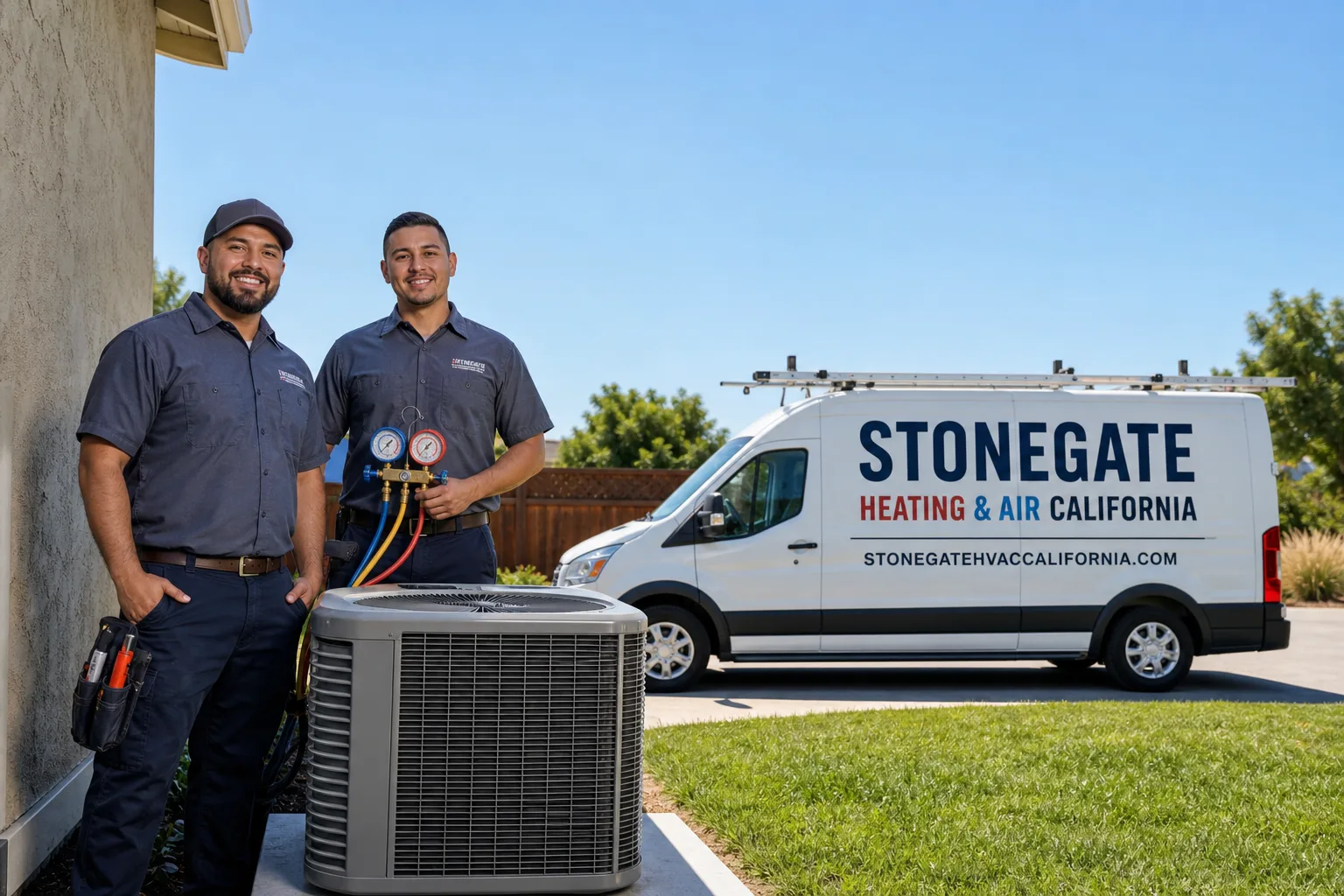
Fast, Reliable Air Quality & Ventilation Across Crestline
Air quality and ventilation work in Crestline isn’t like the flatland. At 4,500 feet in the San Bernardino Mountains, your cabin’s heating system runs harder, your air stays drier, and the framing that was never meant for ductwork fights every retrofit. We’ve been climbing Highway 18 to Crestline for 16 years, and we know the difference between a valley HVAC fix and a mountain HVAC fix. Whether you’re in the Lake Gregory neighborhood, along Lake Drive, or up toward Valley of the Falls Drive, our Air Quality & Ventilation team reaches Crestline with the right parts and the right altitude-adjusted specs. Call (855) 467-1888 for a free estimate.
Why Stonegate Heating & Air California Is Crestline’s Preferred Air Quality & Ventilation Company
Crestline homeowners don’t call us for generic answers. They call because Jason Trent, our owner and Field Supervisor, has personally diagnosed CO issues in A-frame knee walls and specified propane-orificed furnaces that flatland techs would undersize by 10%. That owner-on-the-job accountability shows in our numbers: 16 years, nearly 500 reviews at 4.7 stars, and repeat calls from the same Crestline cabins year after year.
Our technicians carry altitude-deration charts and propane regulator gauges as standard kit, not special-order tools. We’ve worked on Carrier wall furnaces from the 1970s still limping along in Crestline’s 92325 zip, and we’ve installed fresh air intakes in tight stud bays where no return path existed. When a vacation cabin’s been frozen solid for two weeks because the propane ran dry, we know to check for cracked heat exchangers before we even fire the new unit. That specificity is what 499 verified reviews reflect.
Our Air Quality & Ventilation Services in Crestline
Ventilation Install
Crestline’s 1950s A-frame cabins, originally built with wall furnaces and wood stoves, often lack any central return air path. Retrofitting a forced-air system requires creative framing in tight knee-wall spaces that were never designed for ductwork, unlike the standard crawlspaces or basements found in valley homes. We install ERV and HRV systems that recover heat from exhaust air while bringing in fresh mountain air pre-conditioned against Crestline’s dry cold. Every install accounts for altitude deration and propane-specific orifice sizing that San Bernardino techs never touch.

Air Filtration
Crestline’s extended heating season means your filter works overtime. We size media filters for the actual airflow your altitude-derated furnace produces, not the nominal spec on the box. For cabins with 1-inch ceiling grille slots common in 1970s builds, we evaluate whether a 4-inch upgrade is structurally feasible or if a bypass HEPA unit makes more sense. Jason Trent has walked enough Crestline attics to know when a filter upgrade is straightforward and when it’ll require reframing.

Humidifier Install
Crestline’s winter air runs bone-dry, but whole-home humidifiers here face a unique enemy: overnight setback. When a cabin drops below 40°F because the owner sealed the return grille to stop drafts or the thermostat’s programmed for vacancy, the humidifier’s water panel freezes solid, cracks, and floods the crawlspace on thaw. We install bypass and fan-powered humidifiers with freeze-stats and drain safeguards spec’d for Crestline’s part-time occupancy patterns. A typical humidifier install in Crestline runs $150–$700 depending on access and whether we need to run new low-voltage wiring through A-frame framing.

UV Air Purifier
UV-C lamps target the mold and biofilm that grows in drip pans and coil surfaces, especially in Crestline’s mixed-use cabins where heating runs hard half the year and the system sits stagnant the other half. We mount UV units downstream of the coil with sight-glass access for annual bulb replacement, because nobody wants to crawl a Crestline knee wall twice. For wall furnace applications, we evaluate whether a ductless UV option or integrated coil treatment makes sense given your specific propane-fired setup.

What happens when you call
- 1
A real person answersNo phone trees — you reach a local pro.
- 2
You get an upfront price rangeHonest numbers before anyone is dispatched.
- 3
A background-checked tech heads outLicensed & insured, dispatched right away.
- 4
You approve before work beginsNothing starts until you say go.
Trusted Brands We Service in Crestline
We carry factory training on Carrier, Trane, Lennox, Goodman, Rheem, York, Daikin, Bryant, and American Standard, which means whatever brand is in your Crestline cabin, we’ve likely serviced it at altitude before. Our parts van stocks propane orifice kits for Goodman and Carrier furnaces specifically, because those are the units we see most often in Crestline’s retrofit market. When a thermocouple fails on a January weekend and your vacation cabin’s dropping toward freezing, that local parts inventory means same-day heat instead of a week waiting for valley warehouse shipping.
Common Air Quality & Ventilation Problems We See in Crestline Homes
- Ice-dammed return grilles on south-facing rooflines block airflow during Crestline’s freeze-thaw cycles, causing burner cycling and hidden CO accumulation. We clear the ice path and relocate grilles where feasible, or spec sealed-combustion systems that don’t depend on exterior air intakes.
- Retrofit ductwork in non-standard A-frame framing leaks more than 20% of conditioned air into unoccupied attic buffer zones, wasting propane. We pressure-test every retrofit and seal with mastic rated for the temperature swings at 4,500 feet.
- Entire-home humidifiers freeze solid on overnight setback when cabins drop below 40°F, cracking the water panel and flooding the crawlspace. Our installs include freeze-protection controls and proper drainage pitched for Crestline’s occasional deep cold.
- Sealed return grilles for “draft control” starve propane furnaces of combustion air, spiking CO and shortening equipment life. We find this constantly in Crestline’s older cabins and open safe return paths through interior framing instead.
Pricing for Air Quality & Ventilation in Crestline, CA
Mountain HVAC costs more than valley work. The access is harder, the specs are tighter, and the callbacks from altitude mistakes are expensive. Here’s what we typically see in Crestline’s market:
| Service | Typical Range in Crestline |
|---|---|
| Ventilation Install (ERV/HRV) | $3,500–$7,500 |
| Humidifier Install | $150–$700 |
| UV Air Purifier (coil-mounted) | $400–$900 |
| 4-inch Media Filter Upgrade | $200–$550 |
| Return Path Modification / Framing | $350–$1,200 |
Your actual cost depends on access (knee wall vs. crawlspace), whether we need to run new electrical or low-voltage wiring through finished A-frame spaces, and whether your existing propane furnace needs re-orificing for proper altitude operation. We don’t quote over the phone for Crestline retrofits without seeing the framing. Call (855) 467-1888 for a free, on-site estimate with Jason Trent or one of our senior techs.
We Also Serve Cities Near Crestline
Our mountain service area extends to Lake Arrowhead for similar altitude-deration work, down to Muscoy and San Bernardino for valley propane and natural gas systems, and across to Highland for mixed residential-commercial HVAC. Each area gets the same owner-supervised approach, with specs adjusted for local elevation and fuel type.
Serving Crestline, CA — Our Local Coverage Area
We’re based in the Crestline area and know this community well. Use the map below to see our service coverage — if you’re nearby, we can almost certainly help.
FAQs — Air Quality & Ventilation in Crestline
Often yes, but it depends on your knee-wall geometry and existing propane furnace location. We’ve installed ERVs in Crestline cabins by splitting the unit between attic and knee-wall zones, using flexible duct in stud bays where rigid duct won’t fit. The critical factor is finding a path for balanced supply and exhaust that doesn’t compromise your A-frame’s structural triangles. Call (855) 467-1888 and Jason Trent will walk your specific framing.
You’ve choked off combustion air, forcing the furnace to recirculate depleted oxygen and run continuous cycles without reaching setpoint. In Crestline’s tight cabins, this also drives CO production. We see this exact scenario in Lake Gregory-area homes every winter. The fix is a properly sized return path through interior framing, not an exterior grille that admits 20°F air. Call (855) 467-1888 before you run another heating season this way.
For part-time Crestline cabins, we typically recommend an ERV over an HRV because it manages humidity transfer, preventing the bone-dry conditions that damage woodwork and the moisture spikes that follow occupancy. The energy recovery matters less than the humidity balance when your cabin alternates between 30°F vacant and 70°F occupied. We can set controls to run minimum ventilation during vacancy and boost on arrival. Call (855) 467-1888 to size one for your occupancy pattern.
Not necessarily. A 1-inch pleated filter changed monthly often outperforms a 4-inch filter changed annually in Crestline’s heavy heating-use environment. We evaluate your actual airflow (derated for altitude), grille box depth, and whether your A-frame framing can support the weight of a 4-inch media housing. Sometimes the better move is a dedicated bypass HEPA unit. Jason Trent will measure static pressure and give you an honest answer for your specific cabin.
Standard coil-mounted UV units won’t fit wall furnaces, but we can install ductless UV options in the conditioned space or integrate with any existing supply ductwork from a retrofit add-on. For cabins still on original wall furnaces without central air, we sometimes recommend a standalone air purifier with UV/HEPA as a more practical path than forcing UV into equipment that was never designed for it. Call (855) 467-1888 and we’ll assess your specific setup.
On a snowy January morning in the Lake Gregory neighborhood, we found a 1962 cabin with a Carrier 60,000 BTU propane furnace installed in a 6-foot-wide knee wall. The homeowner had sealed the only return grille with plywood to “keep the draft out,” starving the system of air and spiking CO levels to 35 ppm. We opened up a new return path through an interior stud bay, installed a Goodman 80,000 BTU unit properly orificed for altitude, and dropped CO to safe levels. That’s the difference between valley HVAC thinking and Crestline HVAC thinking.
Ready to fix your cabin’s air quality right? Call Stonegate Heating & Air California at (855) 467-1888 for a free estimate. Jason Trent or one of our senior techs will come to your Crestline property, measure your actual conditions, and give you specs that work at 4,500 feet — not copy-pasted from a San Bernardino manual.
Written by Jason Trent, Owner and Field Supervisor at Stonegate Heating & Air California, serving Crestline and the San Bernardino Mountains since 2008.