
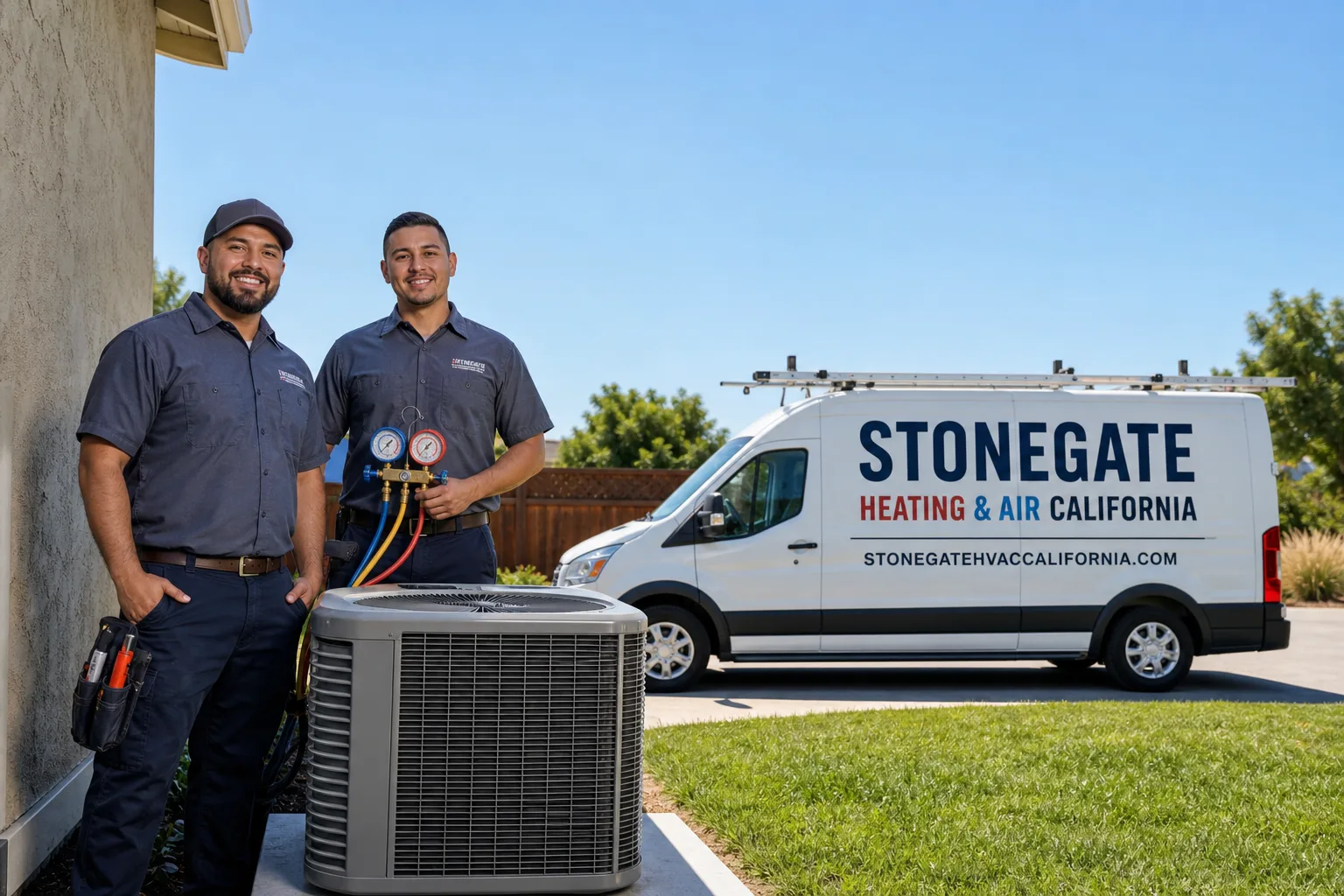
Fast, Reliable Air Quality & Ventilation Across Fillmore
Air quality and ventilation work in Fillmore, CA demands more aggressive maintenance than generic HVAC advice suggests. Between the agricultural dust rolling off surrounding citrus groves and the Santa Clara River Valley’s heat-trap effect that pushes summer temperatures to 100–108°F, standard filter schedules and off-the-shelf equipment often fall short here. We’ve been making the drive to Fillmore from our Sacramento base for years, and our Air Quality & Ventilation team knows the local failure patterns cold. Call (855) 467-1888 for a free estimate. Jason Trent supervises every project personally.
Why Stonegate Heating & Air California Is Fillmore’s Preferred Air Quality & Ventilation Company
Sixteen years in business and nearly 500 verified reviews at a 4.7-star average mean we’ve earned our reputation one job at a time. Fillmore homeowners specifically mention our willingness to explain why their filters clog faster here, not just swap them out and leave.
Owner Jason Trent holds the title of Field Supervisor, not just Owner. He’s physically present on job sites, not managing from a back office. That matters in Fillmore, where the post-1994 Northridge reconstruction housing stock and unique agricultural environment reward hands-on diagnostic experience.
We’re certified on nine leading HVAC brands: Carrier, Trane, Lennox, Goodman, Rheem, York, Daikin, Bryant, and American Standard. Whatever equipment is in your Fillmore home, we’ve worked on it before.
From a single-room mini split to a full commercial system, we cover the full equipment landscape. Emergency HVAC is available when the valley heat turns your indoor air into a particulate-heavy burden.
Our Air Quality & Ventilation Services in Fillmore
Air Filtration
Fillmore’s citrus grove agriculture generates year-round fine dust and pollen loads that standard MERV 8 filters surrender to within weeks. We serviced a home on B Street near the east edge of Fillmore where the Lennox air filtration system was clogged within three months due to fine citrus grove dust. We replaced the MERV 11 filter with a MERV 13, installed a UV air purifier to manage biological growth, and set a 6-month coil inspection schedule. For Fillmore properties bordering the groves, especially on the east and north edges where groves sit upwind of prevailing summer breezes, we typically recommend higher-capacity filtration with shorter replacement intervals.

UV Air Purifier Installation
The same agricultural moisture that feeds Fillmore’s citrus industry creates conditions for biological growth in HVAC systems, particularly in the humid pockets of older wood-frame homes that survived the 1994 earthquake. A UV air purifier installed at the coil or in the return ductwork neutralizes mold, bacteria, and virus particles before they circulate. We’ve found UV systems especially valuable in Fillmore’s post-Northridge reconstruction homes, where tighter building envelopes trap moisture and particulates that older construction would have ventilated naturally.

Ventilation Installation
Many Fillmore homes built during the 1994–1999 reconstruction wave have undersized ductwork that struggles to handle modern high-SEER equipment without airflow balancing work. The Santa Clara River Valley channels and traps heat in summer while funneling cold air drainage in winter, giving Fillmore genuine four-season HVAC demand. A whole-house ventilation system, whether an ERV or HRV unit, can recover energy while exchanging stale indoor air for fresh outdoor air. This matters more in Fillmore than in coastal Ventura, where natural ventilation through open windows actually works most of the year.

Humidifier & Dehumidifier Installation
Fillmore’s winter cold drainage from the surrounding hills can drop indoor humidity to bone-dry levels in older homes with original wood-frame construction. Conversely, the valley’s summer heat trap can create sticky indoor conditions in tighter post-1994 homes. We size humidifier and dehumidifier installations to the specific square footage and envelope characteristics of your Fillmore property, not just the county average.

What happens when you call
- 1
A real person answersNo phone trees — you reach a local pro.
- 2
You get an upfront price rangeHonest numbers before anyone is dispatched.
- 3
A background-checked tech heads outLicensed & insured, dispatched right away.
- 4
You approve before work beginsNothing starts until you say go.
Trusted Brands We Service in Fillmore
We carry factory training and hands-on experience across Carrier, Trane, Lennox, Goodman, Rheem, York, Daikin, Bryant, and American Standard. For Fillmore customers, this means we don’t need to special-order basic parts or decline service on equipment other companies won’t touch. We stock common filtration components, UV lamps, and ventilation hardware for faster turnaround. A Daikin or Bryant system in a Fillmore tract home gets the same experienced attention as a commercial Carrier installation.
Common Air Quality & Ventilation Problems We See in Fillmore Homes
- Agricultural dust accelerates filter and coil fouling. Condenser units on properties bordering citrus groves accumulate a sticky layer of agricultural dust and organic particulate that standard annual maintenance intervals don’t account for. Local techs know to inspect and clean coils every 6 months.
- Continuous summer operation overloads filtration systems. When Fillmore hits 100–108°F, HVAC fans run near-constantly, loading filters with particulates and shortening filter life by 40–60% compared to coastal Ventura’s milder cycles.
- Post-Northridge ductwork restricts airflow. The 1990s reconstruction wave produced modest single-story stucco tract homes with ductwork sized for the equipment of that era, not modern high-SEER units demanding higher airflow volumes.
- Tight envelopes trap moisture and biological growth. Energy-efficient construction practices in 1990s Fillmore homes reduced natural air exchange, concentrating agricultural moisture and creating conditions for mold in ductwork and air handlers.
Pricing for Air Quality & Ventilation in Fillmore, CA
We believe in upfront numbers, not vague “call for pricing” runarounds. Here’s what typical air quality and ventilation work runs in the Fillmore market:
| Service | Price Range in Fillmore |
|---|---|
| Air Filtration Filter Replacement | $80–$200 |
| UV Air Purifier Install | $150–$700 |
| Ventilation Installation | $1,500–$3,500 |
Actual cost depends on your home’s square footage, existing ductwork condition, and whether we’re retrofitting into a 1920s wood-frame survivor or a 1996 post-earthquake tract home. Properties near the citrus groves may need additional intake sealing or upgraded filtration housings. Every estimate we provide in Fillmore is free, detailed, and owner-supervised by Jason Trent. Call (855) 467-1888 to schedule yours.
We Also Serve Cities Near Fillmore
Our service radius covers the full Santa Clara River Valley and surrounding communities. We regularly dispatch to Moorpark, Santa Paula, Simi Valley, and Camarillo for air quality and ventilation work, bringing the same owner-supervised approach that Fillmore customers expect. Whether you’re in the 93015 or 93016 ZIP code or across county lines, the same technician standards apply.
Serving Fillmore, CA — Our Local Coverage Area
We’re based in the Fillmore area and know this community well. Use the map below to see our service coverage — if you’re nearby, we can almost certainly help.
FAQs — Air Quality & Ventilation in Fillmore
Most Fillmore homes need filter replacement every 60–90 days, not the standard 90-day interval recommended for suburban areas. Homes on the east or north edges of town, closer to active citrus groves, often see filters load up in 45–60 days during spring bloom and summer harvest activity. Call (855) 467-1888 and we’ll assess your specific exposure.
Yes, a properly sized UV air purifier installed at the coil or in the return ductwork neutralizes mold, bacteria, and algae that thrive in the humid conditions created by Fillmore’s agricultural environment. We’ve measured significant reduction in biological buildup on coils after UV installation in homes near the groves. Call (855) 467-1888 for a free assessment of your system’s exposure.
Constant operation in Fillmore usually traces to one of three local factors: a heat-stressed system fighting 100–108°F valley temperatures, coils clogged with agricultural dust despite a clean filter, or undersized ductwork from the 1990s reconstruction era restricting airflow and forcing the unit to overwork. We diagnose which applies before recommending any equipment change. Call (855) 467-1888 for a same-week appointment.
You likely need mechanical ventilation if your home was built or rebuilt after 1994, as tighter construction standards reduced natural air exchange. Older pre-earthquake homes in Fillmore sometimes ventilate adequately through gaps and older windows, but even these benefit from controlled ventilation during the valley’s intense summer heat. We evaluate your specific envelope and occupancy patterns before recommending ERV, HRV, or targeted exhaust ventilation. Call (855) 467-1888 for a free analysis.
A MERV 13 pleated filter strikes the right balance for most Fillmore homes, capturing fine citrus grove dust and pollen without overloading older post-Northridge blower motors. Homes with newer high-SEER equipment can sometimes handle MERV 14–16, but we verify static pressure tolerance first to avoid equipment damage. Call (855) 467-1888 and we’ll match filtration to your specific system capacity.
Written by Jason Trent, Owner and Field Supervisor at Stonegate Heating & Air California, serving Fillmore and the Santa Clara River Valley since 2008.