
Emergency AC Repair & Installation Near Me: What Sacramento Homeowners Should Do First
When your AC fails during a Sacramento heat event, run four self-checks in the first 10 minutes before calling anyone: breaker, thermostat, filter, and outdoor condenser. These resolve about 15% of “emergency” calls without a tech visit. If those don’t restore cooling, know the exact questions to ask dispatchers so you don’t get stuck in a 3-day queue with a company that advertised same-day service.
If you’d rather skip the troubleshooting and talk to someone now, Stonegate Heating & Air California takes emergency calls at (855) 467-1888. We’ve been owner-supervised in Sacramento since 2010.
Why Sacramento Heat Emergencies Are Different
During Sacramento’s July 2021 heat dome, AC service calls spiked 340% in 48 hours. Companies that advertise emergency service were quoting 3–5 day windows by day two. The difference between homeowners who got same-day relief and those who sweated through the week often came down to what they did in the first 30 minutes after their system quit.
Sacramento’s Central Valley climate punishes equipment harder than coastal California. Triple-digit stretches from June through September push compressors to thermal limits. Attic ductwork in older neighborhoods like Land Park or East Sacramento can reach 140°F, accelerating refrigerant line degradation. We’ve replaced capacitors in Pocket-Greenhaven homes that failed three years earlier than their rated lifespan because of accumulated heat cycling.
This isn’t theoretical. When you call during a regional heat emergency, you’re competing with hundreds of other homeowners for maybe two dozen available technicians. The companies that actually have capacity get booked in hours, not days. Everyone else takes your information and puts you on a callback list that may never come.
The Four Self-Checks That Save You a Service Call
Before you dial any number, spend 10 minutes on these four checks. We’ve tracked our own dispatch data: roughly 15% of after-hours emergency calls in the Sacramento area resolve here.
1. Check your breaker. AC units pull significant startup current. During heat events when grid demand peaks, breakers trip more frequently. Find your electrical panel. The AC breaker is usually a double-pole switch labeled 30, 40, or 50 amps. Flip it fully off, then back on. If it trips again immediately, stop. You have an electrical fault that needs professional attention.
2. Verify thermostat settings. Sounds obvious until you’ve seen how often it fixes the problem. Someone bumps the switch from “cool” to “off” or “heat.” Programmable thermostats sometimes reset after power blinks, defaulting to a schedule that has the system off during your crisis hour. Set it to “cool,” target temperature at least 5 degrees below current room temp, and fan to “auto.”
3. Inspect your air filter. A completely clogged filter can trigger high-pressure safeties that shut the system down. In Sacramento’s dry, dusty summers, we’ve seen filters loaded with cottonwood seed, agricultural dust, and wildfire ash. If your filter is gray or you can’t see light through it, that’s your culprit. Replace it, wait 15 minutes for any internal safeties to reset, then try the system again.
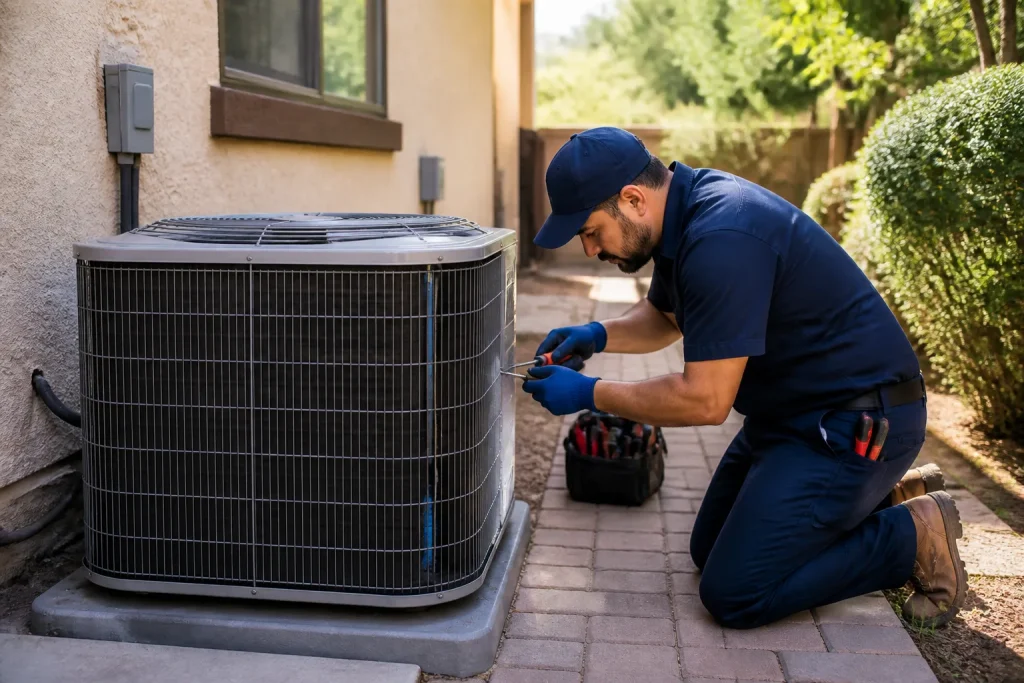
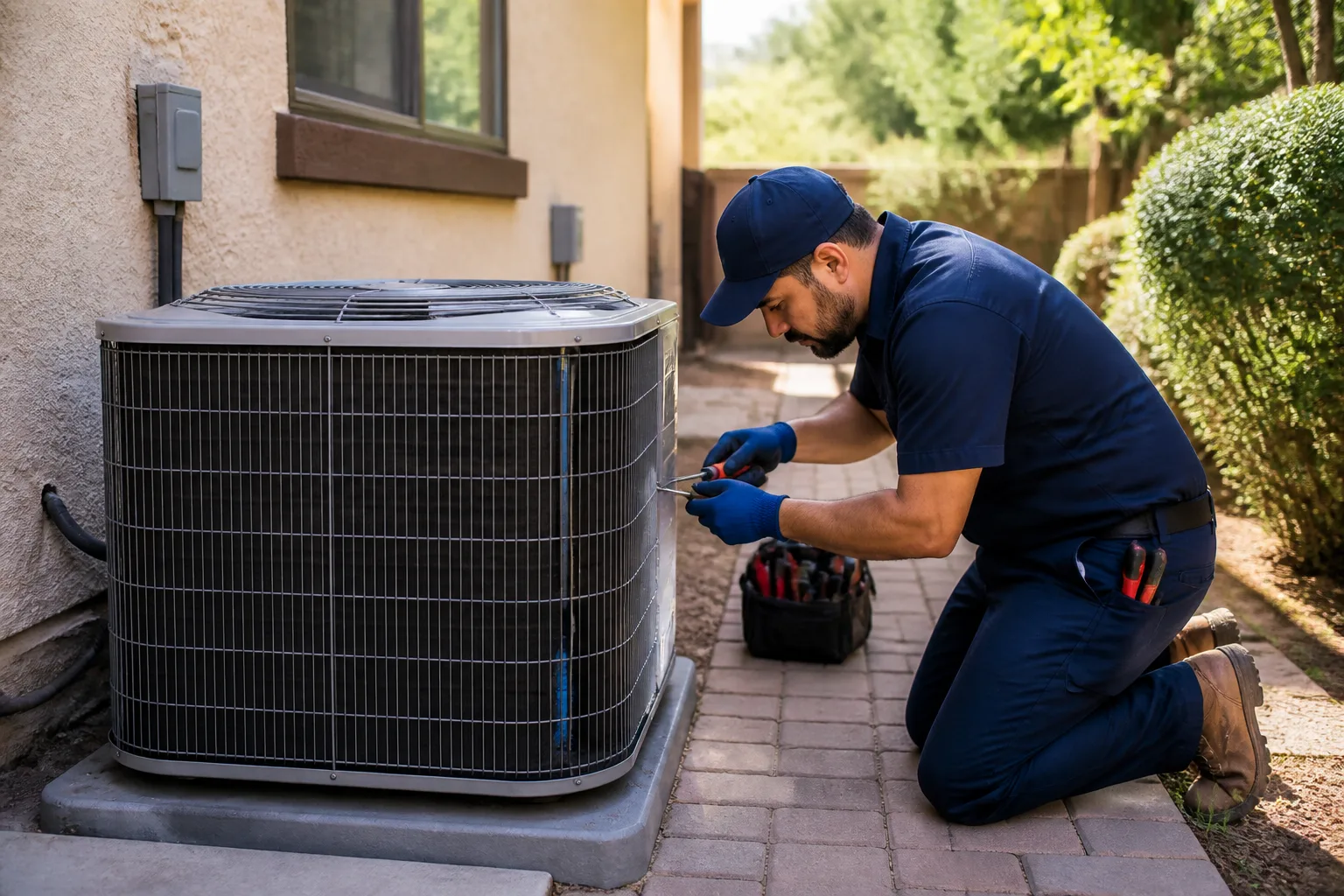
4. Clear the outdoor condenser. Walk outside to your condenser unit. Remove any visible debris: weeds growing into the coil fins, a tarp that blew against it, a cardboard box someone stored too close. The unit needs 18-24 inches of clear space on all sides to reject heat. During a 108°F day in Natomas, a blocked condenser will overheat and shut down in under an hour.
If all four check out and you’ve still got warm air or no airflow, you’ve got a real mechanical or refrigerant issue. Time to call.
How to Keep Your Home Livable While You Wait
Sacramento’s dry heat is more survivable than humid climates, but 105°F indoors is still dangerous for infants, elderly residents, and anyone with cardiac or respiratory conditions. Here’s how to buy 4–8 hours of manageable temperatures without AC.
- Isolate one room. Pick the smallest interior room, usually a bathroom or interior bedroom. Close doors, stuff towels under gaps, and hang blankets over windows. You’re creating a thermal bunker. Body heat and minimal solar gain will keep this space 10–15 degrees cooler than the rest of the house for several hours.
- Manage windows strategically. Close everything and cover south- and west-facing windows by 10 AM. Open east-facing windows briefly at dawn if outside temp is below 75°F, then seal them before solar gain starts. In Sacramento’s climate, once outside exceeds inside, every open window imports heat.
- Use evaporative cooling. Wet a sheet and hang it in front of a box fan, or place a shallow pan of ice water in front of airflow. This drops perceived temperature 5–10 degrees in dry conditions. It won’t match AC, but it prevents heat exhaustion.
- Know your cooling centers. Sacramento County opens designated cooling centers when temperatures exceed 105°F or heat health alerts are declared. The Central Library downtown, Arden-Dimlick Community Center, and several senior centers typically participate. Check cityofsacramento.org or call 311 for current locations. Don’t wait until you’re symptomatic.
We’ve had customers in Elk Grove and Citrus Heights ride out 6-hour waits using these methods. One family in Folsom kept their nursery at 82°F during a 111°F afternoon with nothing but a box fan, wet sheets, and a closed door.
The Dispatch Questions That Separate Real Availability from Marketing
When you call for emergency AC repair in Sacramento, most companies answer with some version of “we’ll get someone out today.” That phrase means nothing. Ask these specific questions:
- “Do you have a technician currently finishing a job within 15 miles of my address?” If they don’t know or won’t say, they don’t have real-time dispatch visibility. You’re talking to a call center or answering service.
- “What’s your current backlog for non-contract customers?” Many companies prioritize maintenance agreement holders. That’s fair business, but you need to know where you stand. If they hedge, assume you’re at the bottom.
- “Is the dispatch fee a flat rate or does it apply to repair costs?” The classic bait: $89 dispatch that “applies to repairs,” then a $400 diagnostic that doesn’t count as repair labor. Get clarity.
- “Can you text me the technician’s name, photo, and ETA?” Legitimate operations with actual techs en route can do this. Operations that are still scrambling to find a subcontractor cannot.
At Stonegate, Jason Trent answers these directly because he’s physically tracking jobs as Field Supervisor. When we say someone’s coming, someone is already in a truck.
Red Flags in Emergency HVAC Calls
Heat stress makes people vulnerable to pressure tactics. Watch for these specific warning signs:
- Verbal-only quotes over the phone. No reputable technician diagnoses your system without seeing it. Anyone quoting a repair price before arrival is either guessing or setting up a bait-and-switch.
- Pressure to approve replacement before diagnostic completion. We’ve recovered systems that other companies declared “unrepairable” because they wanted the equipment sale. A proper diagnostic takes 20–40 minutes and includes refrigerant pressures, amp draws, and temperature splits.
- Dispatch fees that “apply to repairs” but exclude diagnostics. Read the fine print. The fee applies to the repair labor, not the repair total, meaning you pay it regardless.
- Brand-restricted technicians. If you hear “we don’t work on that brand,” you’re talking to a limited shop. Sacramento homes run everything from legacy Bryant systems in Tahoe Park to newer American Standard and Carrier installs in Natomas. Our team is experienced across nine major brands, whatever’s in your home.
Related services in Sacramento: if your system is older and you’re weighing repair versus replacement, our heat pump and mini-split options include equipment that performs efficiently in Sacramento’s dry climate, often with utility rebate eligibility.
What to Have Ready Before the Tech Arrives
Every minute a technician spends asking basic questions is a minute you’re paying for. Have this information ready:
- System age and brand. Check the nameplate on your outdoor unit. If you have a Carrier, Trane, Lennox, Goodman, Rheem, York, Daikin, Bryant, or American Standard system, our technicians have factory or field experience on it.
- Maintenance history. When was the last filter change? Any previous repairs? Recent refrigerant additions?
- Symptom timeline. Did it quit suddenly or degrade over days? Any unusual noises before failure? Burning smell?
- Breaker location. If the tech needs to kill power for safety, show them immediately.
- Previous contractor invoices. If someone else worked on it, those notes prevent redundant diagnostics.
Last summer we serviced a home in Midtown where the homeowner had three years of maintenance records organized. The diagnostic took 12 minutes instead of 35. That difference showed up in their bill.
When to Call a Pro Immediately
Some situations skip the self-checks entirely. Call now if you smell burning from the indoor unit, see refrigerant oil pooling under the condenser, hear grinding or screeching from the compressor, or the system is blowing warm air while the outdoor unit is completely silent with a humming electrical noise. These indicate electrical failure, compressor seizure, or refrigerant loss that will worsen with continued operation attempts.
We’ve also seen homeowners in Sacramento’s older neighborhoods ignore ice formation on the refrigerant lines. That means low refrigerant or severe airflow restriction, and running the system in that state can slug liquid back to the compressor, destroying it.
The Bottom Line
Sacramento heat emergencies reward preparation and punish panic. Run your four self-checks first. If you need service, ask dispatchers specific questions about real technician availability. Keep your home manageable with room isolation and evaporative cooling while you wait. And have your system information ready to cut diagnostic time and cost.
Stonegate Heating & Air California has handled Sacramento emergencies for 16 years, nearly 500 reviews, with Jason Trent on-site as Field Supervisor. If you’re stuck now, call (855) 467-1888. We’ll tell you honestly whether we can get there today, and if we can’t, we’ll say so upfront.
Frequently Asked Questions
Most emergency AC repairs in Sacramento fall between $150 and $800 depending on the component failed. Capacitor and contactor replacements are at the lower end; compressor or refrigerant leaks run higher due to parts and labor intensity. We don’t quote exact prices until we’ve diagnosed your specific system. Call (855) 467-1888 for a free estimate on replacement scenarios, or schedule a diagnostic if you’re unsure.
No. Warm airflow usually means the compressor isn’t running or refrigerant is critically low. Continuing to operate the system can overheat the compressor or slug liquid refrigerant back to it, turning a $300 repair into a $2,500 replacement. Shut it off at the thermostat and check your breaker and filter while you wait for a technician.
Generally, if your system is over 12 years old and the repair exceeds 40% of replacement cost, replacement is the better long-term value. Sacramento’s heat load means older systems run harder and fail more frequently. That said, we’ve saved customers thousands by repairing a failed capacitor on a 14-year-old Trane that had two good seasons left. We don’t recommend replacement unless the numbers actually favor it. Call (855) 467-1888 and we’ll walk through both options.
During normal summer weather, same-day or next-day service is common. During regional heat emergencies, even companies advertising 24/7 service may have 2–5 day backlogs. The only way to know is asking specific questions about current technician location and backlog, as outlined above. At Stonegate, we tell you our real availability, not what we wish it were.
Written by Jason Trent, Owner / Field Supervisor at Stonegate Heating & Air California, serving Sacramento since 2010.
Need HVAC Help?
Call Stonegate Heating & Air California — licensed & insured, available 24/7 in California.
(855) 467-1888