
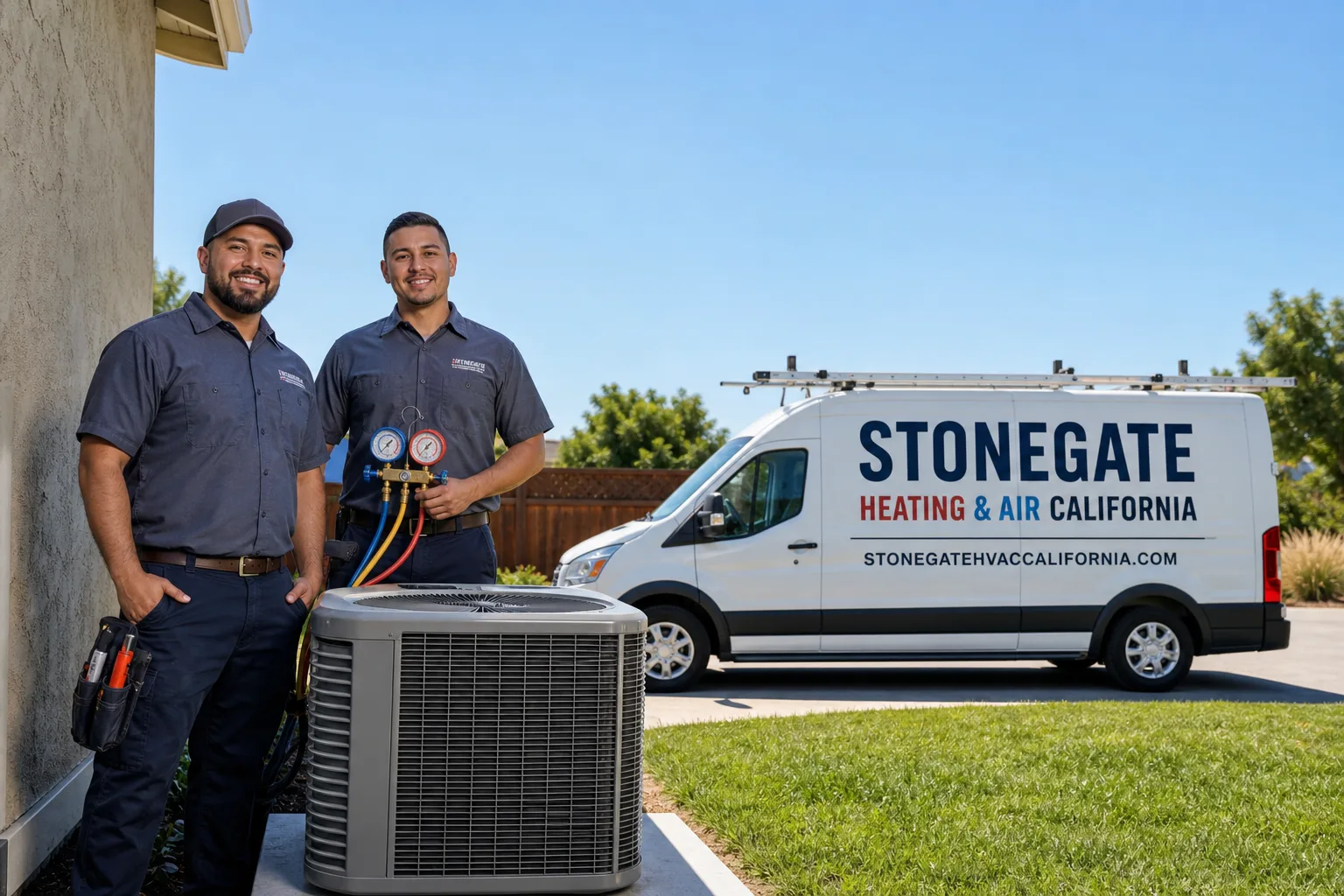
Fast, Reliable AC Repair & Installation Across Stanford
AC repair and installation in Stanford, CA typically runs $150–$650 for repairs and $3,500–$7,500 for full system installation, with most service calls completed same-day once permits are in hand. Our AC Repair & Installation team has worked Stanford’s unique dual-permitting environment for 16 years, and we know how to keep your project moving.
Stanford isn’t like neighboring Palo Alto or Los Altos Hills. Nearly every residential neighborhood here sits on university-owned land, and that changes how HVAC work gets done. Whether you’re in a 1960s ranch on Salvatierra Street, a faculty home along Gerona Road, or managing a building near the Main Quad, your AC project likely needs sign-off from Stanford’s Land Use Office before Santa Clara County will even look at a mechanical permit. We’ve navigated this system hundreds of times. Owner Jason Trent supervises every Stanford job personally, and our team understands the ARB compliance, quiet-operation requirements, and carbon-neutrality mandates that define this market. Call (855) 467-1888 for a free estimate.
Why Stonegate Heating & Air California Is Stanford’s Preferred AC Repair & Installation Company
Our reputation in Stanford was built one faculty household and campus facility at a time. Over 16 years, we’ve accumulated 499 verified reviews averaging 4.7 stars, and a significant portion of that volume comes from repeat calls within the 94305 zip code. Faculty members talk. Department administrators share vendor lists. We’ve earned our place on both.
Response time to Stanford matters, especially when summer temperatures in this Bay Area microclimate spike into the low 90s and an aging ranch home’s original cooling system finally gives out. We’re based in Sacramento with crews regularly dispatched down I-280 and Highway 101, and we prioritize Stanford calls because we know the permitting timeline is already working against the schedule. Jason Trent, our owner and active Field Supervisor, has personally handled compressor failures in campus-adjacent housing and coordinated with Stanford Facilities on research building cooling issues. That direct accountability is why customers here call us back.
Local knowledge isn’t optional in Stanford. It’s the difference between a three-day condenser swap and a three-week permit nightmare. We know which faculty neighborhoods fall under strict architectural review, which buildings tie into the Central Energy Facility district loops, and how to pre-coordinate with the Land Use Office so county permits aren’t held up. Outside contractors who don’t understand this hierarchy waste their customers’ time. We don’t.
Our AC Repair & Installation Services in Stanford
AC Repair in Stanford
Most Stanford AC repair calls we get involve capacitor failure, refrigerant leaks, or compressor issues in 20- to 40-year-old systems. The faculty housing stock here, built largely between the 1950s and 1970s, was often equipped with cooling barely adequate for the original design loads, let alone today’s warmer summers. When a capacitor blows on a 95°F afternoon in the Faculty Ghetto, we carry replacement parts for Carrier, Trane, Lennox, and Goodman systems on our trucks to avoid delays. Typical repair costs in Stanford run $150–$650 depending on whether we’re replacing a contactor or addressing a sealed-system leak.

AC Installation in Stanford
New AC installation in Stanford demands more than proper load calculation. It requires pre-approval of exterior equipment placement, panel color, and noise specifications through Stanford’s Land Use Office and often the neighborhood ARB. We recently replaced a failing Trane condenser at a ranch-style home on Salvatierra Street in the Faculty Ghetto. The homeowner’s HOA required an ARB-approved, low-profile condenser in a neutral tone to match the exterior. We coordinated with Stanford’s Land Use Office for the panel approval and county permits simultaneously, completing the swap in three days without any HOA violation. Standard installation pricing starts around $3,500 and ranges up to $7,500 for higher-capacity or multi-zone systems.

AC Replacement in Stanford
Replacement work in Stanford frequently uncovers complications: asbestos-containing duct insulation in mid-century ranches, electrical panels undersized for modern efficiency standards, or the discovery that the existing system was never properly permitted in the first place. We assess these conditions during our initial site visit and flag them before ordering equipment. In campus-proximate neighborhoods like the one bounded by Campus Drive and Sand Hill Road, we’ve replaced systems where the original installation predated current seismic bracing requirements. Our replacement quotes include all anticipated permit and compliance costs, so there are no mid-project surprises.

Refrigerant Recharge & Compressor Repair in Stanford
Refrigerant leaks in Stanford’s older housing stock often trace to corroded copper linesets buried in concrete slabs or running through inaccessible crawlspaces. We use electronic leak detection and nitrogen pressure testing to pinpoint the source before adding refrigerant. Compressor repair or replacement represents the upper end of our repair range, sometimes approaching full replacement cost on systems over 15 years old. For campus buildings connected to Stanford’s Central Energy Facility, we coordinate with Facilities to isolate the affected zone and verify loop compatibility before any work begins.

What happens when you call
- 1
A real person answersNo phone trees — you reach a local pro.
- 2
You get an upfront price rangeHonest numbers before anyone is dispatched.
- 3
A background-checked tech heads outLicensed & insured, dispatched right away.
- 4
You approve before work beginsNothing starts until you say go.
Trusted Brands We Service in Stanford
We maintain factory-trained experience on nine major HVAC brands: Carrier, Trane, Lennox, Goodman, Rheem, York, Daikin, Bryant, and American Standard. For Stanford customers, this means whatever system is currently installed, we likely have direct experience with its failure modes and parts availability. We stock common capacitors, contactors, and refrigerant for Carrier, Trane, and Lennox systems on our service vehicles, which matters when you’re trying to restore cooling before a Land Use Office inspection or faculty move-in date. Our parts relationships let us source less common Goodman and Rheem components within 24 hours when needed. Nine brands, one team. No dead ends.
Common AC Repair & Installation Problems We See in Stanford Homes
- Short-cycling from oversized replacement units. Stanford’s sharp diurnal temperature swing, 25–35°F between day and night, means improperly sized cooling equipment cycles on and off excessively, wasting energy and failing to dehumidify. We see this most in 1960s ranches where a previous installer matched the old unit’s capacity without updating the load calculation for current conditions.
- ARB violations from unapproved condenser installations. Installing a condenser without prior ARB panel color approval triggers a violation notice and forced re-paint or replacement. We pre-submit color samples and equipment cut sheets to avoid this entirely.
- Failed dual-permitting coordination. Failing to obtain Stanford Land Use Office sign-off before pulling the county permit results in weeks of delays and frustrated homeowners. We file Land Use applications first, then coordinate county permitting to run parallel rather than sequential.
- Misdiagnosed district-loop vs. standalone systems. Using standard rooftop equipment on historic campus buildings that require connection to Stanford’s Central Energy Facility district loops instead of standalone systems creates compatibility failures we then have to untangle. We verify the building’s mechanical infrastructure before quoting any campus-adjacent work.
Pricing for AC Repair & Installation in Stanford, CA
Here’s what typical AC work costs in the Stanford market. These ranges reflect our actual project history across faculty housing, campus-adjacent properties, and commercial buildings in the 94305 area.
| Service | Price Range in Stanford |
|---|---|
| AC Repair | $150–$650 |
| AC Installation | $3,500–$7,500 |
| Tune-Up / Maintenance | $80–$200 |
What moves a project toward the higher end: dual-permitting complexity requiring Land Use Office pre-approval, ARB-compliant equipment upgrades, asbestos abatement in older ductwork, or electrical service upgrades to accommodate modern efficiency standards. What keeps costs down: straightforward like-for-like replacement in post-1990 housing with existing adequate electrical and no compliance complications. Every estimate we provide is free and itemized. Call (855) 467-1888 to schedule.
We Also Serve Cities Near Stanford
Our service radius extends throughout the Peninsula and South Bay. We regularly complete AC repair and installation work in Palo Alto to the north, Atherton to the northwest, East Palo Alto to the northeast, and Los Altos Hills to the south. Each city has its own permitting environment and housing characteristics, and we adjust our approach accordingly. For Stanford customers, that means your contractor understands how your specific municipal context differs from even your closest neighbors.
Serving Stanford, CA — Our Local Coverage Area
We’re based in the Stanford area and know this community well. Use the map below to see our service coverage — if you’re nearby, we can almost certainly help.
FAQs — AC Repair & Installation in Stanford
Yes. Stanford’s Land Use Office must approve any exterior equipment placement or duct penetration before Santa Clara County will issue a mechanical permit. We handle this pre-coordination as standard practice on every Stanford faculty housing job, filing Land Use applications before ordering equipment to prevent the multi-week delays that catch outside contractors off guard. Call (855) 467-1888 and we’ll walk you through the specific requirements for your neighborhood.
Yes, but the exterior condensing unit and line set routing require the same Land Use Office and ARB approvals as conventional split systems. Mini-splits are increasingly popular in Stanford’s smaller faculty cottages and garage conversions where ductwork doesn’t exist, and their quiet operation often satisfies campus noise ordinances more easily than traditional equipment. We specify low-profile, neutral-toned condensers and concealed line covers to streamline ARB approval.
Then your building likely uses chilled water or hot water from the district plant rather than a standalone refrigerant-based system, and any cooling issue requires coordination with Stanford Facilities, not just a standard HVAC contractor. We’ve worked with Facilities on these systems and understand the isolation procedures, loop compatibility checks, and scheduling constraints involved. Call (855) 467-1888 to discuss whether your building falls under this infrastructure.
Land Use Office review typically takes 5–10 business days for standard residential equipment replacement, with ARB review adding another 3–7 days if your neighborhood requires it. County permitting runs 3–5 business days once Land Use approval is documented. We file both applications in parallel where possible, and our established relationships with both offices help prevent the procedural missteps that extend timelines. Total coordination time from contract to permit-in-hand: typically two to three weeks for complex cases, under one week for straightforward replacements where we have pre-approved equipment specifications.
Yes. We regularly specify variable-speed and inverter-driven condensers with sound ratings below 60 decibels for Stanford installations, particularly in the densely clustered faculty housing near the Main Quad and along Lomita Drive. These units cost marginally more upfront but satisfy ARB noise requirements and avoid neighbor complaints that can trigger compliance reviews. We’ll discuss specific decibel targets and equipment options during your free estimate.
Written by Jason Trent, Owner and Field Supervisor at Stonegate Heating & Air California, serving Stanford and the greater Sacramento-to-Peninsula corridor since 2008.