
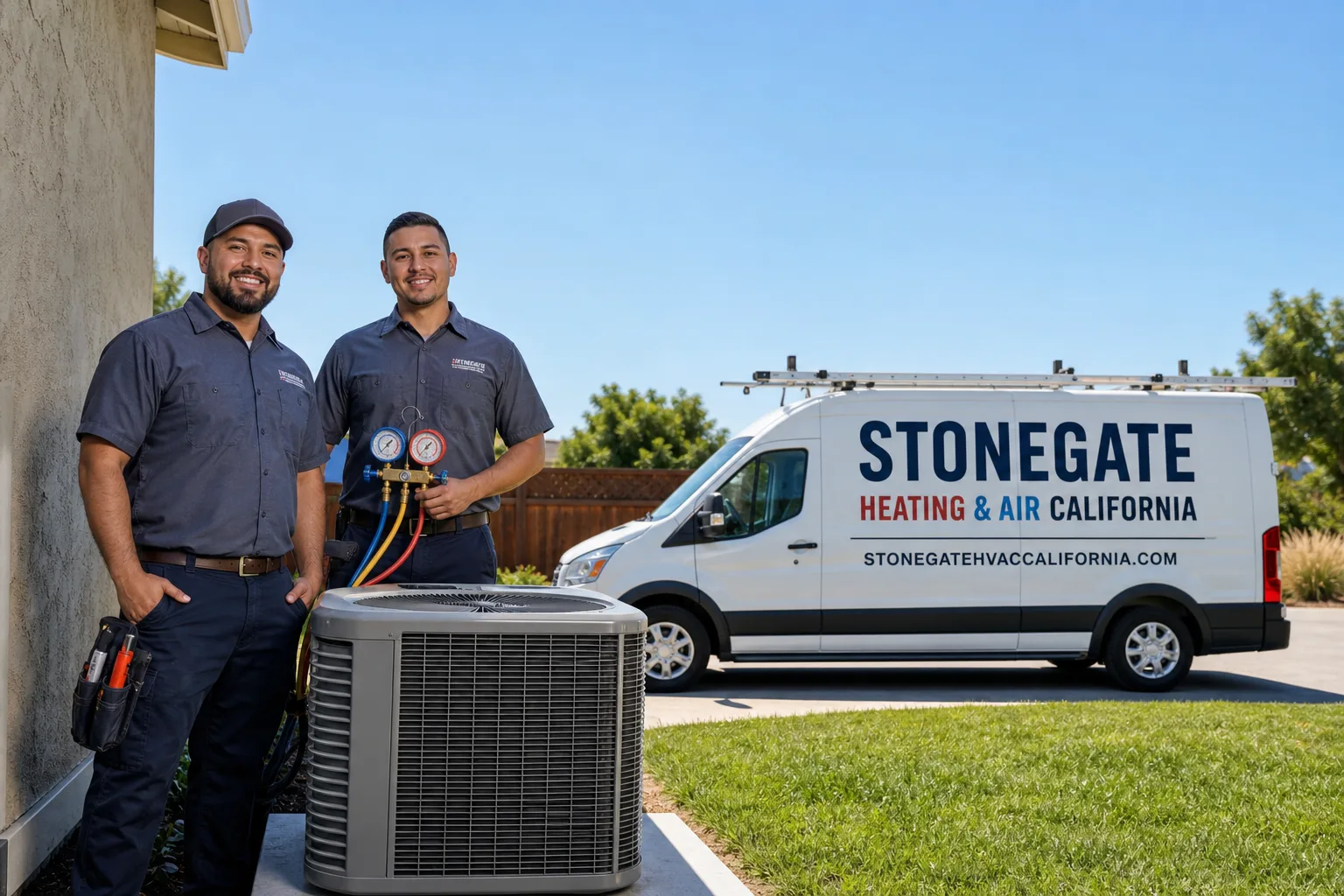
Fast, Reliable Heating & Furnace Across Auburn
Heating and furnace repair in Auburn, CA typically runs $150–$700, with most calls completed same-day by our Heating & Furnace team. We’re based in Sacramento and make the 35-mile run up Interstate 80 to Auburn regularly — usually arriving within the hour for emergency no-heat calls, especially through the 95602 and 95603 ZIP codes. Jason Trent, our owner and Field Supervisor, has spent 16 years working California’s HVAC extremes, and Auburn’s foothill climate presents a specific challenge he knows well: true freeze-thaw demand that flatland Sacramento shops often underestimate.
Why Stonegate Heating & Air California Is Auburn’s Preferred Heating & Furnace Company
We’ve earned 499 verified reviews at a 4.7-star average across platforms, and a significant share comes from Auburn homeowners who found us after frustrating experiences with Valley contractors who didn’t understand propane systems or hillside access. Jason Trent supervises every project personally — he’s not a back-office owner, he’s on-site checking heat exchanger integrity and combustion analysis numbers.
Our response time to Auburn averages under an hour for heating emergencies during winter cold snaps, because we keep parts inventory stocked for the Carrier, Bryant, and American Standard units common in Auburn’s 1980s–2000s hillside builds. We also maintain propane conversion fittings and dual-fuel control boards that most Sacramento shops don’t carry — a direct result of serving Auburn’s 95602 propane belt for years.
The elevation difference matters. At 1,255 feet, Auburn’s winter nights routinely hit the mid-20s°F, and we’ve seen enough frozen condensate drains and cracked heat exchangers to know that equipment sized for Sacramento’s milder lows won’t cut it here. Our technicians don’t guess at temperature differentials — we calculate them.
Our Heating & Furnace Services in Auburn
Furnace Repair
Furnace repair in Auburn demands brand fluency and fuel-type flexibility that generic shops lack. We service all nine major brands — Carrier, Trane, Lennox, Goodman, Rheem, York, Daikin, Bryant, and American Standard — and we carry ignition modules, gas valves, and flame sensors for both natural gas and propane configurations. A typical repair in Auburn runs $150–$700 depending on part availability and access difficulty. Hillside homes on Bell Road or Dry Creek Road often require crawling 40-foot runs of cramped crawlspace; we quote that labor upfront, not as a surprise add-on.

Furnace Replacement
Replacement is where Auburn’s housing stock gets complicated. Victorian-era homes in Old Town lack original ductwork entirely. Mid-century ranches along Highway 49 have undersized returns. And the 1980s–2000s builds on the hillsides may have propane furnaces with rusted heat exchangers that haven’t been manufactured in 15 years. We size every replacement using Manual J load calculations that honor both Auburn’s 100°F summer peaks and its sub-freezing winter lows — dual-demand sizing that prevents the short-cycling and uneven heating we see from improperly specified equipment. Propane-to-heat-pump dual-fuel systems are increasingly common in 95602, and we’ve installed dozens.

Furnace Tune-Up
A furnace tune-up in Auburn costs $80–$200 and should happen every fall before the first serious freeze. Our tune-ups include combustion analysis, heat exchanger inspection with borescope, propane pressure verification where applicable, and MERV-13 filter assessment. Given Auburn’s wildfire smoke exposure from Tahoe National Forest fires, filter loading happens faster here than in Lincoln or Loomis. We check blower amp draw and capacitor tolerance because clogged filters stress motors into premature failure — a pattern we’ve documented across multiple Auburn smoke seasons.

Heat Exchanger Inspection & Replacement
Heat exchanger cracks are a safety-critical failure mode, especially in Auburn’s older propane furnaces where corrosion from combustion byproducts accelerates metal fatigue. We use combustion analyzers and visual borescope inspection — never guesswork. In a 1960s ranch home on Dry Creek Road, we found a cracked exchanger in an original propane furnace that had been red-tagged by another company. The steep hillside crawlspace and lack of natural gas infrastructure made replacement complex. Jason Trent specified a dual-fuel Carrier system: heat pump for moderate days, propane backup for sub-freezing nights. That’s standard thinking in Auburn’s 95602 propane belt, but foreign to most Sacramento Valley contractors.

What happens when you call
- 1
A real person answersNo phone trees — you reach a local pro.
- 2
You get an upfront price rangeHonest numbers before anyone is dispatched.
- 3
A background-checked tech heads outLicensed & insured, dispatched right away.
- 4
You approve before work beginsNothing starts until you say go.
Trusted Brands We Service in Auburn
We maintain active certification and parts access for nine leading HVAC brands: Carrier, Trane, Lennox, Goodman, Rheem, York, Daikin, Bryant, and American Standard. For Auburn customers, this means no “we don’t service that brand” dead ends. We stock common ignition components, control boards, and gas valves for Carrier and Bryant systems locally — the brands we see most often in Auburn’s hillside subdivisions. American Standard and Daikin heat pump components ride in our Sacramento inventory for next-day delivery to 95602 and 95603 when needed. Fast turnaround matters when your propane furnace quits on a 28°F night.
Common Heating & Furnace Problems We See in Auburn Homes
- Propane furnace short-cycling in 95602. Many homes in the 95602 ZIP code run propane with older single-stage furnaces. When the heat exchanger develops corrosion-induced cracks, the high-limit switch trips repeatedly, causing short cycles that never reach thermostat setpoint. We test with combustion analyzers and replace with properly sized dual-fuel systems where the infrastructure supports it.
- Inadequate airflow in Old Town Victorians. Pre-1900 homes near the historic district were never built with forced-air ductwork. Retrofitted systems often lack return air pathways, creating pressure imbalances that cause freeze-ups during cold snaps. We design duct modifications or specify ductless mini-split alternatives that respect the building envelope.
- Blower motor burnout after wildfire season. Standard 1-inch filters load with particulate matter within days during smoke events. The restricted airflow overworks blower motors until they fail. We’ve replaced dozens of motors in Auburn that would have survived with MERV-13 media filter upgrades installed before smoke season.
- Frozen condensate drains on Bell Road hillsides. North-facing exposures and 1,255-foot elevation mean overnight lows drop hard. Condensate drains from high-efficiency furnaces freeze solid, triggering pressure switches and shutdowns. We install trace heat and proper drain slope as standard practice on hillside replacements — not optional upsells.
Pricing for Heating & Furnace in Auburn, CA
| Service | Typical Range in Auburn |
|---|---|
| Furnace Repair | $150–$700 |
| Furnace Tune-Up | $80–$200 |
What moves a repair toward the higher end? Propane system diagnostics take longer than natural gas. Hillside crawlspace access on steep lots along Dry Creek Road or Bell Road adds labor hours. And obsolete heat exchangers in 1980s propane furnaces often can’t be sourced, forcing full replacement. We diagnose before we quote, and every estimate is free. Call (855) 467-1888 for exact pricing on your system — no obligation, no pressure.
We Also Serve Cities Near Auburn
Our Heating & Furnace crews run regular routes to North Auburn, Loomis, Lincoln, and Alta Sierra. The same owner-supervised service, same propane expertise, same 4.7-star accountability. If you’re in Placer County and your heating system is letting you down, we’re already nearby.
Serving Auburn, CA — Our Local Coverage Area
We’re based in the Auburn area and know this community well. Use the map below to see our service coverage — if you’re nearby, we can almost certainly help.
FAQs — Heating & Furnace in Auburn
It’s usually the unit, not the gas supply. Short-cycling in 95602’s propane furnaces most often traces to a cracked or corroded heat exchanger triggering the high-limit switch, or a failing flame sensor that can’t maintain proof of ignition. We verify gas pressure at the manifold first — propane runs at a different pressure setpoint than natural gas — then inspect the exchanger with a borescope. If the exchanger is compromised, replacement is the only safe path. Call (855) 467-1888 and we’ll diagnose it properly.
Yes, with a dual-fuel system. Auburn’s mid-20s°F lows exceed the balance point of standalone heat pumps sized for our summer cooling loads. We specify Carrier and Bryant dual-fuel systems that switch to propane backup when outdoor temperatures drop below the heat pump’s efficient operating range — typically around 35°F. This preserves efficiency for 80% of the heating season while guaranteeing capacity on the coldest nights. Jason Trent has supervised dozens of these installs in 95602 and 95603.
Auburn’s position downwind of Tahoe National Forest fire activity means smoke particulate loads are heavier here than in Roseville or Lincoln. Standard 1-inch fiberglass filters capture almost none of it; pleated MERV-8 filters load within a week; only MERV-13 media or thicker 4–5 inch filters handle repeated smoke events without restricting airflow to failure. We assess your blower’s static pressure tolerance and specify filter upgrades that won’t burn out the motor. The upgrade pays for itself in avoided service calls.
We can, but duct retrofits in pre-1900 Victorians are often more disruptive than homeowners expect. Cramped basements, plaster walls, and irregular framing make full duct systems impractical. We more commonly specify ductless mini-split heat pumps with propane backup, or high-velocity small-duct systems that fit within existing cavities. Jason Trent evaluates each Old Town home individually for the least invasive solution that meets heating load. Call (855) 467-1888 for a free assessment.
We use a three-step protocol: visual borescope inspection through the burner compartment, combustion analysis comparing O2 and CO levels against manufacturer specs, and a smoke-pencil test for flue gas leakage into the supply airstream. Older furnaces on Bell Road’s hillsides often show corrosion patterns from decades of propane combustion in crawlspaces with limited ventilation. If we find cracks, we show you the borescope footage and explain replacement options — no scare tactics, just the data. Estimates are free at (855) 467-1888.
Written by Jason Trent, Owner and Field Supervisor at Stonegate Heating & Air California, serving Auburn and the Sierra foothills since 2008.