
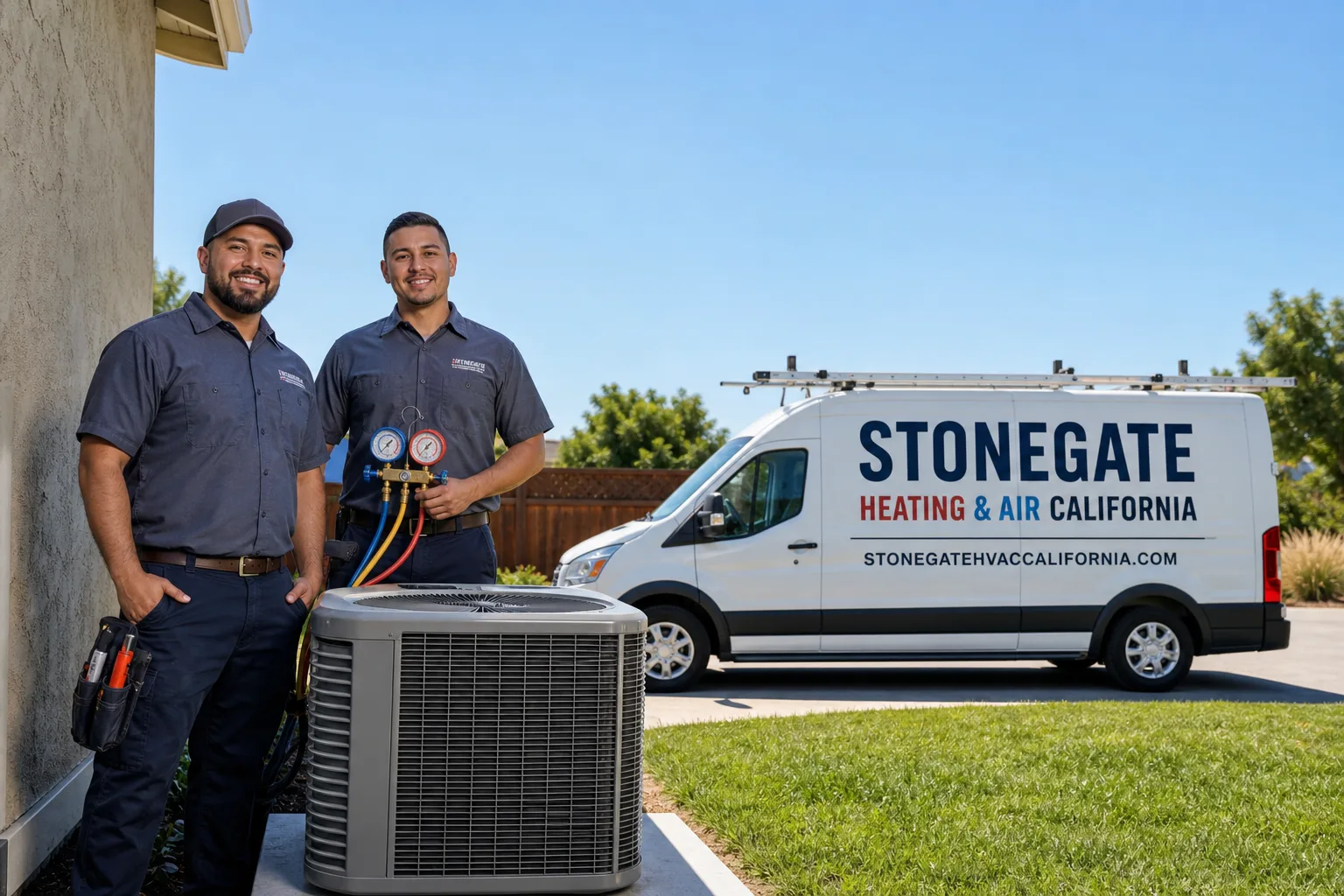
Fast, Reliable Heat Pump & Mini Split Across Woodland Hills
Heat pump and mini split repair in Woodland Hills typically runs $150–$650, with most service calls completed same-day. Installation of a new heat pump system in this market ranges from $3,500–$7,500 depending on capacity, electrical upgrades, and whether your home needs attic duct sealing to handle the valley’s extreme heat loads. Call (855) 467-1888 for a free estimate.
We’ve been sending our Heat Pump & Mini Split team to Woodland Hills for years. Jason Trent, our owner and Field Supervisor, knows the western San Fernando Valley’s unique punishment of HVAC equipment: salt-laden marine air from the Pacific accelerates corrosion on outdoor components, while the Santa Monica Mountains trap inland heat that pushes systems past their design limits. That combination — coastal corrosion plus valley furnace conditions — is not what you’ll find in Reseda or Northridge. It’s why we stock corrosion-resistant hardware and carry factory-spec coil coatings on every truck serving the 91364, 91365, 91367, and 91371 ZIP codes.
Why Stonegate Heating & Air California Is Woodland Hills’s Preferred Heat Pump & Mini Split Company
Sixteen years in business, nearly 500 reviews at a 4.7-star average — that volume matters because it means we’ve solved real problems in real homes, not cherry-picked a handful of easy jobs. Woodland Hills customers specifically mention our response to the area’s dual climate threat: technicians who don’t just charge a system and leave, but inspect contactors for salt corrosion and verify attic duct integrity before declaring a job done.
Jason Trent supervises every project personally. He’s not managing from a Sacramento office; he’s the Field Supervisor who reviews load calculations for hillside homes south of Ventura Boulevard and checks that valley-floor ranch jobs get proper coil protection. When you call (855) 467-1888, you’re getting owner-accountable service, not a rotating cast of subcontractors.
Our multi-brand fluency eliminates the “we don’t service that” dead end. Whatever brand you have — Carrier, Trane, Lennox, Goodman, Rheem, York, Daikin, Bryant, or American Standard — our technicians carry the diagnostic software and common failure-pattern knowledge to fix it without ordering parts from three counties away.
Our Heat Pump & Mini Split Services in Woodland Hills
Heat Pump Repair
Woodland Hills heat pumps fail differently than inland systems. The salt-air corridor affects outdoor unit electrical connections first, with contactor corrosion causing intermittent compressor cycling that inexperienced techs misdiagnose as low refrigerant or a bad capacitor. We see this pattern constantly on older Carrier and Rheem models in valley-floor homes within eight miles of the ocean. Our repair protocol includes voltage-drop testing across the contactor, fin integrity inspection, and application of protective coating where factory finish has degraded. Heat pump repair in Woodland Hills runs $150–$650.

Heat Pump Installation
New heat pump installation in Woodland Hills demands oversizing discipline and corrosion-proofing from day one. Title 24 load calculations calibrated for coastal LA zones chronically undersize equipment here because they don’t account for the 105–110°F peaks that stall 10–15 miles west of the marine layer. We perform Manual J calculations with local design temperatures, then specify coated coils, stainless hardware, and proper elevation to minimize salt spray accumulation. From a single-zone replacement to a full multi-zone layout in a custom hillside home, heat pump installation in Woodland Hills ranges from $3,500–$7,500.

Mini Split Install
Ductless mini split installation solves the attic-duct problem that plagues 1960s–70s ranch homes throughout Woodland Hills. When flex duct runs through 150–160°F attic voids lose 30% or more of cooling capacity to conduction, a wall-mounted mini split bypasses that thermal furnace entirely. We size these systems for the actual sensible load, not the theoretical load from a ducted design, and we route line sets to minimize wall penetrations where salt air concentrates corrosion. Multi-zone systems let you condition additions, converted garages, or master suites without tying into compromised existing ductwork.

Mini Split Repair
Mini split repair in Woodland Hills often traces to flare fitting corrosion at the wall penetration point, where salt-laden air settles and attacks the copper-to-aluminum junction. This produces refrigerant micro-leaks that standard electronic leak detectors miss because the loss rate is too gradual. Our protocol: nitrogen pressure test to isolate the circuit, re-flare with stainless steel nuts and proper torque, then verify with a standing pressure test overnight. Mini split repair in Woodland Hills runs $150–$650.

Multi-Zone System Service
Multi-zone ductless systems are increasingly popular in Woodland Hills’s 1980s–2000s custom homes south of Ventura Boulevard, where complex floor plans and steeper roof pitches create uneven load distribution. We service and install Daikin, Bryant, and American Standard multi-zone platforms, configuring individual head capacities to match each zone’s actual heat gain rather than applying equal tonnage by room count. This prevents the short-cycling and humidity control failures that come from oversized heads in smaller zones.

What happens when you call
- 1
A real person answersNo phone trees — you reach a local pro.
- 2
You get an upfront price rangeHonest numbers before anyone is dispatched.
- 3
A background-checked tech heads outLicensed & insured, dispatched right away.
- 4
You approve before work beginsNothing starts until you say go.
Trusted Brands We Service in Woodland Hills
We maintain factory-trained or field-proven expertise across nine brands: Carrier, Trane, Lennox, Goodman, Rheem, York, Daikin, Bryant, and American Standard. For Woodland Hills customers, this means no referral to a “specialist” who might take a week to show up. We stock contactors, capacitors, defrost boards, and flare hardware for the brands most common in this market — particularly Daikin mini splits and Carrier/Bryant heat pumps, which have strong penetration in the western Valley. Fast turnaround matters when your system is cycling on and off at 108°F or your mini split is blowing lukewarm air through a corroded flare joint.
Common Heat Pump & Mini Split Problems We See in Woodland Hills Homes
- Contactor failure from salt-air corrosion. Outdoor unit contactors in valley-floor Woodland Hills homes corrode faster than inland equivalents, causing the compressor to start intermittently or not at all. The symptom looks like a bad capacitor, but the root cause is environmental — and replacing the capacitor without addressing contactor corrosion guarantees a callback.
- Attic duct conduction losses in ranch homes. In the 1960s–70s tract homes near Fallbrook Avenue and Ventura Boulevard, flex duct through unconditioned attics loses so much cooling capacity that the system runs continuously without reaching setpoint. Homeowners blame the heat pump; the real fix is sealing and insulating duct runs, or bypassing them with ductless heads.
- Defrost board failure during peak heat events. Heat pump defrost boards fail prematurely in Woodland Hills when attic-mounted air handlers draw excessive current during 105°F+ afternoons, sagging voltage stresses control board capacitors. This is a voltage quality issue, not a board quality issue — but the board still needs replacement, and the electrical supply still needs verification.
- Mini split flare corrosion at wall penetrations. Salt-laden air concentrates at the exterior wall penetration where the line set exits, corroding flare fittings and producing micro-leaks that gradually reduce cooling capacity. Standard pressure tests often miss these until refrigerant charge drops enough to trigger low-pressure lockout.
Pricing for Heat Pump & Mini Split in Woodland Hills, CA
| Service | Price Range in Woodland Hills |
|---|---|
| Heat Pump Repair | $150–$650 |
| Mini Split Repair | $150–$650 |
| Heat Pump Installation | $3,500–$7,500 |
These ranges reflect actual Woodland Hills market conditions. The high end of repair typically involves compressor electrical diagnostics, coil coating application, or extensive flare re-work on multi-head mini splits. Installation at the upper range covers larger homes, electrical service upgrades, or attic duct remediation to address the heat-load realities of this specific microclimate. We don’t quote by phone without seeing the job — but we don’t charge to look, either. Call (855) 467-1888 for a free, on-site estimate with exact numbers.
We Also Serve Cities Near Woodland Hills
Our service radius covers the full western San Fernando Valley and adjacent communities. We regularly send our Heat Pump & Mini Split crews to Canoga Park for commercial multi-zone installs, Calabasas for hillside custom-home heat pump sizing, West Hills for ranch-home ductless conversions, and Las Flores for system upgrades in newer construction. Same owner supervision, same brand coverage, same corrosion-aware diagnostic protocol — wherever you are in the western Valley.
Serving Woodland Hills, CA — Our Local Coverage Area
We’re based in the Woodland Hills area and know this community well. Use the map below to see our service coverage — if you’re nearby, we can almost certainly help.
FAQs — Heat Pump & Mini Split in Woodland Hills
Yes. Woodland Hills’s position within the coastal salt-air corridor accelerates corrosion of outdoor coil fins, contactors, and electrical connections compared to inland Valley cities like Reseda or Northridge. We address this with factory-spec coil coatings, stainless hardware upgrades, and contactor inspections as standard protocol on every service call — not as upsells, but as necessary adaptations to local conditions. Call (855) 467-1888 to schedule a corrosion assessment.
In Woodland Hills, the most common cause is flare fitting corrosion at the wall penetration, producing a micro-leak that only becomes symptomatic when the system runs at maximum capacity for extended periods. The charge reads normal at rest but drops under sustained load. We nitrogen-test the full circuit, re-flare with stainless hardware, and verify with overnight pressure testing. Call (855) 467-1888 if your mini split fades on the hottest afternoons.
Sacrifice anodes in heat pump water heaters typically need inspection every 2–3 years in Woodland Hills due to elevated chloride content in the coastal air, compared to 3–5 years inland. We check anode condition during annual HVAC maintenance visits and replace when depletion exceeds 50% — before tank corrosion begins. Call (855) 467-1888 to add water heater anode inspection to your next service.
Yes, especially if your home has original flex duct through unconditioned attic space. A multi-zone mini split eliminates duct conduction losses that can waste 30% or more of cooling capacity in 150°F+ attic voids, and it lets you condition specific zones — master suite, converted garage, rear addition — without tying into compromised existing ductwork. We size each head to actual room load, not theoretical square footage. Call (855) 467-1888 for a free multi-zone design consultation.
A dual-fuel setup — heat pump for mild heating and cooling, gas furnace for extreme cold — is practical in Woodland Hills if your furnace is relatively new and your electrical panel can handle the heat pump load. Given the valley’s extreme cooling demands and moderate heating needs, many homeowners find a properly sized heat pump handles the full load, especially with attic duct remediation. We evaluate your specific furnace age, duct condition, and electrical capacity before recommending either full replacement or dual-fuel retention. Call (855) 467-1888 for an honest assessment.
In a 1960s ranch home near the corner of Ventura Boulevard and Fallbrook Avenue, our tech diagnosed a Daikin heat pump that was short-cycling due to a corroded contactor and salt-caked condenser coils. We replaced the contactor, installed a factory-spec coil coating, and upsized the condensate line to prevent coastal debris buildup — restoring full 14-SEER performance through a 108°F September afternoon.
Woodland Hills sits in a geographic heat trap at the base of the Santa Monica Mountains in the western San Fernando Valley — the NWS cooperative station here recorded 121°F on September 6, 2020, an all-time record for the Western United States. HVAC systems must be sized and maintained for peak cooling loads that far exceed what neighboring Valley communities like Calabasas or Reseda experience, making proper load calculation and attic duct performance the defining challenge of every installation here — not just comfort, but survivability during heat emergencies. The coastal proximity adds a second threat: salt-laden air accelerates corrosion of outdoor coil fins and electrical connections, meaning condenser failures here often stem from rusted contactors and compromised fin integrity, a problem far less common in inland Valley cities. These dual pressures — extreme heat and salt corrosion — demand strategies that generic HVAC guides simply don’t address.
The majority of residential Woodland Hills is 1950s–1970s ranch-style and split-level tract homes, many with original or first-replacement ductwork routed through unconditioned attic spaces never engineered for sustained 150°F+ ambient temperatures. In these homes, flex ductwork loses so much cooling capacity to conduction that homeowners experience inadequate cooling even with a fully charged, mechanically sound system — a pattern that sends inexperienced technicians chasing phantom refrigerant leaks when the real fix is sealing and insulating the duct runs before they pass through that thermal furnace overhead. The hillside areas south of Ventura Boulevard have a higher concentration of 1980s–2000s custom homes with more complex multi-zone layouts and steeper roof pitches that create even hotter attic voids, making ductless or properly engineered zoned systems essential rather than optional.
Written by Jason Trent, Owner and Field Supervisor at Stonegate Heating & Air California, serving Woodland Hills and the western San Fernando Valley since 2008.