
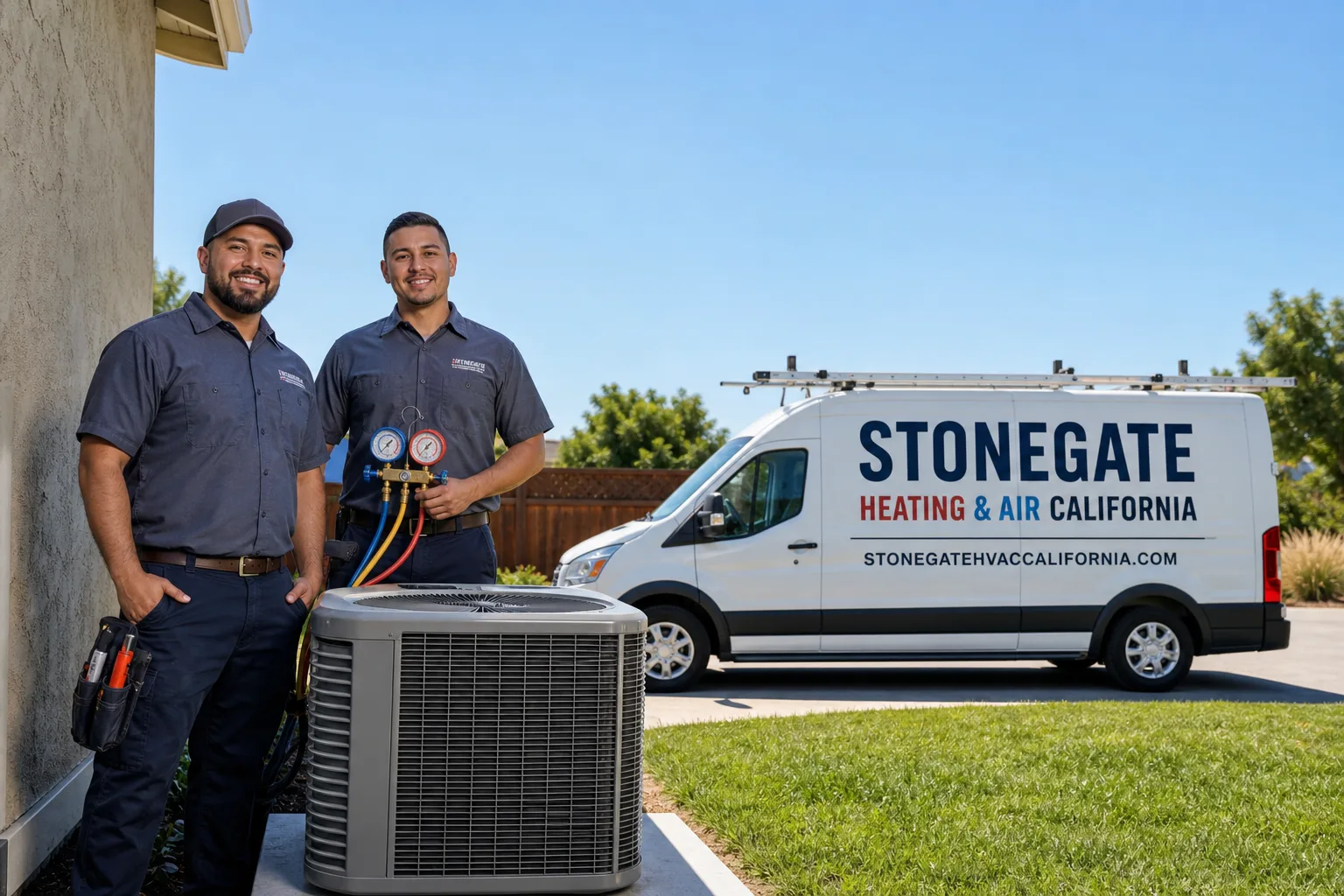
Fast, Reliable Emergency & Commercial HVAC Across Temecula
When your AC quits on a 105°F July afternoon in Temecula or your commercial rooftop unit throws a high-pressure alarm, you need a contractor who knows this valley’s specific failure patterns, not a dispatcher reading from a script. Stonegate Heating & Air California keeps emergency crews ready for Temecula’s inland climate, where builder-grade systems from the 1990s boom hit their limits hard and fast. Call (855) 467-1888 — Jason Trent supervises every emergency and commercial project personally, and we’ve spent 16 years learning exactly how Temecula’s heat, wind, and housing stock break HVAC equipment.
Why Stonegate Heating & Air California Is Temecula’s Preferred Emergency & Commercial HVAC Company
We’ve built our reputation on showing up with the right parts and the right experience. Nearly 500 verified reviews at 4.7 stars back that up — not cherry-picked testimonials, but a volume that comes from doing the work correctly across hundreds of real jobs. In Temecula specifically, that means recognizing the difference between a Paloma del Sol dual-zone damper failure and a Wolf Creek condenser pad shifted by Gap winds. Owner Jason Trent holds the title of Field Supervisor, not just Owner. He’s on job sites, not in a back office. That accountability matters when you’re staring at a 90°F indoor temperature and a system that was already marginal when it was installed in 1998.
Our Emergency & Commercial HVAC team carries factory-level familiarity with nine major brands — Carrier, Trane, Lennox, Goodman, Rheem, York, Daikin, Bryant, and American Standard. Whatever equipment is on your roof or in your attic, we’ve worked on it. No “we don’t service that brand” dead ends. No waiting for a specialist from another county.
Our Emergency & Commercial HVAC Services in Temecula
24/7 Emergency HVAC
Temecula’s inland valley floor sits 1,000–1,500 feet above sea level, and summer highs regularly punch past 105°F while winter nights drop near freezing. That wide swing means both heating and cooling emergencies are real, year-round. We take calls for compressor burnouts, refrigerant leaks, failed capacitors, and dead blowers — the failures that spike when a heatwave hits and 25-year-old systems across Redhawk, Harveston, and Wolf Creek fail simultaneously. Our emergency response targets Temecula’s ZIP codes — 92590, 92591, 92592, 92593 — with stocked trucks carrying the actuators, contactors, and capacitors that fail most often here.

Commercial HVAC
Small-to-midsize commercial properties in Temecula face a specific challenge: many were built during the same 1990s–2000s boom as the residential tracts, using similarly spec’d equipment that now runs past design life. Office parks near Winchester Road, retail on Temecula Parkway, and medical suites off Ynez Road all need contractor-level expertise without the contractor-level runaround. Jason Trent supervises commercial projects directly, sizing replacements correctly for actual Temecula loads rather than copying whatever was there before. We handle split systems, packaged units, and multi-zone controls for properties from 2,000 to 50,000 square feet.

Rooftop Unit Service
Temecula’s commercial rooftops take a beating. The Temecula Gap funnels strong westerly gusts across exposed equipment, stressing curb mounts, flex duct connections, and refrigerant lines. We’ve found RTU refrigerant leaks on windy afternoons that trace directly to line set vibration at anchor points. Our rooftop work includes wind-load inspection of equipment pads, refrigerant line support reinforcement, and corrosion assessment of coastal-influenced hardware — because even 30 miles inland, Temecula’s air carries enough salt load to accelerate metal fatigue on exposed commercial equipment.

Chiller Service
While less common in pure residential settings, Temecula’s larger commercial and light industrial facilities — medical buildings, data-adjacent office space, winery production facilities — rely on chillers for process cooling and large-zone climate control. Chiller failures don’t offer the margin for guesswork. We diagnose low-pressure faults, cooling tower efficiency loss, and compressor motor issues with the same owner-supervised rigor we apply to every other system type.

What happens when you call
- 1
A real person answersNo phone trees — you reach a local pro.
- 2
You get an upfront price rangeHonest numbers before anyone is dispatched.
- 3
A background-checked tech heads outLicensed & insured, dispatched right away.
- 4
You approve before work beginsNothing starts until you say go.
Trusted Brands We Service in Temecula
We maintain active technical fluency across Carrier, Trane, Lennox, Goodman, Rheem, York, Daikin, Bryant, and American Standard — nine brands, one team. For Temecula customers, that translates to faster repairs without special-order delays. We stock common failure parts for the brands most prevalent in local 1990s–2000s construction: Goodman and Carrier split systems dominate Redhawk and Paloma del Sol, while Trane and Lennox appear frequently in later-phase Harveston builds. When we roll to a Temecula emergency, the part we need is usually already on the truck.
Common Emergency & Commercial HVAC Problems We See in Temecula Homes
- Dual-zone damper actuators seize in 140–150°F attics. In Harveston and Wolf Creek, “zone 2 not cooling” is almost always a failed actuator motor before it’s ever a refrigerant issue. The original units weren’t spec’d for attic temperatures this extreme, and replacement with heavy-duty actuators solves it permanently.
- Builder-grade compressors burn out on the first 105°F day after winter idleness. Systems installed during the 1990s boom across Redhawk and Paloma del Sol suffer seasonal start-up failures that overwhelm emergency capacity. The compressor was already marginal; the heatwave just finishes it.
- Condenser pads shift in the Temecula Gap wind corridor. Exposed lots see equipment pad movement that kinks refrigerant lines, trips high-pressure switches, and causes sudden leaks. We re-anchor with proper load distribution and inspect line set stress points.
- Duct seal failure accelerates in unconditioned attics. Temecula’s large 2-story tract homes route ductwork through spaces that hit furnace-level temperatures. Tape and mastic degrade years faster than in coastal installations, leaking cooled air into the attic and spiking energy bills before the homeowner realizes equipment isn’t the problem.
Pricing for Emergency & Commercial HVAC in Temecula, CA
Honest numbers matter when you’re making decisions under pressure. In the Temecula market, here’s what we typically see:
| Service | Typical Range in Temecula |
|---|---|
| AC Repair | $150–$650 |
| AC Installation | $3,500–$7,500 |
| Furnace Repair | $150–$700 |
| Annual Tune-Up | $80–$200 |
What moves you within these ranges? System age, accessibility (attic work in 140°F heat adds time), parts availability for discontinued 1990s components, and whether the job requires correcting prior substandard work. Emergency calls outside standard hours carry additional trip charges. We quote upfront before any work begins — no open-ended billing. Call (855) 467-1888 for a free estimate on non-emergency work, or ask for exact pricing when you call for emergency service.
We Also Serve Cities Near Temecula
Our emergency and commercial crews cover the full Temecula Valley service area, including Murrieta to the northwest, Wildomar and Menifee to the north, and Fallbrook to the southwest. The same owner-supervised standards apply whether we’re responding to a Murrieta retail rooftop or a Menifee tract home with the same 1990s-era equipment patterns. If you’re searching from any of these communities, our Emergency & Commercial HVAC capabilities extend to your location.
Serving Temecula, CA — Our Local Coverage Area
We’re based in the Temecula area and know this community well. Use the map below to see our service coverage — if you’re nearby, we can almost certainly help.
FAQs — Emergency & Commercial HVAC in Temecula
The original damper actuators in 1990s-built communities like Harveston and Wolf Creek weren’t designed for attics that reach 140–150°F. The motor windings fail prematurely, leaving one zone blowing warm while the other cools normally. We replace these with heavy-duty actuators rated for extreme attic temperatures, which solves the root cause rather than repeating the same failure every few years. Call (855) 467-1888 if you’re seeing uneven cooling between floors — estimates are free.
The Gap funnels consistent westerly gusts that vibrate refrigerant lines, shift equipment pads, and fatigue flex duct connections at curb mounts. We’ve responded to sudden high-pressure shutdowns on windy afternoons that traced directly to line set stress from pad movement. Our commercial inspections include wind-load assessment of pad anchoring and line support reinforcement. For exposed rooftop equipment near the corridor, we recommend annual inspection before peak wind season.
Yes, and often it’s necessary rather than optional. The original systems were built to mid-1990s Title 24 minimums that didn’t account for Temecula’s actual 105°F+ peaks. A straight swap of the same tonnage frequently underperforms because the home’s heat load was underestimated from day one. We size replacements using current Manual J calculations for real Temecula conditions, which typically means higher capacity and significantly higher SEER for operating cost recovery. The investment pays back fastest on homes with the worst duct seal degradation.
Refrigerant loss from vibration-fatigued line sets and corroded condenser coils. Many Temecula commercial properties built during the 1990s–2000s boom used equipment with thinner-gauge tubing and basic coil coatings that haven’t held up to inland valley temperature cycling plus salt-influenced air corrosion. The system runs, then doesn’t, often with no warning beyond gradually rising utility bills. We pressure-test the full circuit and inspect coil integrity before simply adding refrigerant — band-aid recharges waste money and violate EPA regulations.
Twice yearly — spring and fall — with coil cleaning every spring without exception. Freeway-proximate homes see accelerated condenser coil fouling from particulate load, which reduces heat rejection capacity exactly when Temecula’s 105°F days demand maximum output. A dirty coil at 95°F ambient functions like a clean coil at 105°F; you’re already starting behind. Spring maintenance catches refrigerant level, electrical connection, and actuator function before the first heatwave. Call (855) 467-1888 to schedule — we book Temecula maintenance visits with specific time windows, not all-day waits.
Written by Jason Trent, Owner and Field Supervisor at Stonegate Heating & Air California, serving Temecula and the full Sacramento-to-Inland-Empire region since 2008.