
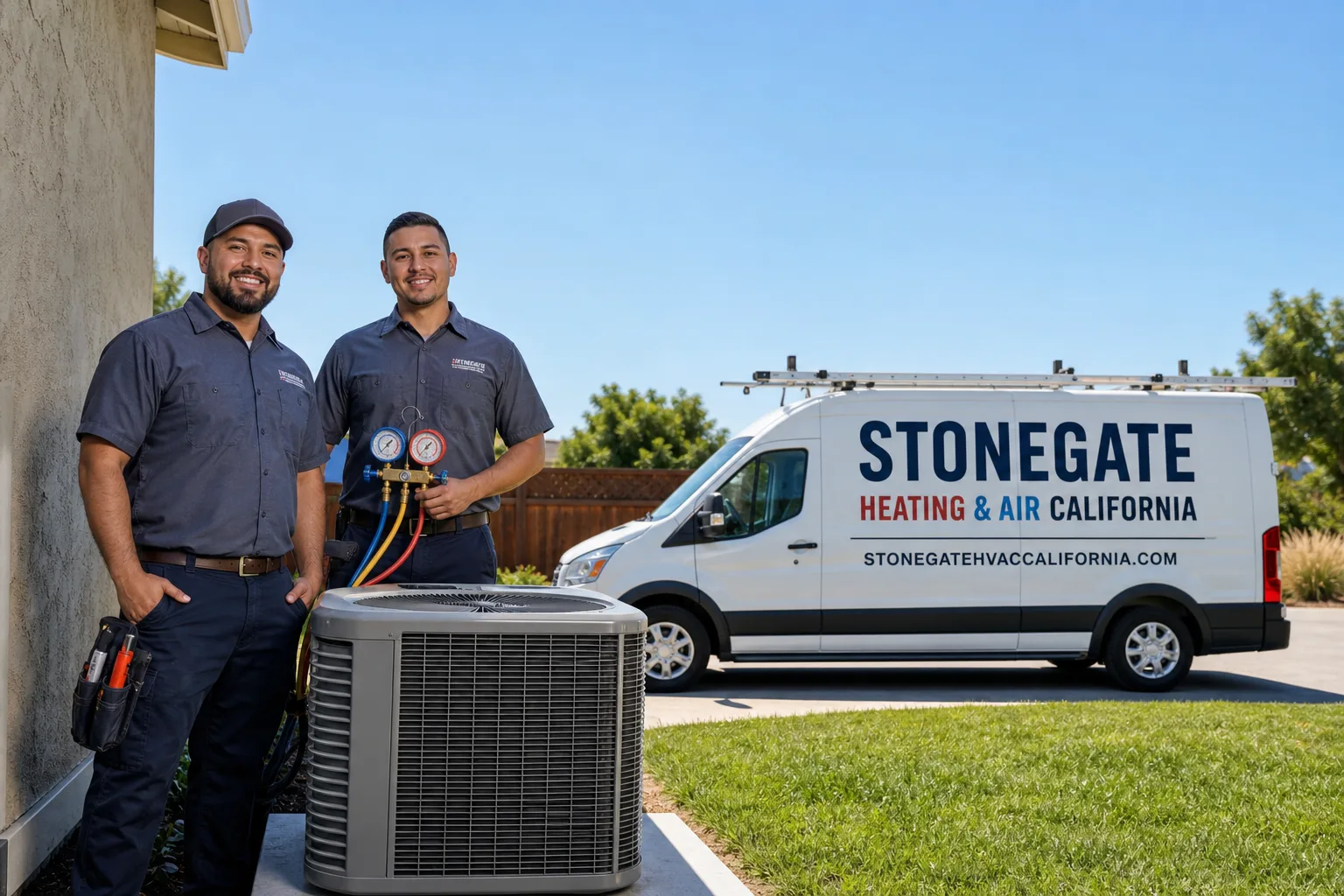
Fast, Reliable AC Repair & Installation Across Chinatown
AC repair in Chinatown, CA typically runs $150–$650, while a full AC installation costs $3,500–$7,500. Most calls we get from the 94133 zip are same-day or next-day, because we know the neighborhood’s mixed-use buildings can’t wait when a compressor goes down in July.
We’re Stonegate Heating & Air California, and our AC Repair & Installation team has been handling the unusual HVAC demands of San Francisco’s Chinatown for 16 years. Owner Jason Trent supervises every project personally, and our technicians have learned what every other company learns the hard way: this neighborhood’s combination of century-old wiring, restaurant-dense ventilation, and salt-fog corrosion creates failure patterns you won’t find in the Mission District or down in Noe Valley. When your through-wall unit starts blowing warm air or your mini-split throws a code on a Saturday night, we’ll pick up. Call (855) 467-1888.
Why Stonegate Heating & Air California Is Chinatown’s Preferred AC Repair & Installation Company
Chinatown landlords and restaurant owners have left us nearly 500 verified reviews across platforms, averaging 4.7 stars. That volume matters because it reflects repeat calls from property managers who’ve tried the competition and come back. Jason Trent doesn’t delegate to a dispatcher; he’s Field Supervisor on jobs from Stockton Street walk-ups to commercial kitchens on Grant Avenue.
Our response time to Chinatown averages same-day for emergency calls and next-day for standard AC repair. We stock capacitors, contactors, and coils for Carrier, Trane, Lennox, and Goodman systems at our Sacramento warehouse, which means fewer return trips for parts. In a neighborhood where a single building might house three restaurants, twelve residential units, and a shared ventilation chase, that efficiency saves everyone money and downtime.
We’ve also built relationships with San Francisco’s Department of Building Inspection over years of permit pulls on post-1906 structures. When your installation requires navigating DBI’s requirements for historic mixed-use buildings, that familiarity keeps projects moving.
Our AC Repair & Installation Services in Chinatown
AC Repair
Most AC repair calls we run in Chinatown aren’t simple capacitor swaps. The restaurant grease that migrates up shared building chases coats evaporator coils, clogs condensate drains, and causes compressors to short-cycle until they fail. A typical AC repair in Chinatown runs $150–$650, depending on whether we’re cleaning a coil, replacing a capacitor damaged by old wiring, or tracing a refrigerant leak back to grease-corroded flare fittings. We recently serviced a 1920s walk-up on Stockton Street where the landlord complained of warm air blowing from the through-wall A/C. Upon arrival, we found the condenser coil and filter caked with wok-range grease that had migrated up the building’s shared chase. The fix: a deep chemical coil cleaning, UV grease trap inspection, and recommending a commercial-grade filtration upgrade for the restaurant below.

AC Installation
AC installation in Chinatown demands creativity. These 3–6 story brick and wood-frame buildings, rebuilt between 1907 and the 1920s, have zero original ductwork and framing clearances measured in inches. We’ve installed ductless mini-splits in SRO hotels, through-wall units in walk-up apartments, and rooftop condensers on commercial buildings where the only access is a fire escape. At $3,500–$7,500, AC installation here costs more than in suburban Sacramento because every job is custom: electrical upgrades from knob-and-tube, structural reinforcement for rooftop equipment, and coordination with DBI permits. Jason Trent reviews every installation plan personally before we start cutting.

AC Replacement
When a compressor fails in a mixed-use Chinatown building, replacement isn’t always straightforward. The original AC may have been shoehorned into a space that no longer meets code, or the electrical panel may need upgrading to handle modern startup loads. We evaluate whether replacement or repair makes financial sense, factoring in the remaining life of the condenser, the cost of bringing associated systems up to code, and whether the building’s shared ventilation can handle the load. In Chinatown’s tight lot lines, crane access for rooftop units sometimes requires street closure permits, another layer we navigate routinely.

Refrigerant Recharge
Low refrigerant in Chinatown usually means a leak, not normal consumption. Greze-corroded flare fittings, vibration-worn copper in century-old chases, and salt-fog pitting on outdoor coils all create escape paths. We don’t just top off and leave. Our AC repair protocol includes electronic leak detection, nitrogen pressure testing, and repair of the underlying cause. A recharge without finding the leak is money wasted, and in a neighborhood where many tenants are rent-burdened, we don’t waste money.

Compressor Repair
Compressor repair in Chinatown, CA runs $150–$650 and represents our most critical call type. When a compressor short-cycles due to grease-coated coils or fails from voltage spikes in old wiring, the building loses cooling fast. In restaurant kitchens where heat stress affects worker safety, or in residential units above where elderly tenants can’t open windows due to street noise, speed matters. We carry replacement compressors for Carrier, Trane, and Goodman systems, and Jason Trent’s field supervision means we diagnose correctly the first time, not after three callbacks.

What happens when you call
- 1
A real person answersNo phone trees — you reach a local pro.
- 2
You get an upfront price rangeHonest numbers before anyone is dispatched.
- 3
A background-checked tech heads outLicensed & insured, dispatched right away.
- 4
You approve before work beginsNothing starts until you say go.
Trusted Brands We Service in Chinatown
Whatever brand you have, we probably work on it. Our technicians are factory-trained or deeply experienced on nine major HVAC brands: Carrier, Trane, Lennox, Goodman, Rheem, York, Daikin, Bryant, and American Standard. In Chinatown, we most commonly see Carrier and Trane commercial units in restaurant applications, Goodman and Lennox in residential retrofits, and a surprising number of legacy brands held together with creative maintenance. We stock common parts for all nine brands at our Sacramento facility, which means faster turnaround on AC repair calls from Stockton Street to Grant Avenue. No “we don’t service that brand” dead ends. Nine brands, one team.
Common AC Repair & Installation Problems We See in Chinatown Homes
- Grease-laden evaporator coils cause freeze-ups and compressor short-cycling. In mixed-use buildings with shared ventilation chases, wok-range grease migrates upward and coats residential A/C components. We’ve pulled coils in Chinatown that weighed twice their clean weight in accumulated grease. The compressor works harder, draws more amps, and eventually fails.
- A/C condensate lines clog within months from restaurant grease and dust. Century-old brick walls absorb the overflow, creating mold and structural damage that outlasts the original equipment. We install grease-resistant condensate pumps and recommend quarterly cleanings for units above ground-floor restaurants.
- Poor electrical bonding from original knob-and-tube wiring causes capacitor failures. Post-1906 buildings in Chinatown often have ungrounded or improperly bonded electrical systems. When a modern compressor starts, the voltage spike finds path of least resistance through control boards and capacitors. We see this more in Chinatown than anywhere else we serve.
- Salt-fog corrosion attacks outdoor condenser fins and electrical connections. Chinatown sits close enough to the Bay that marine layer corrosion accelerates equipment aging. We specify coated coils and sealed electrical compartments on new AC installation, and we inspect for salt corrosion on every maintenance call.
Pricing for AC Repair & Installation in Chinatown, CA
Here’s what AC work costs in Chinatown’s market. These ranges reflect the complexity of working in century-old mixed-use buildings, not inflated margins.
| Service | Price Range |
|---|---|
| AC Repair | $150–$650 |
| AC Installation | $3,500–$7,500 |
| Compressor Repair | $150–$650 |
What moves a job toward the high end: electrical upgrades from knob-and-tube, DBI permit requirements for structural modifications, crane or hoist rental for rooftop access, and extensive coil cleaning or grease remediation. What keeps it lower: straightforward capacitor or contactor replacement, accessible equipment locations, and systems that have been maintained regularly. We provide upfront pricing before any work begins, and estimates are free. Call (855) 467-1888.
We Also Serve Cities Near Chinatown
Our service radius extends throughout San Francisco and into neighboring communities. We regularly run AC repair and installation calls in the Mission District, where Victorian conversions present their own ductwork challenges; Noe Valley, with its hillside access issues and modern residential systems; and Visitacion Valley, where industrial and residential HVAC needs overlap. Each neighborhood gets the same owner-supervised service, but Chinatown’s restaurant-residential density remains our most specialized market.
Serving Chinatown, CA — Our Local Coverage Area
We’re based in the Chinatown area and know this community well. Use the map below to see our service coverage — if you’re nearby, we can almost certainly help.
FAQs — AC Repair & Installation in Chinatown
Probably not without major modification. These buildings lack ductwork and have framing clearances too tight for conventional systems. Most Chinatown apartments use through-wall units, window A/C, or ductless mini-splits. We’ve installed mini-splits in dozens of 1907–1920s Chinatown buildings, and they’re the practical choice when you want real cooling without gutting the structure. Call (855) 467-1888 and Jason Trent can evaluate your specific layout.
Quarterly, minimum. In Chinatown’s mixed-use buildings, we see filters and coils fouled within 6–8 weeks during busy kitchen periods. For residential units directly above restaurants on Stockton Street or Grant Avenue, we recommend a professional coil cleaning every three months and monthly filter changes with commercial-grade media. The grease doesn’t stop, so maintenance can’t either. We offer maintenance plans tailored to Chinatown’s conditions.
Yes, nearly always. San Francisco’s DBI requires permits for any new A/C installation, and Chinatown’s historic mixed-use buildings often trigger additional review for electrical and structural work. We handle permit applications as part of our installation service, including the DBI inspections that verify your building’s shared ventilation meets fire code. Our 16 years of California work includes extensive SF permit experience.
If it’s leaking, recharging without repairing the leak violates EPA regulations and wastes money. Most old window units in Chinatown use R-22 refrigerant, which is no longer manufactured. A recharge might get you through one season, but the underlying leak, usually at corroded flare fittings or pinholed copper, will return. We evaluate whether repair or replacement makes sense based on the unit’s age, the refrigerant type, and the leak location. Call (855) 467-1888 for an honest assessment.
Carrier and Trane both offer coastal-duty packages with coated coils and sealed electrical compartments that hold up better near the Bay. Goodman and Lennox have entry-level lines that work fine with proper maintenance but may need more frequent coil protection. For any brand, we recommend annual corrosion inspections and protective coatings on outdoor equipment. The salt-fog is constant; the question is whether you’re fighting it proactively.
Ready to get your AC fixed or replaced? Call Stonegate Heating & Air California at (855) 467-1888 for a free estimate. Owner Jason Trent supervises every Chinatown job personally, and we’ve got 16 years and nearly 500 reviews to back it up.
Written by Jason Trent, Owner at Stonegate Heating & Air California, serving Sacramento and the Bay Area since 2009.